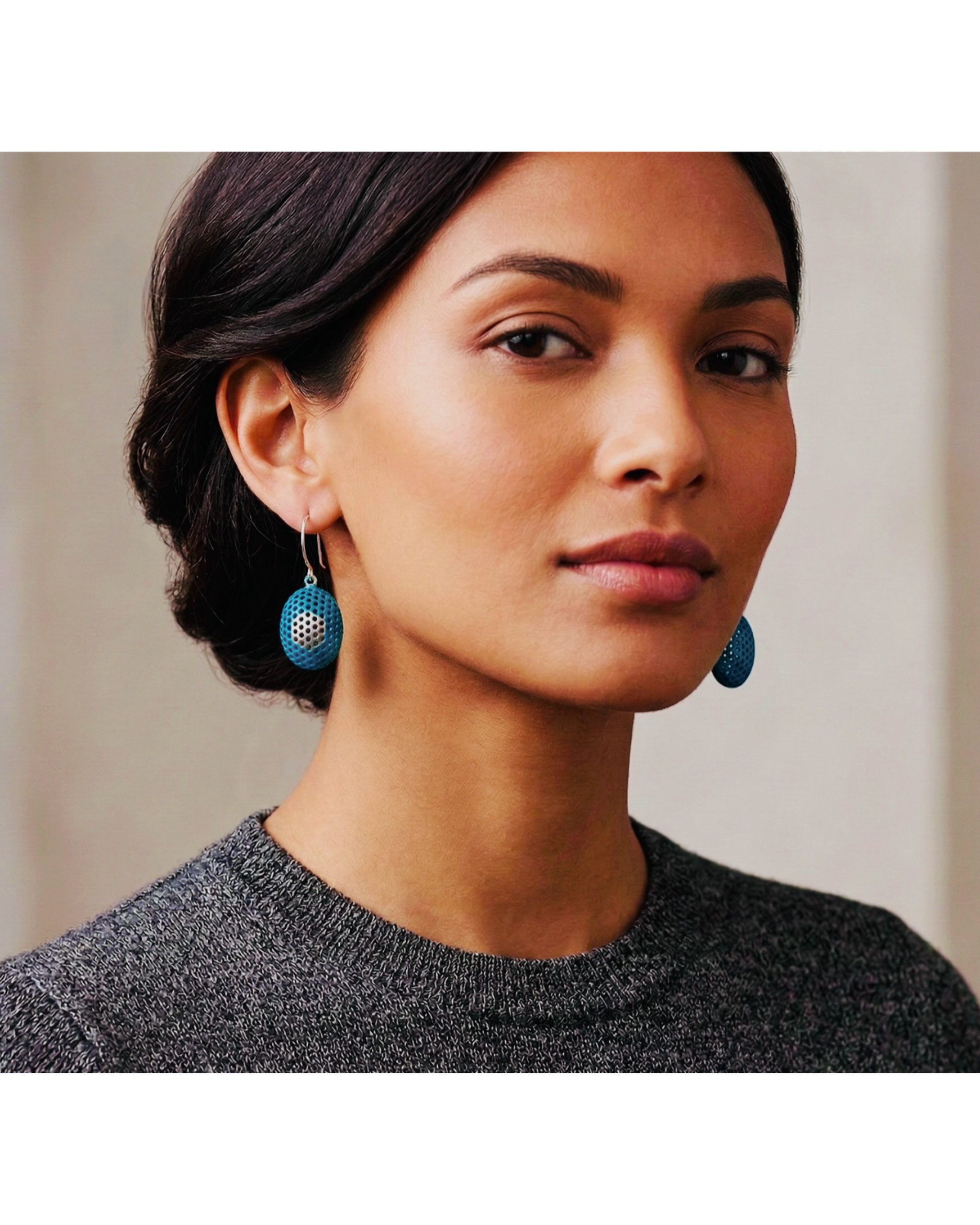
DAY 06 · THU 29 OCT : The Ring Algorithm: Discovering My Hidden Design Language
DAY 06 · THU 29 OCT - “Hand & Algorithm — A Nine-Day Online Exhibition”
Chap.6- 47 | DAY 05— The Ring Algorithm: Discovering My Hidden Design Language
Learning 6 — Repetition Can Reveal Originality
When I began looking through seventeen years of rings, I didn't expect to discover something new about my own design language.
I had around 35 rings ready to sell, including returned stock, older experiments and recently completed pieces. Some had been sitting in my studio for years. With AI as my studio assistant, I began organising, photographing and analysing them.
What surprised me was how many familiar elements kept appearing: circles, ovals, perforations, layered structures, geometric forms and the relationship between solid and empty spaces.
Even though the rings were made at different times, they seemed to share a common language.
Perhaps I had been following my own algorithm without realising it.
Finding the Hidden Lines — Latent Lines
In May this year, I developed a new series of six rings called Latent Lines.
For many years, perforated mild steel has been one of my signature materials. I have cut, formed, soldered, blackened and powder-coated it, combining it with precious metals to create wearable geometric structures.
But this time, I began looking at the material differently.
Instead of seeing the perforations as individual holes or a repeated surface pattern, I started seeing invisible lines connecting them.
By selecting certain holes and inserting silver or brass, I could create continuous or interrupted lines within the existing grid.
The interesting thing was that I wasn't drawing a line onto a blank surface. The possibility of the line was already there, hidden within the material.
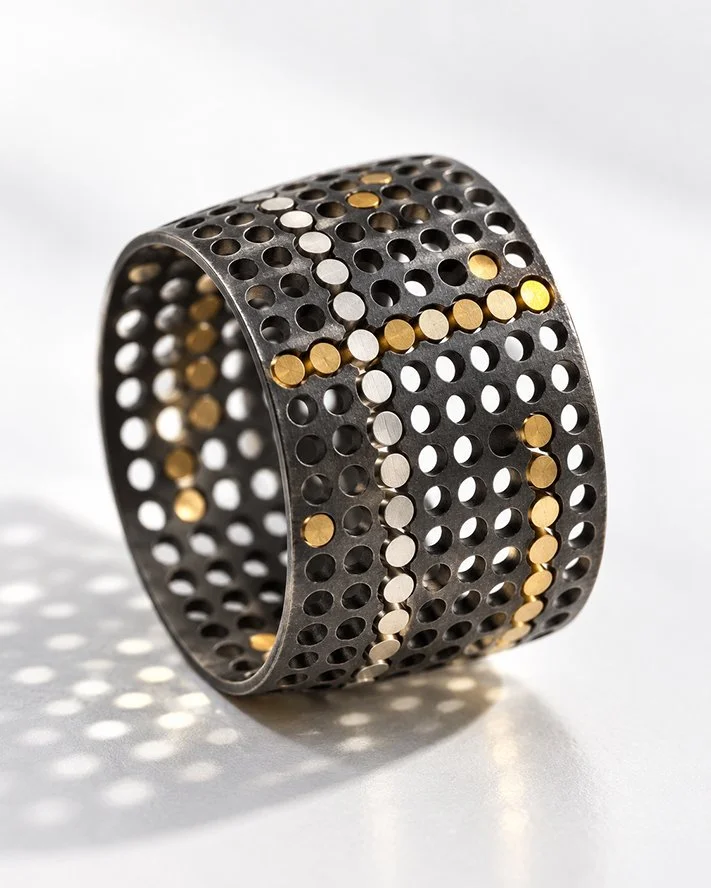
That became the idea behind the title Latent Lines.
A few silver or brass points could completely change how we see the object. The eye begins connecting those points, creating shapes, pathways and sometimes imaginary boundaries.
I was fascinated by how something so small could transform the reading of an entire structure.
Repetition, Movement and Unexpected Forms
I have always been interested in repetition, but repetition doesn't necessarily mean making identical things.
The same material can produce completely different results depending on how I cut, bend, join or interrupt it.
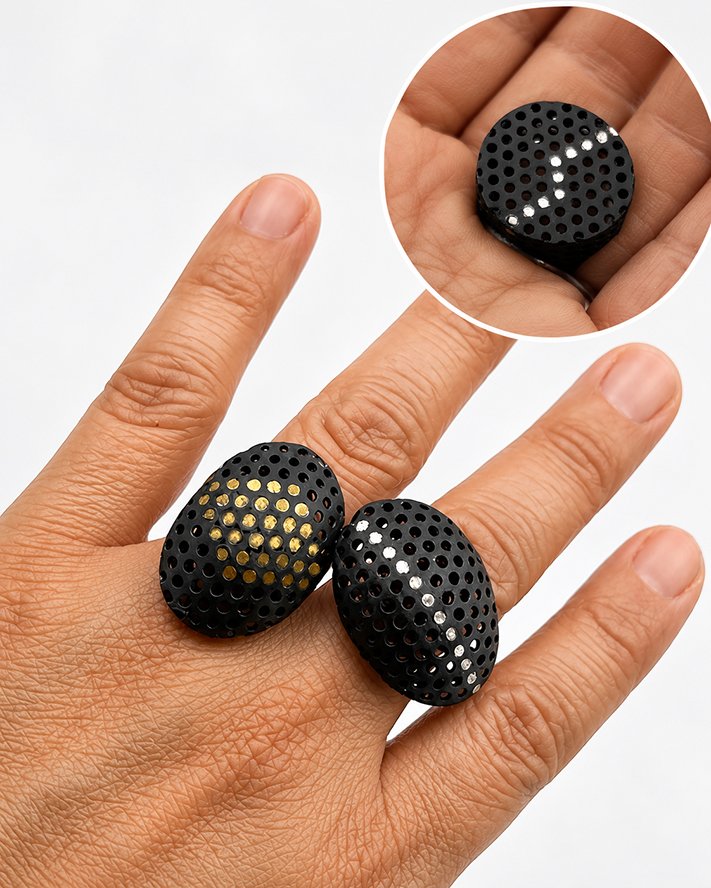
In Latent Lines, some rings became oval and vessel-like, while others developed more architectural structures. The perforations allowed light and shadow to become part of the design.
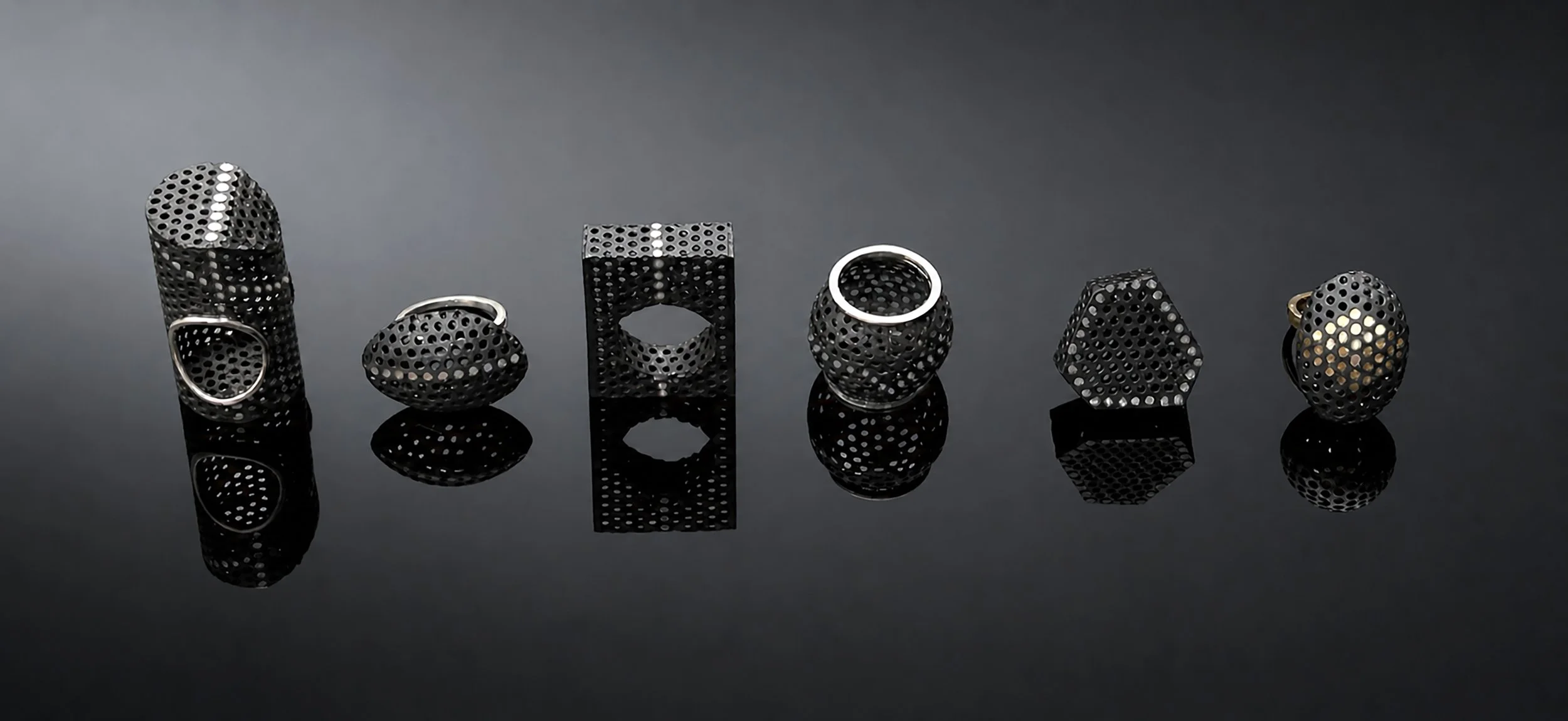
When a ring moves on the finger, the appearance changes. The silver catches the light, some holes disappear into shadow, and the skin becomes visible through the openings.
The body itself becomes part of the composition.
I also enjoyed allowing myself more freedom with this series.
After so many years of professional making, it is easy to become concerned about whether a piece will sell, whether it looks too unusual, or whether it belongs to an established collection.
This time, I wanted to follow my curiosity rather than commercial expectations.
What happens if I extend this line? What if I leave some perforations empty? What if the form becomes taller or more sculptural?
Each small decision opened another possibility.
What Did AI Help Me Discover?
AI did not design or make these rings. The technique and forms developed through years of material experimentation and the knowledge of my hands.
However, when I began analysing my ring archive with AI, something interesting happened.
It helped me recognise repeated decisions that I hadn't consciously identified: circles becoming cups, flat sheets becoming curved structures, perforated surfaces creating volume, and gemstones interrupting geometric forms.
I also noticed how frequently I return to construction itself.
I tend to build my jewellery by joining different elements together. Even when I use a conventional gemstone or a familiar ring band, I often transform it into something more architectural.
AI helped me put words around these repeated choices. So it is very good at Naming it and defining it.
Sometimes I agreed with its interpretations. Sometimes I didn't. But even questioning its observations encouraged me to look more carefully at the work I had already made.
Perhaps my personal design algorithm is not a formula for generating new jewellery.
It is a way of understanding the decisions I have repeatedly made throughout my career.
Looking Back to Move Forward
Another unexpected discovery came from looking again at older rings and abandoned experiments.
Some pieces reminded me of techniques I had almost forgotten. Others contained interesting proportions, openings or structures that I might want to explore again.
I realised that an old design doesn't necessarily become irrelevant just because I no longer produce it.
There might still be an unfinished idea hiding inside it.
AI also helped me prepare the rings for a new online campaign through photography editing, measurement images, descriptions and visual presentations.
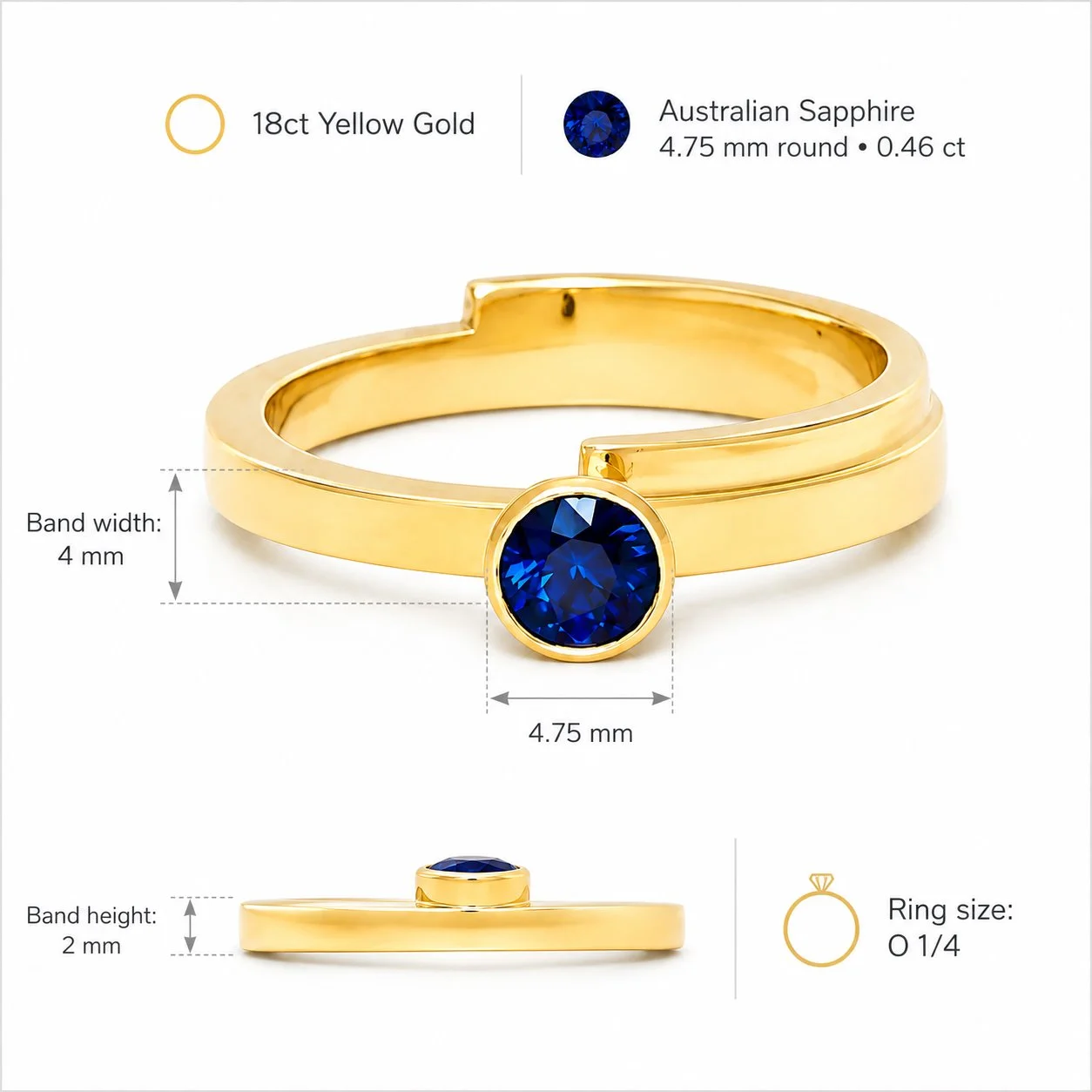
Detailed measurement for my saphire Ring
But the most meaningful discovery wasn't about marketing or efficiency.
It was understanding that my archive could become a resource for future creativity.
Can an algorithm help an artist discover their own creative rules?
I think it can help us recognise patterns. But what we choose to do with those discoveries still depends on our own judgement, experience and curiosity.
After seventeen years of making, I have begun to see my rings as more than individual objects. Together, they reveal a visual language developed through thousands of small decisions.
And just like the hidden lines within perforated steel, perhaps many of my creative possibilities have been there all along.
Related Reading — From My Studio Journal
Explore the original chapters behind Day 06, documenting my ring archive, the development of Latent Lines, and my experiments with AI as a studio assistant.
Chap. 4–28 — Looking at My Rings Again
Rediscovering seventeen years of rings and recognising the repeated forms and structures within my practice.Chap. 4–29 — Expanding My Capacity: Preparing the Ring Campaign with AI
How AI helped me photograph, document and present my rings, expanding my capabilities beyond making.Chap. 4–30 — Latent Lines: Finding Hidden Lines in Perforated Steel
Discovering hidden geometries through silver and brass inlays in perforated mild steel.Chap. 4–31 — Silver Rings: Reading the Algorithm in What I Have Already Made
Identifying my recurring design vocabulary: construction, repetition, perforation, geometry and interruption.Chap. 4–32 — Finding What Was Left Behind
Revisiting abandoned designs and unfinished ideas as a resource for future creativity
The algorithm was already there, in the work of my hands.
Jin Ah Jo
Hand & Algorithm — Radiant Pavilion 2026