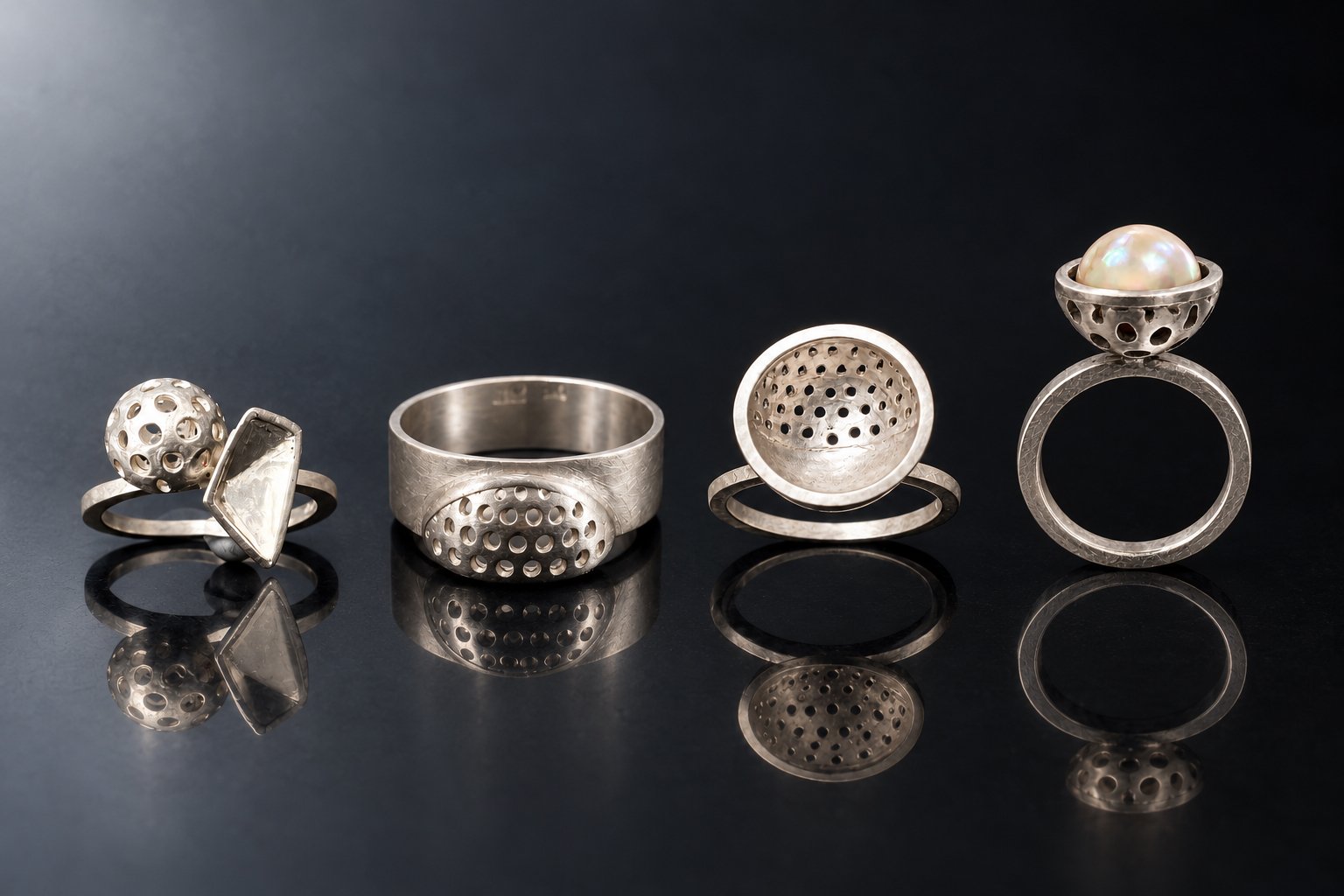
Chap.4-32 — Finding What Was Left Behind
There are things in my studio that I haven't looked at properly for years.
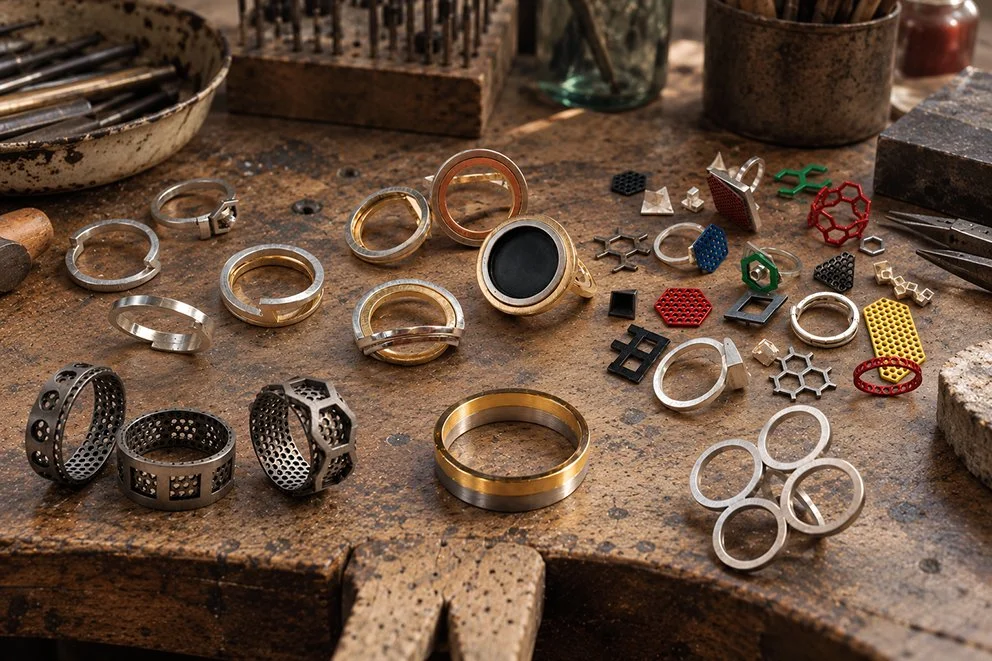
Old rings. Unfinished experiments. Components that never became jewellery. Shapes I tried once and then abandoned. Some I remember clearly, while with others I can barely remember what I intended to do.
Recently, while working on Hand & Algorithm, I started bringing these things out again.
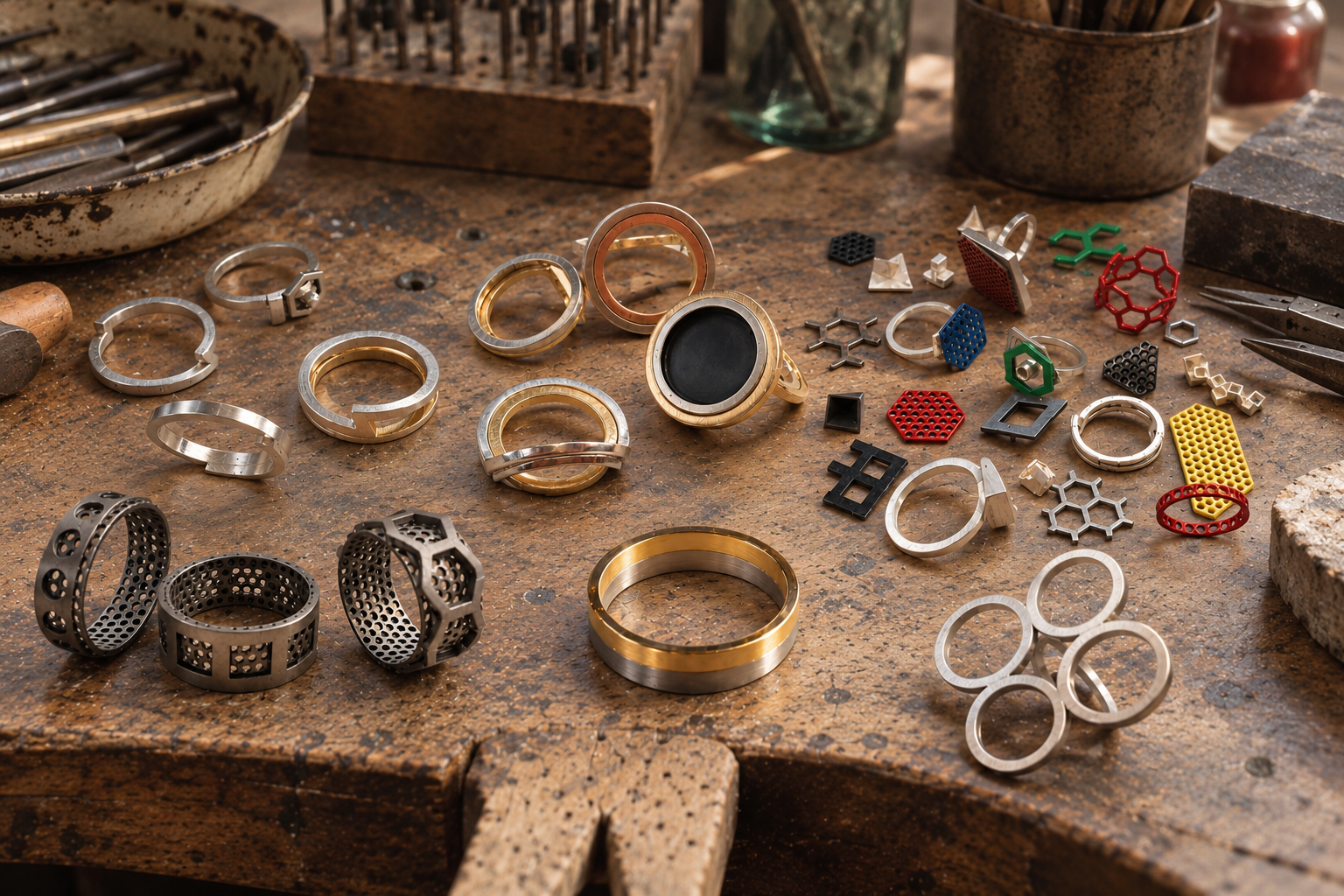
Putting them together created a strange landscape of my own making. Pieces from completely different periods suddenly sat beside each other, and I began to notice connections — circles, grids, perforations, layers, openings, repeated structures and interruptions.
I had thought many of these ideas were finished.
Maybe they weren't.
Construction has always been there
One thing connects much of this work: construction.
My natural way of making is to build. I cut sheet, bend it, solder it, dome it, perforate it and join one component to another.
Across very different rings, certain elements keep returning: a wide band, a dome, a grid, a perforated surface, a small gemstone interrupting a larger structure.
When I put many years of work together, these repetitions become much easier to see.
Maybe this is part of my own algorithm — not one written in computer code, but developed through years of making:
material → construction → repetition → variation → another object
Leftover designs
This made me think about what happens to a design after I stop making it.
Perhaps some of these are leftover designs.
I don't mean unwanted stock. I mean that something may still be left inside the design.
I may never want to remake an old ring exactly as it is, but I might still want its grid, dome, strange proportion, perforation, or the relationship between a tiny gemstone and a wide silver band.
The object can be finished while the idea inside it remains unfinished.
So instead of asking:
Would I make this ring again?
I can ask:
What would I keep?
An old design can become raw material for another:
OLD DESIGN → EXTRACT → MODIFY → COMBINE → NEW DESIGN
It sounds almost like an algorithm, but the source material comes from my own history of making.
AI made me look again
This is where AI has become useful to me in a way I hadn't expected.
I began photographing old rings and unfinished experiments and asking questions:
What repeats across these pieces?
What connects them?
What could be removed or exaggerated?
Is there something here that connects with what I make now?
AI began separating the work into elements: interruption, perforation, geometry, colour, layering, repetition and structure.
Sometimes I agreed with its observations. Sometimes I didn't. But even disagreeing made me look more carefully.
The object itself hadn't changed. My relationship with it had.
From old work to future rings
Once the work was broken down into elements, I could begin recombining them.
A gap from one ring could become the main feature of another. A perforated dome could be enlarged and coloured. Two different perforation patterns could meet on one wide band. A coloured geometric component could interrupt an otherwise simple silver ring.
I can already imagine several directions for future work:
an interrupted silver band holding one small precious element; a coloured perforated dome contained inside a silver structure; a wide ring where one perforation pattern gradually changes into another; or a geometric coloured component inserted into a simple ring.
These aren't completely new ideas arriving from nowhere.
They were already hiding in things I had made, abandoned or forgotten.
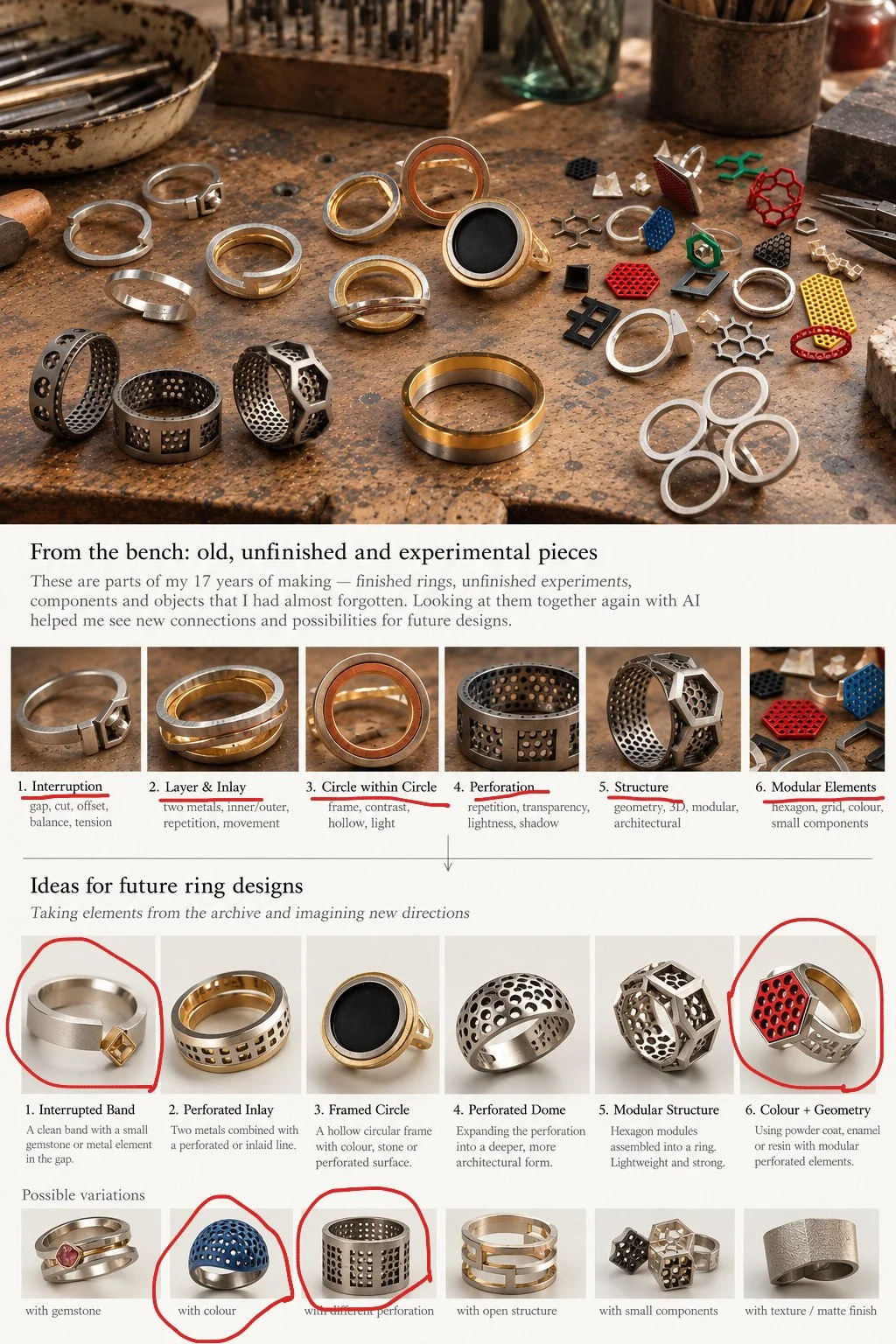
Maybe future design is not always about finding something new. Sometimes it is about recognising what you already started.
Finding value through language
As a maker, I understand much of my work physically.
I know cutting, soldering, bending, doming, filing and constructing through my hands. I don't necessarily put every decision into words. Sometimes I simply make.
Years later, I may no longer remember why a particular form interested me.
The object can become almost silent.
Language can reopen it.
Words such as grid, repetition, interruption, boundary, opening, inside/outside, volume and architecture can create relationships between things made at completely different times.
And there is emotional value here too.
Perhaps I abandoned something because it didn't sell. Perhaps I thought it wasn't successful. Perhaps I became bored with it, or stronger work came afterwards and pushed it aside.
But an abandoned object doesn't have to become a successful product to have value.
It might contain one construction method I still love. One strange proportion. One mistake. One small idea.
Or one question I never finished answering.
AI doesn't give the work its meaning
There is an important distinction here.
AI doesn't give these objects their meaning.
Their histories belong to me. I made them with my hands, materials, decisions and knowledge at particular moments in my life and practice. AI wasn't there and doesn't know what it felt like to make them.
But it can propose language around what it sees.
Then I can respond:
Yes, that feels true.
No, that's not what I was doing.
Or, most interestingly:
I had never thought about it that way.
Perhaps this is another role for AI in my studio.
Not designer.
Not maker.
Not studio master.
But sometimes, a device for looking again.
My archive is not only my past
After 17 years of making, I have accumulated finished jewellery, photographs, drawings, experiments, unfinished pieces and things I simply stopped making.
I used to think of these mainly as evidence of what I had already done.
Now I am beginning to see my archive differently.
Perhaps it can also become a design library for what I haven't made yet.
Not everything needs to return. Some designs belong to their time.
But I can ask:
What do I still recognise as mine?
What have I outgrown?
What keeps returning?
What did I abandon too quickly?
What deserves another look?
Perhaps the next ring doesn't have to begin from nothing.
It might already be hiding inside something I made years ago and almost forgot.
Sometimes we return to an old object with different eyes. And sometimes finding new language for it allows us to see it again.