Chap. 4-31 — Silver Rings: Reading the Algorithm in What I Have Already Made
Silver is probably where many jewellers begin.
It is also where I began, and somehow I continue to return to it.
When I look at the silver rings I have made over the years and still have in stock, I see many different ideas. Some have gemstones. Some have pearls. Some have no stones at all. Some are quite simple and wearable, while others move closer to small sculptural objects.
But when I put them together, as I have done in this photograph, they do not actually look completely unrelated.
There seems to be an algorithm hiding inside them.
My algorithm was already there
I have recently been thinking about algorithms in relation to my rings. Not necessarily an algorithm that a computer generates, but the repeated decisions that I have made as a jeweller.
Looking at these silver rings, I can reduce many of them to a surprisingly small vocabulary:
band + constructed form + perforation + opening + stone or no stone + repetition + variation.
The band is often relatively simple. Then something happens on top of it.
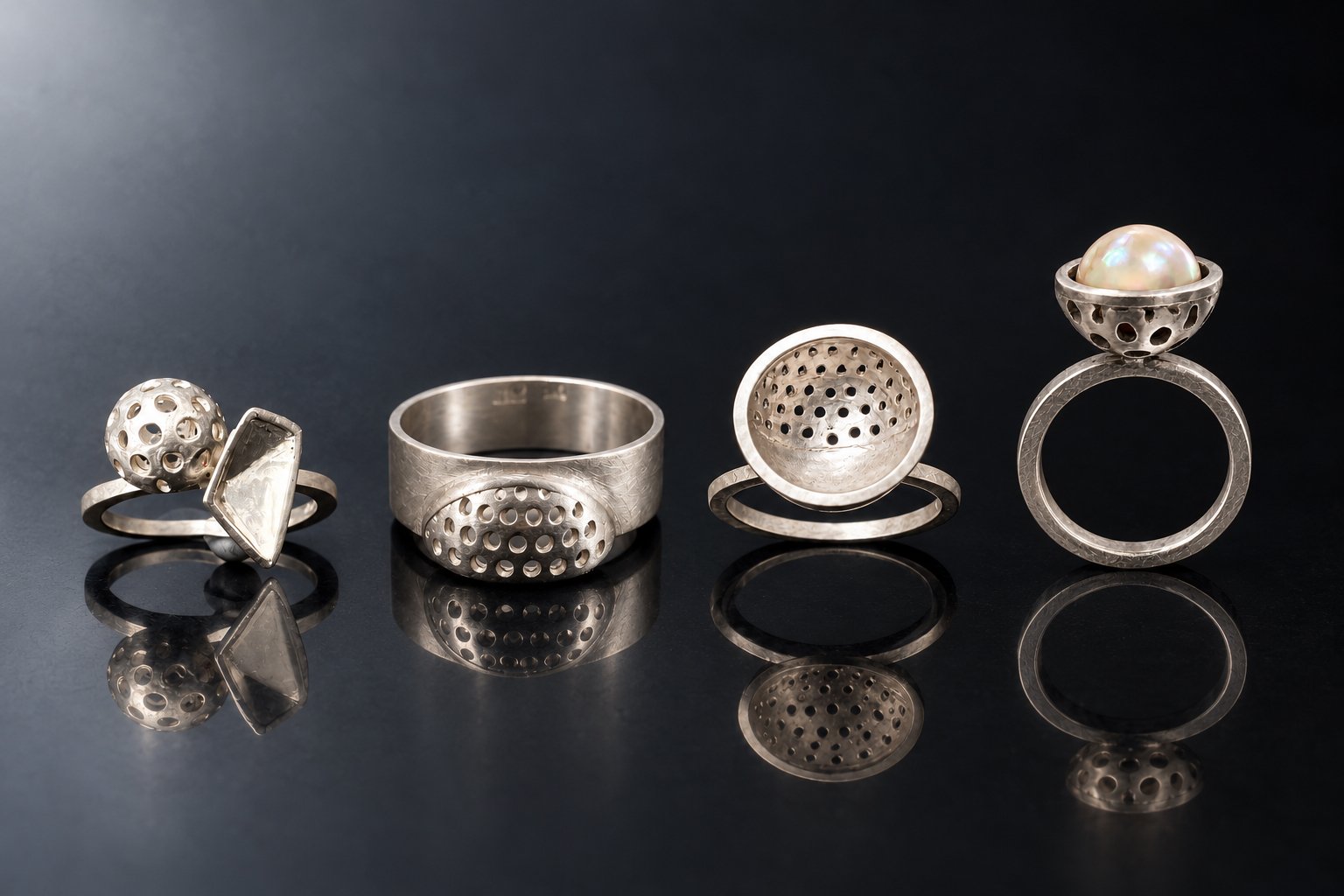
A circle becomes a cup.
A cup becomes perforated.
An oval becomes a platform.
A flat sheet becomes a curved structure.
A gemstone interrupts a repeated pattern.
A pearl sits inside a constructed circular boundary.
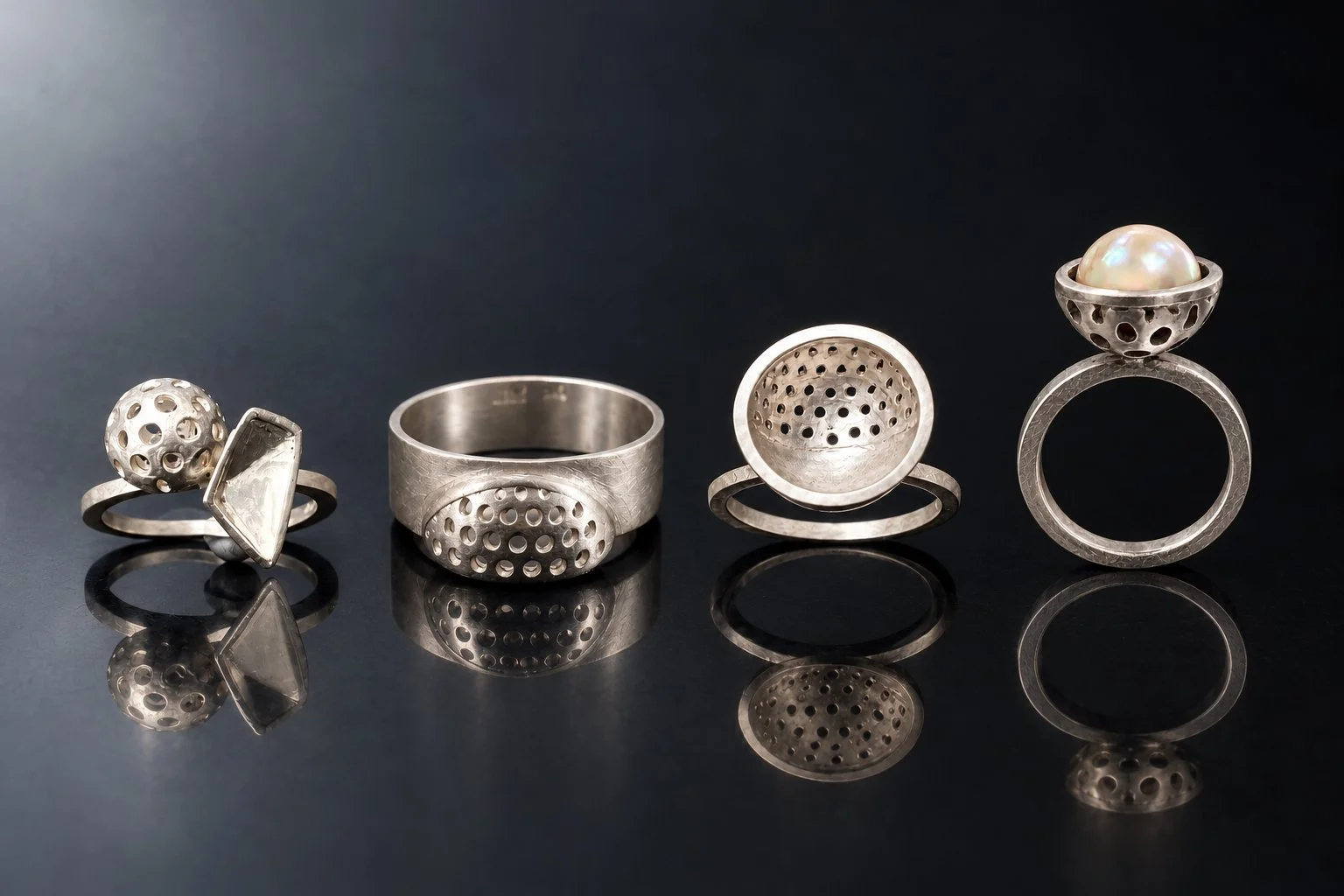
Even when the shapes change, I keep returning to circles, ovals, geometric divisions and perforations.
And there is another kind of repetition: solid and empty.
The holes in the metal are not simply decoration. They allow the background, skin, darkness or light to become part of the ring. A solid silver surface sits beside an open surface. A gemstone might occupy the centre, while dozens of small empty circles surround it.
Perhaps this relationship between material and absence has been part of my visual language for much longer than I consciously realised.
With stones and without stones
The rings also seem to divide into two families.
In one group, the construction itself is the subject. The perforation, geometry, curve, surface and relationship between positive and negative space create the ring.
In the other, a gemstone or pearl becomes a focal point.
But even when I use stones, I don't seem to abandon the constructed language. The gemstone is inserted into an architecture that already belongs to my practice.
That distinction interests me.
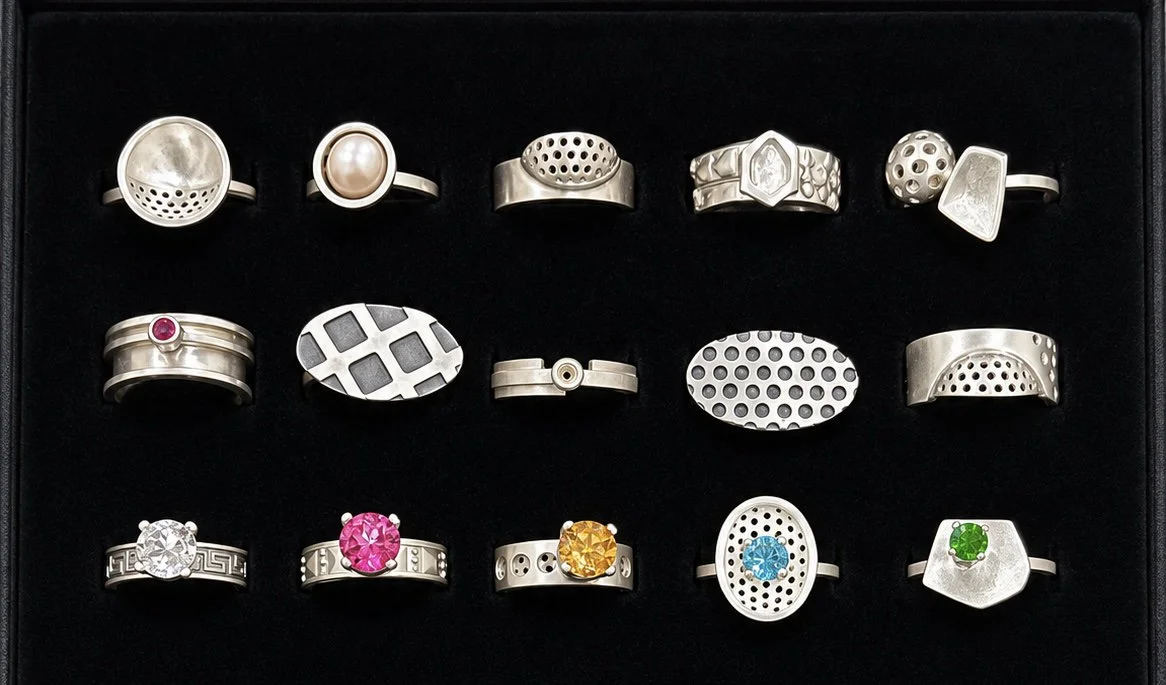
All silver rings with or without stone
I am not starting with a gemstone and simply designing a setting around it. I tend to build a structure and then ask how the stone can exist within that structure.
So perhaps another version of the algorithm is:
structure → repetition → interruption → focal point.
The stone is often the interruption.
Somewhere between trend and craft art
There is another question I find interesting when I look at these rings.
Where do they sit between fashion, trend, wearable jewellery and craft art?
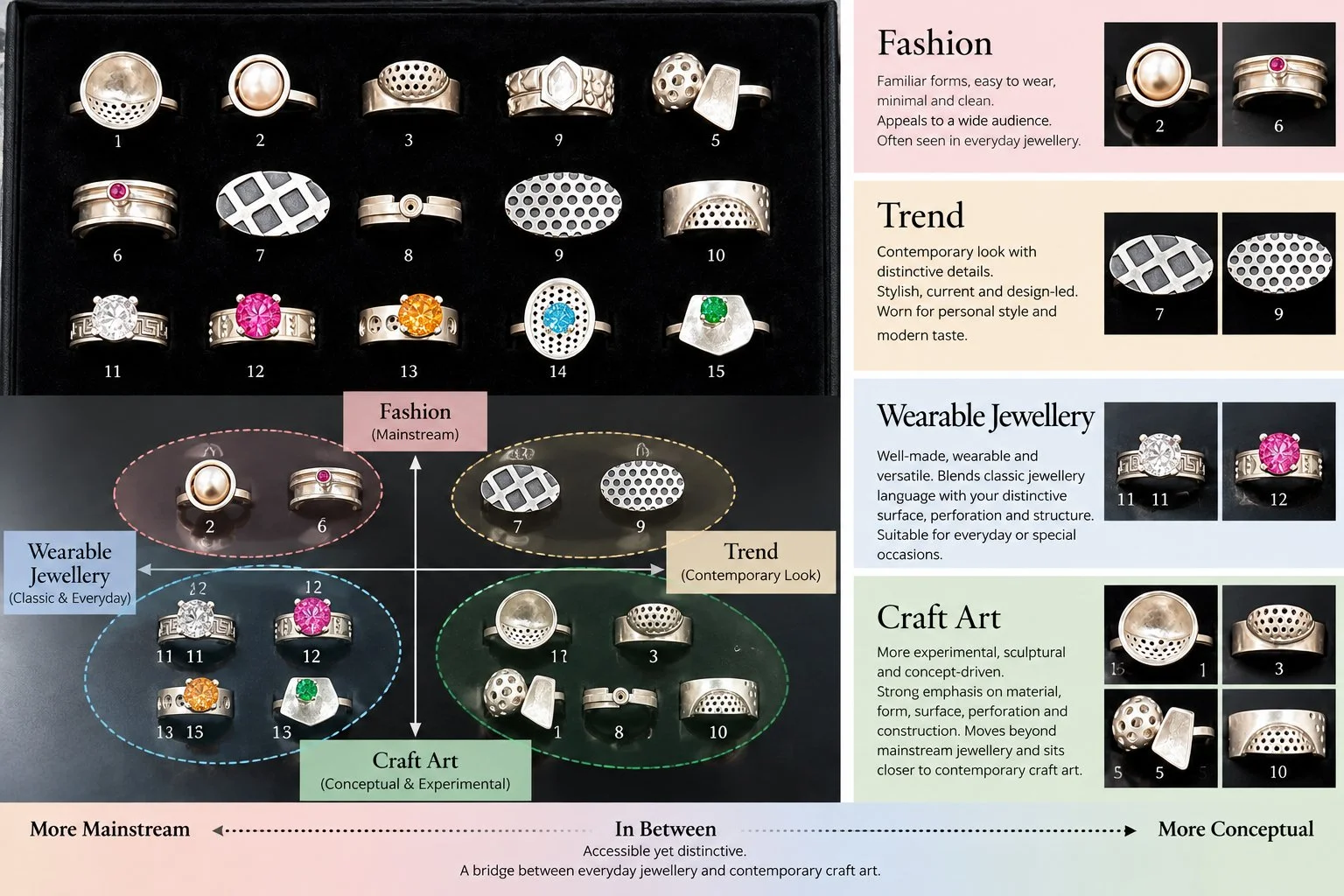
Agreeing or not AI analised my rings in 4 different categories- Interesting!
Some elements are very familiar in jewellery: pearls, coloured gemstones, diamonds, silver bands and solitaire-like compositions. They make the rings immediately recognisable and wearable. A person does not need to understand contemporary jewellery to understand them as rings.
But then something shifts.
The proportions become larger. A conventional setting becomes a perforated oval. A band becomes architectural. A stone sits against industrial-looking holes. Repeated circles and geometric structures begin to compete with the gemstone itself.
That is perhaps where my work sits.
I don't think these rings completely reject conventional jewellery. In fact, they often depend upon it.
I use something recognisable—a ring, a gemstone, a pearl, a band—and then push it towards another place through construction, scale, perforation and geometry.
Maybe this is why I am interested in both making jewellery that can be sold and worn, and making work that belongs within contemporary craft and art jewellery. I don't necessarily see those as two completely separate worlds.
My rings seem to live somewhere in between.
Construction is still my language
Almost all these rings also reveal something very fundamental about the way I make.
I construct.
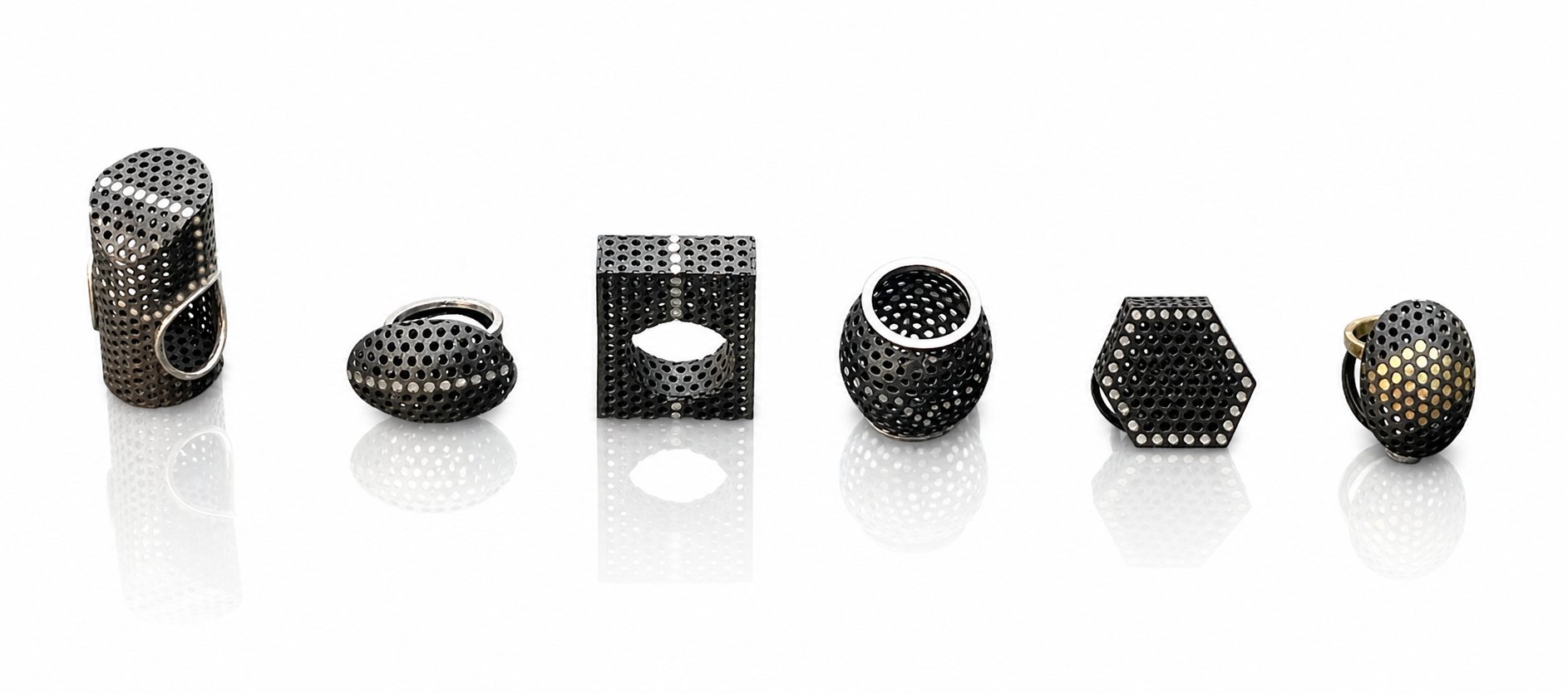
I cut sheet. I bend it. I form it. I solder separate elements together. I make cups, walls, bands and settings. I combine pieces until a three-dimensional form appears.
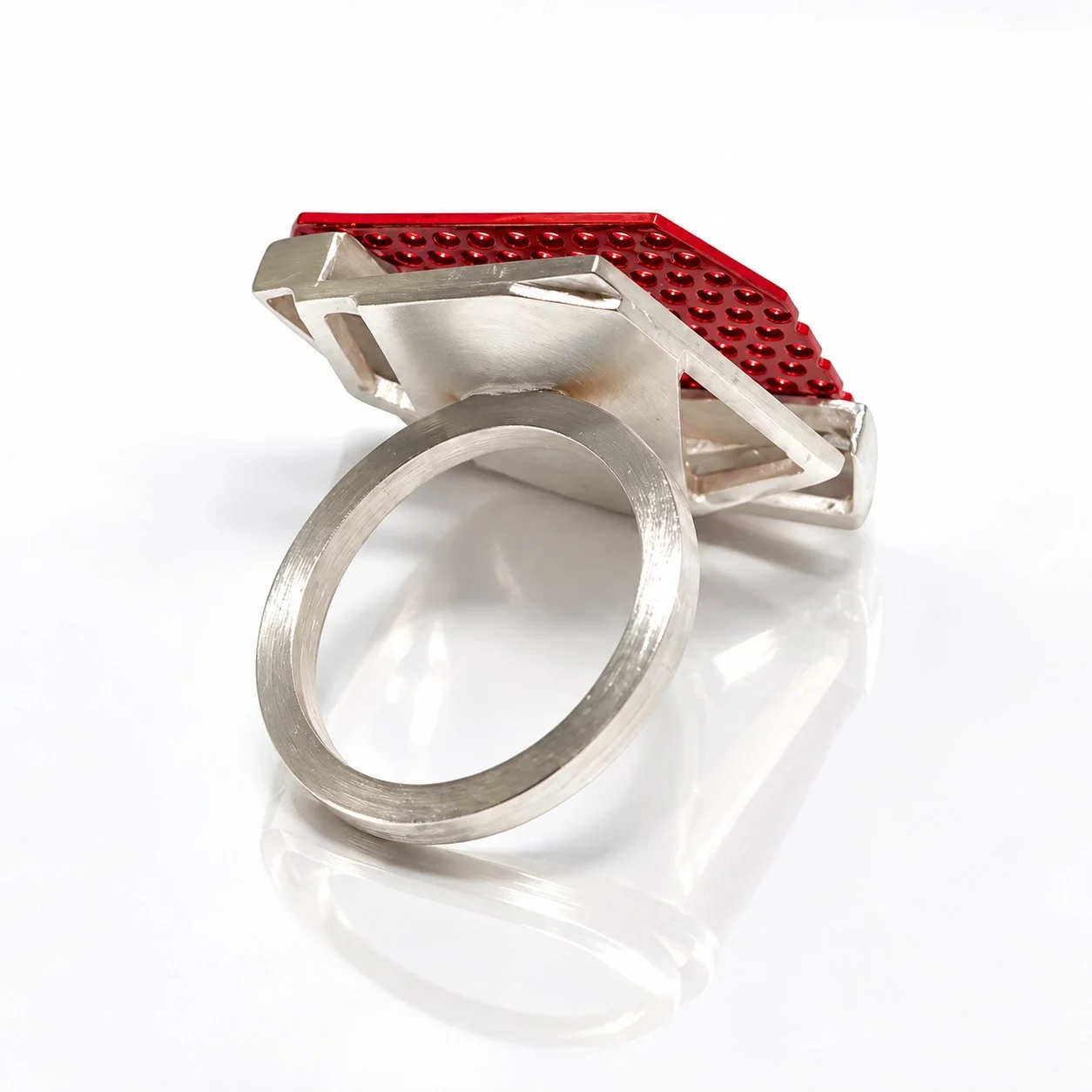
“Constructed” silver and powder coated mild steel ring in 2016
Even when the final object looks simple, my thinking is often based on construction.
That is probably why perforated metal has remained so important to me. It gives me a material that is already a surface and a pattern, but I can cut it, curve it, dome it and transform it into volume.
My hands understand this way of working.
But recently I have become curious about what would happen if I temporarily removed that familiar method.
What if I don't construct?
Perhaps next year I would like to make a group of rings only from wax.
Not using wax merely as another way of producing the same rings, but allowing the process to change the way I think.
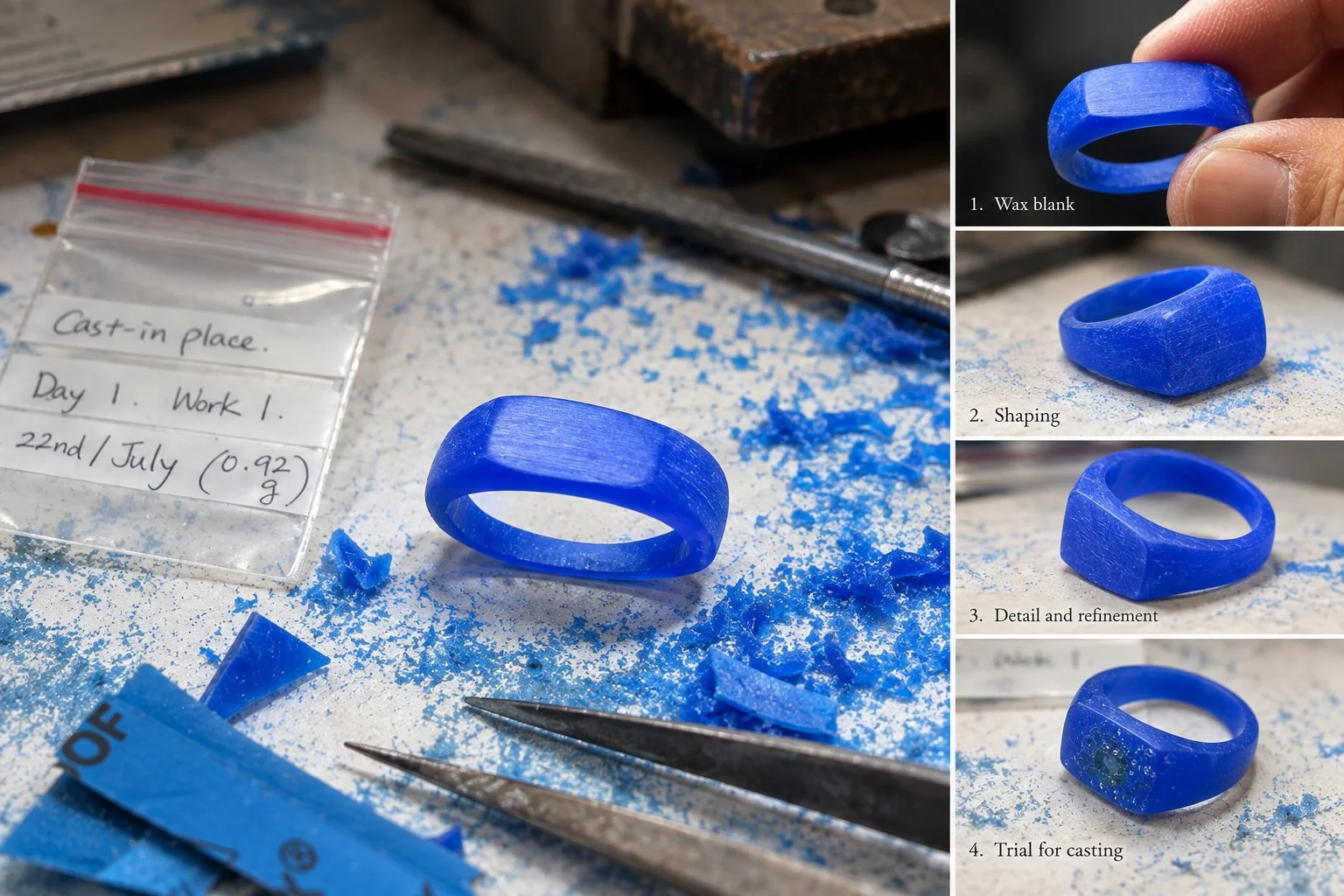
Making ring from wax filling
What happens if I don't begin with sheet?
What happens if I don't construct one component and solder it to another?
What happens if instead of building a form, I carve it, remove material from it, or allow it to grow more organically?
Would the same algorithm still appear?
Would I still make circles, holes, ovals and geometric structures?
Would the rings still look like mine?
That question interests me much more than asking AI to design a new ring for me.
AI can look at these fifteen rings and help me recognise repetition. It can identify patterns that are difficult for me to notice because I have been too close to the work for many years.
But the next experiment still has to happen through material.
Perhaps the real algorithm is not a formula for producing more rings.
It is a way of recognising what I repeatedly choose.
And once I can see those choices, I can decide which ones I want to keep—and which ones I want to challenge.