Chap. 4-30: Latent Lines- Finding Hidden Lines in Perforated Steel (Ring Story)
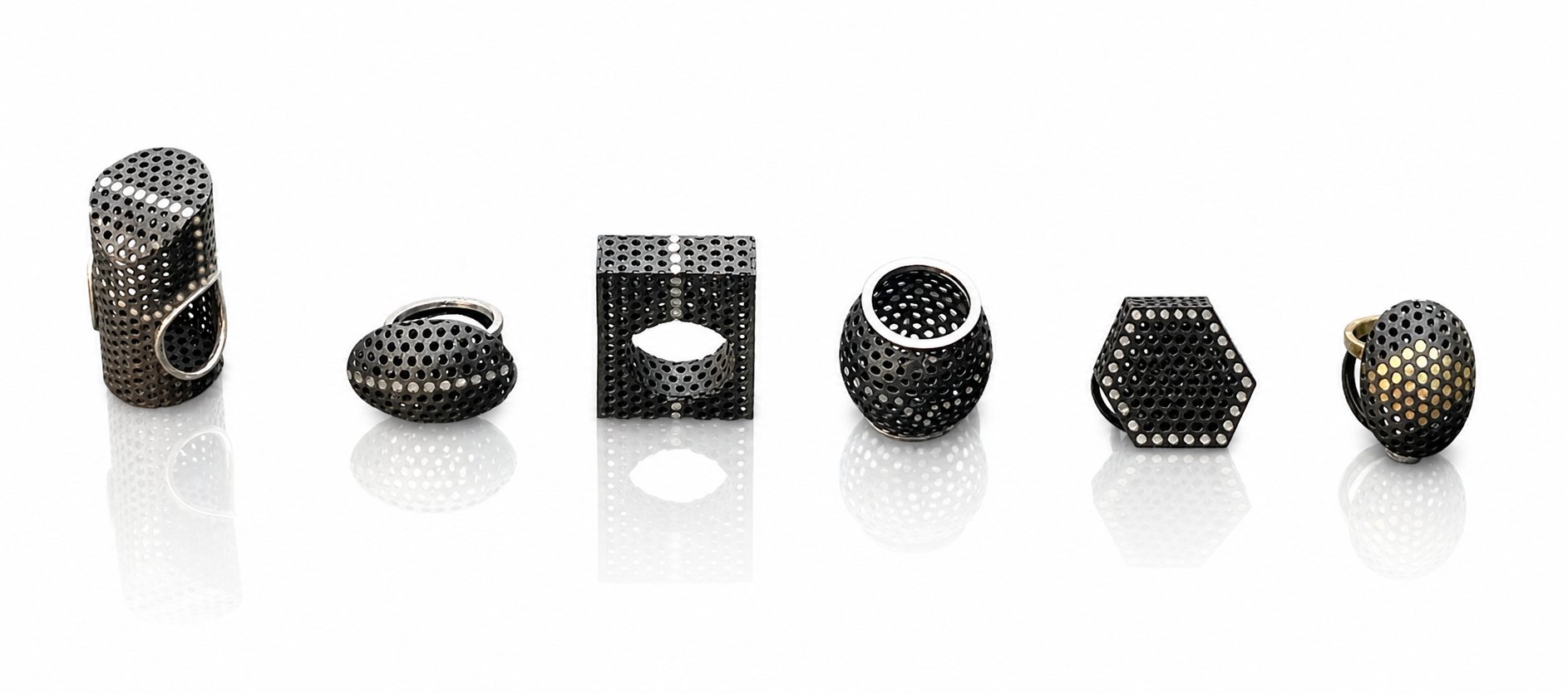
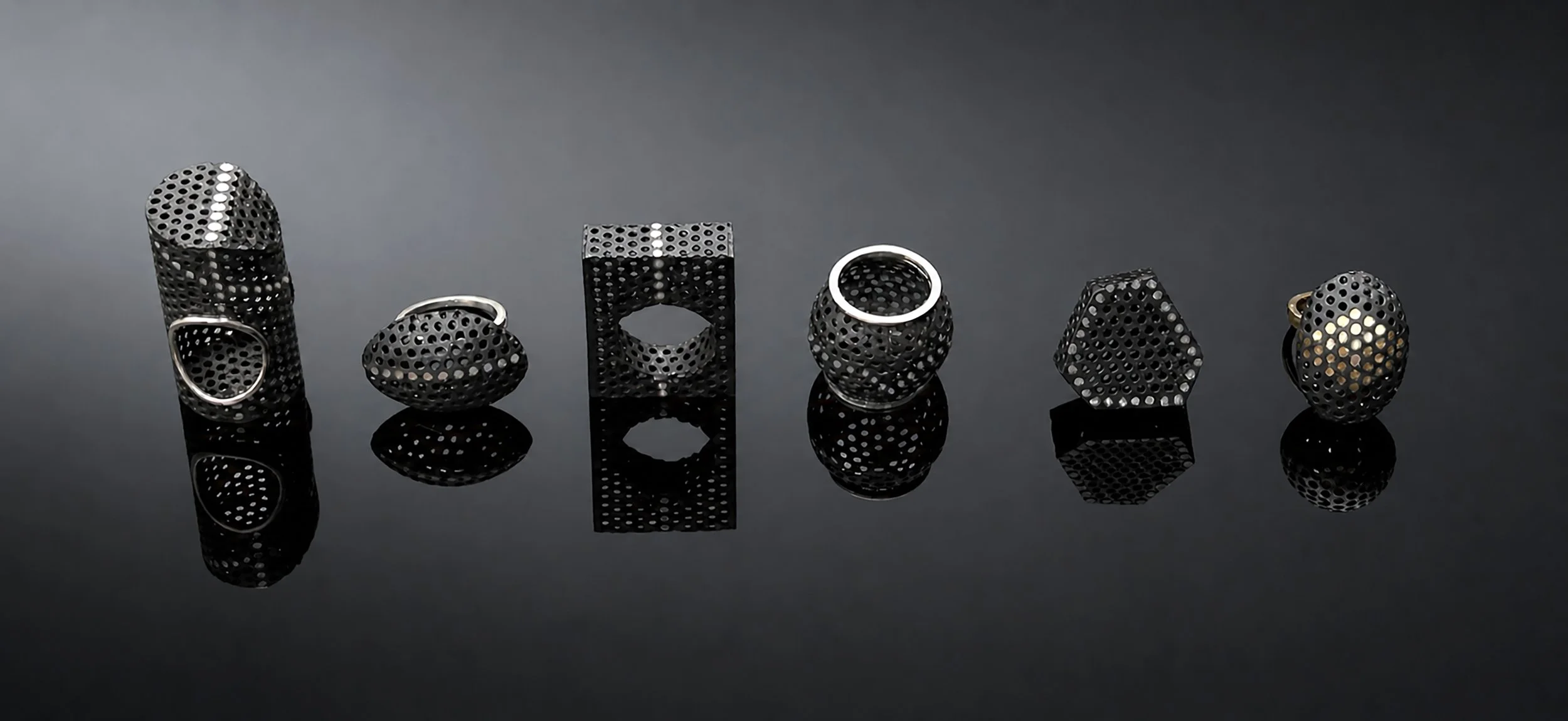
In May this year, I developed a new series of rings called Latent Lines.
Looking back now, I think this series was an important point in my exploration of rings. It was not completely new material or a completely new technique. In fact, it came from materials I have worked with for many years: perforated mild steel, silver and brass.
What changed was the way I started looking at them.
For a long time, perforated steel has been one of the most recognisable materials in my practice. I have cut it, formed it, soldered it, powder-coated it, blackened it and combined it with precious metals. The repeated holes are simply part of the material.
But this time I began to look into the perforations rather than only at the surface.
And I started to see lines.
The Line Was Already There
A perforated sheet is already a kind of grid.
Hundreds of small holes repeat across the surface in an industrial and predictable pattern. Usually we see the holes individually, or we see the whole sheet as a texture.
But what happens if I select only certain holes?
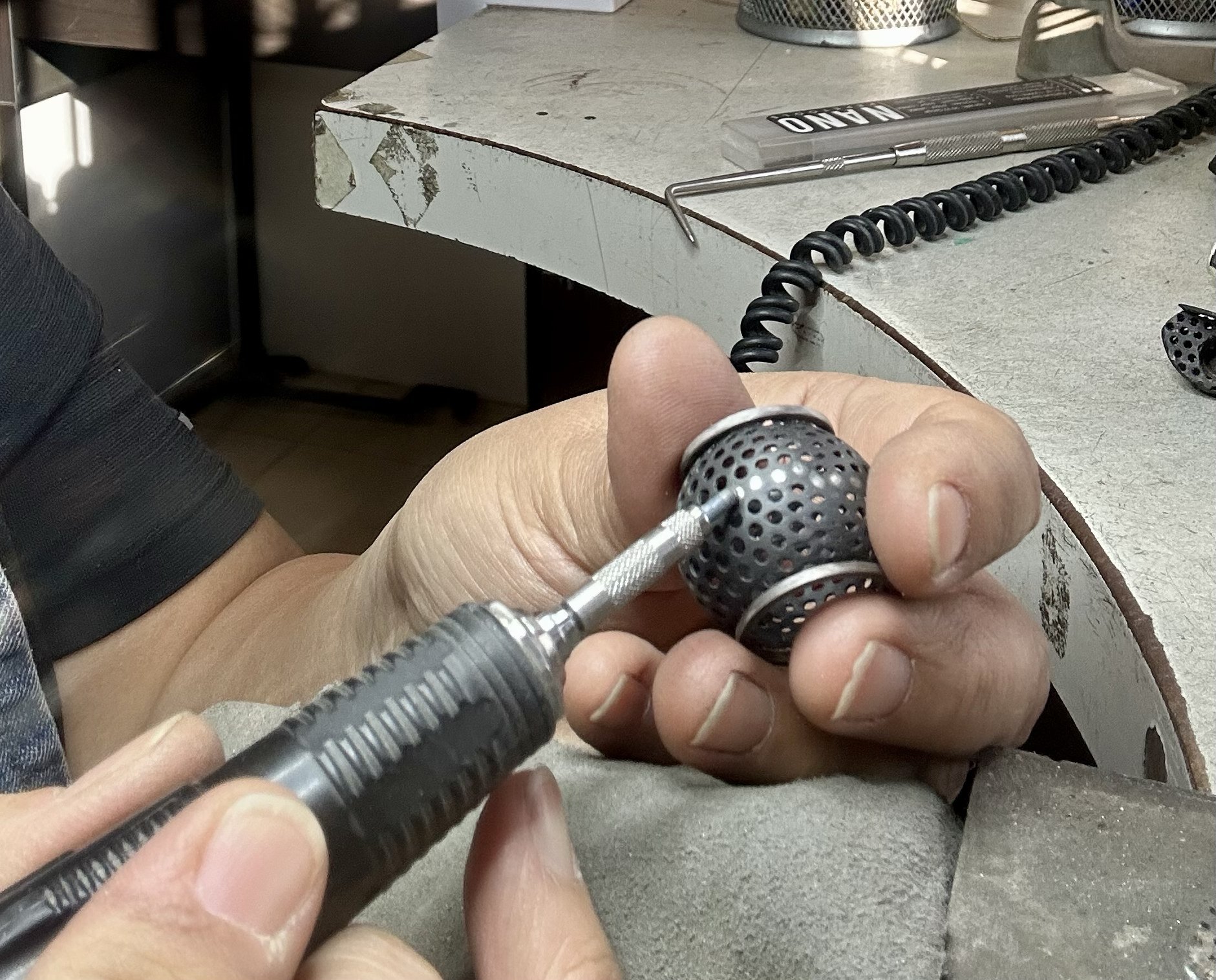
By inserting silver or brass into a sequence of perforations, a line begins to appear.
I am not really drawing that line onto the metal. I am following a pathway that is already contained within the structure of the material.
That became the idea behind the title Latent Lines.
Latent means something that exists but is not yet visible or obvious. I liked this word because it described exactly what I felt I was discovering.
The geometry was already waiting beneath the surface.
My job was to find it.
From an Industrial Grid to a Piece of Jewellery
The perforated mild steel begins with repetition, density and industrial logic.
Every hole is almost the same.
But once I choose particular holes and introduce silver or brass, that regularity is interrupted. One small decision begins to change how the whole surface is read.
A row becomes a line.
A line becomes a boundary.
A group of points becomes a shape.
Sometimes the line is continuous. Sometimes it disappears and reappears. Sometimes it follows the edge of the form, while at other times it cuts across it.
This was something I found particularly interesting: how little material I needed to change the reading of the whole object.
The silver does not have to dominate the steel. A few small points can be enough to make the eye connect them and imagine a line.
The line is partly made by me and partly completed by the person looking.
Light, Shadow and Movement
The perforations also mean that the rings never have a completely solid surface.
There is always space.
Light passes through the holes. Darkness appears behind them. When the ring moves on the finger, some openings become visible while others disappear.
The silver and brass also behave differently from the dark steel. They catch light and occasionally become very bright, while at another angle they almost disappear back into the pattern.
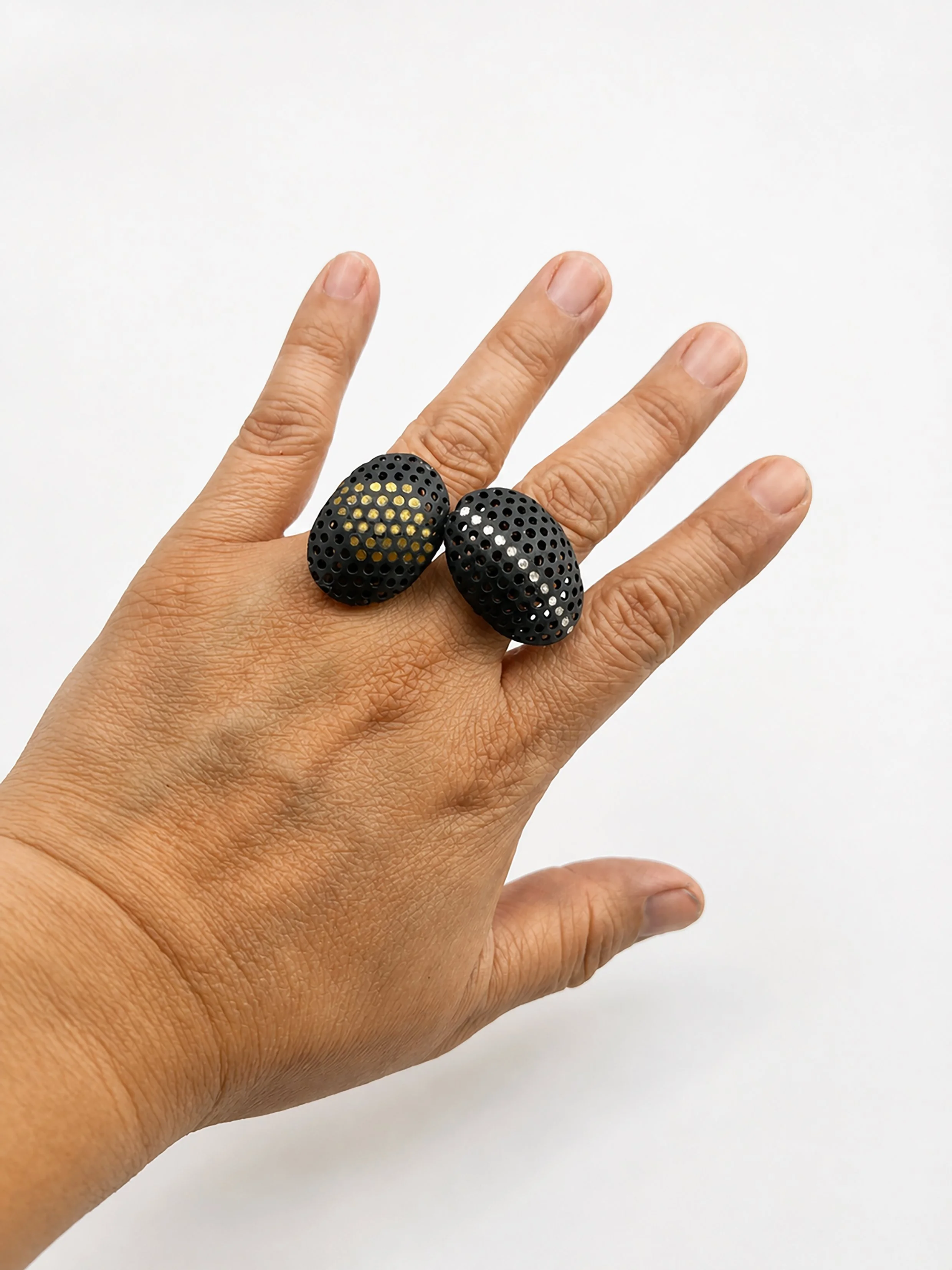
So the geometry is not fixed.
It changes with the hand, the light and the viewpoint.
This is something I have always liked about jewellery. Jewellery is not only an object photographed from one perfect angle. It moves with a body.
With these rings, the finger actually becomes part of the composition. The finger fills the empty interior, while the perforations allow glimpses between inside and outside.
The body completes the space.
Why Rings?

Perhaps this is also why I became interested in exploring this idea specifically through rings.
A ring is such a small object, but structurally it can be surprisingly complex.
It has an outside and an inside. It has to relate to the finger, but it can also extend away from it. It can be functional and wearable while still behaving like a small sculpture.
In Latent Lines, I wanted to allow the forms to become a little strange.
Some are oval and vessel-like. Some are more architectural. Some fold or curve around themselves. The perforated surface continues across these forms, carrying its grid with it, while the silver and brass lines interrupt and reconnect that grid.
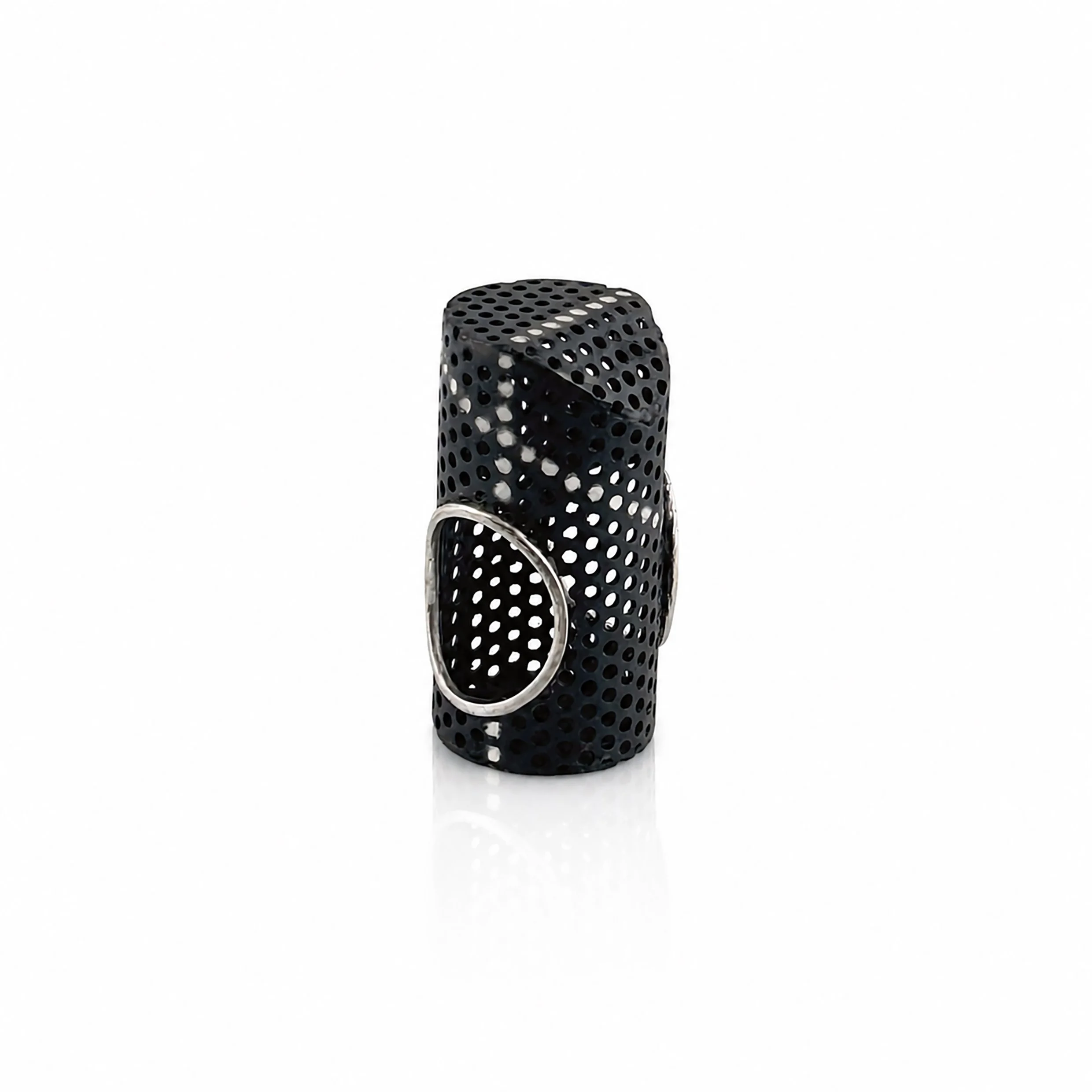
I began to think of them less as decorated rings and more as small structures containing hidden geometries.
Allowing Myself More Freedom
There was another important part of developing this series.
I felt that I was giving myself permission to make what I wanted.
After working professionally for many years, it is very easy to think about whether something will sell, whether it belongs with previous work, whether a gallery will understand it, or whether a ring is too large, too unusual or too industrial.
With Latent Lines, I tried to put some of those questions aside.
I wanted to follow my curiosity.
What happens if the line continues here?
What happens if it stops?
What happens if silver occupies these holes but leaves the others empty?
What happens if the ring becomes taller, more oval, more architectural?
These were small questions, but each one produced another possibility.
And perhaps that is what I value most about this series.
It did not begin with a finished image of what the rings should look like. It began by paying closer attention to a material I already knew extremely well.
Was AI Part of This?
This is an interesting question within the context of Hand & Algorithm.
AI did not make these rings.
It did not cut the steel, form the shapes, insert the silver and brass, solder the joins or decide whether a proportion felt right on my finger.
Those decisions happened through making.
But AI has helped me look back at the work differently.
When I began analysing rings from across my practice, repeated elements became more obvious: perforation, geometry, circles and ovals, interruption, gaps, connections, contrasting metals and visible structural decisions.
Somehow, Latent Lines sits between those two ways of thinking.
There is the physical intelligence accumulated through years of working with perforated metal, and there is this newer process of stepping outside my own practice and analysing what I repeatedly do.
Perhaps the “algorithm” was already there too.
Just like the latent line inside the perforated sheet, many of my own rules may have existed long before I had words for them.
What Was Hidden Was Already Mine
This is what I find most interesting when I look back at the series now.
I thought I was searching for new forms.
Instead, I may have been discovering something that was already embedded in my own material language.
The perforated steel was already there.
The geometry was already there.
The repetition was already there.
And after seventeen years of making, perhaps many of the decisions were already somewhere inside my hands as well.
I only needed to notice them.
Maybe that is what a latent line really is.
Something already present, waiting to be seen.