Chap.4-29: Expanding My Capacity: Preparing the Ring Campaign with AI
After looking again at the language of my rings in the previous chapter, I moved into something much more practical: getting them ready to be seen.
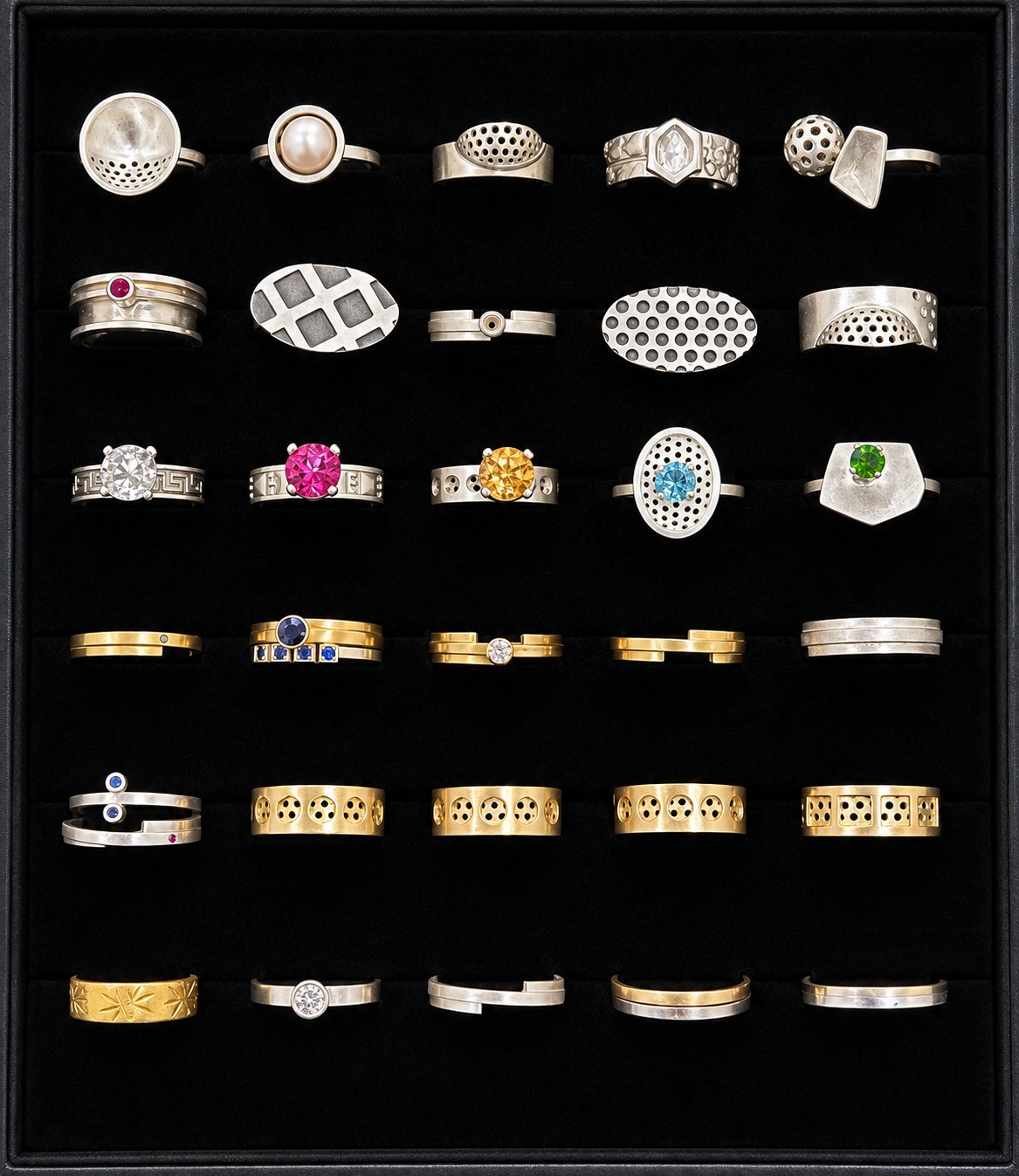
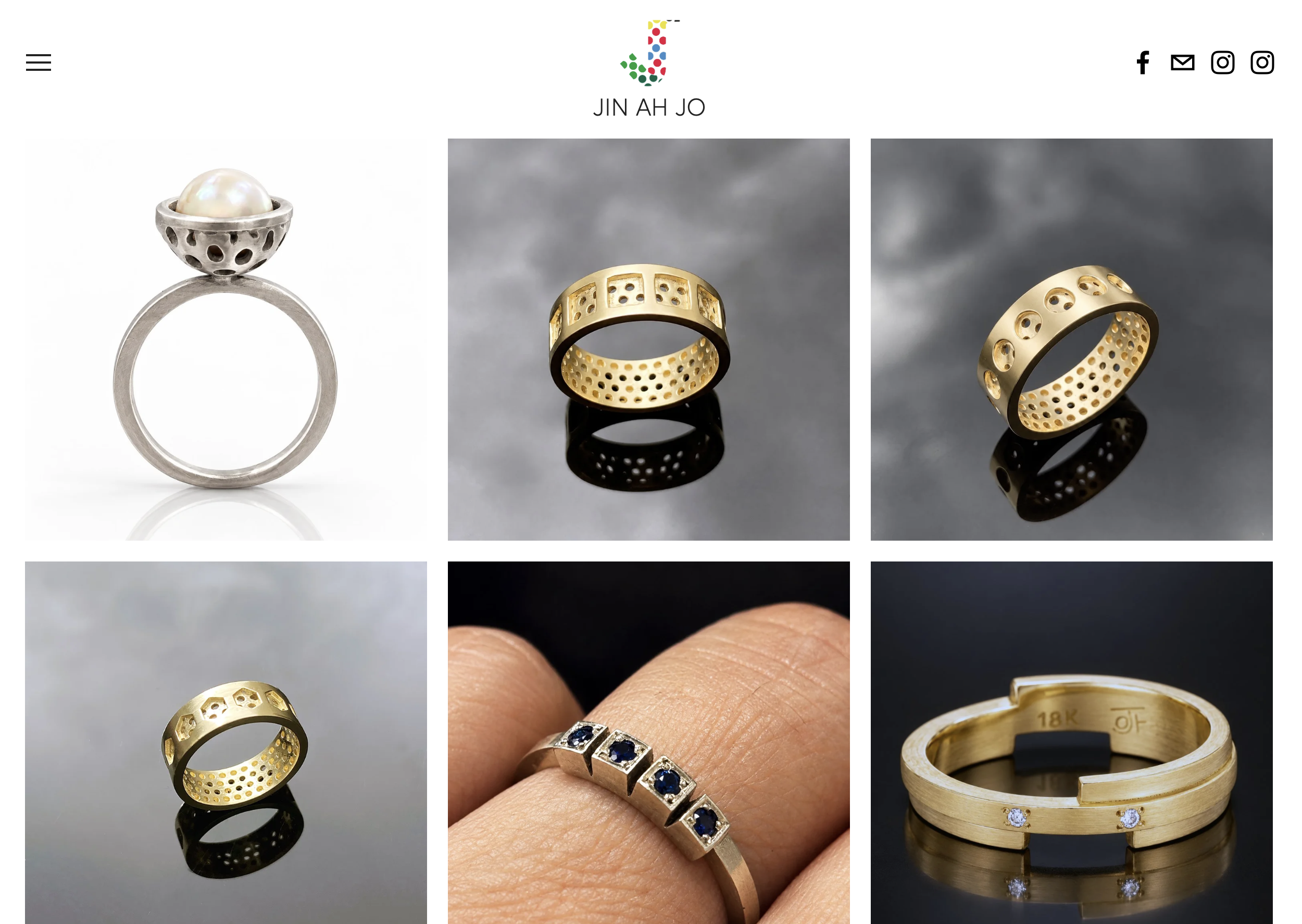
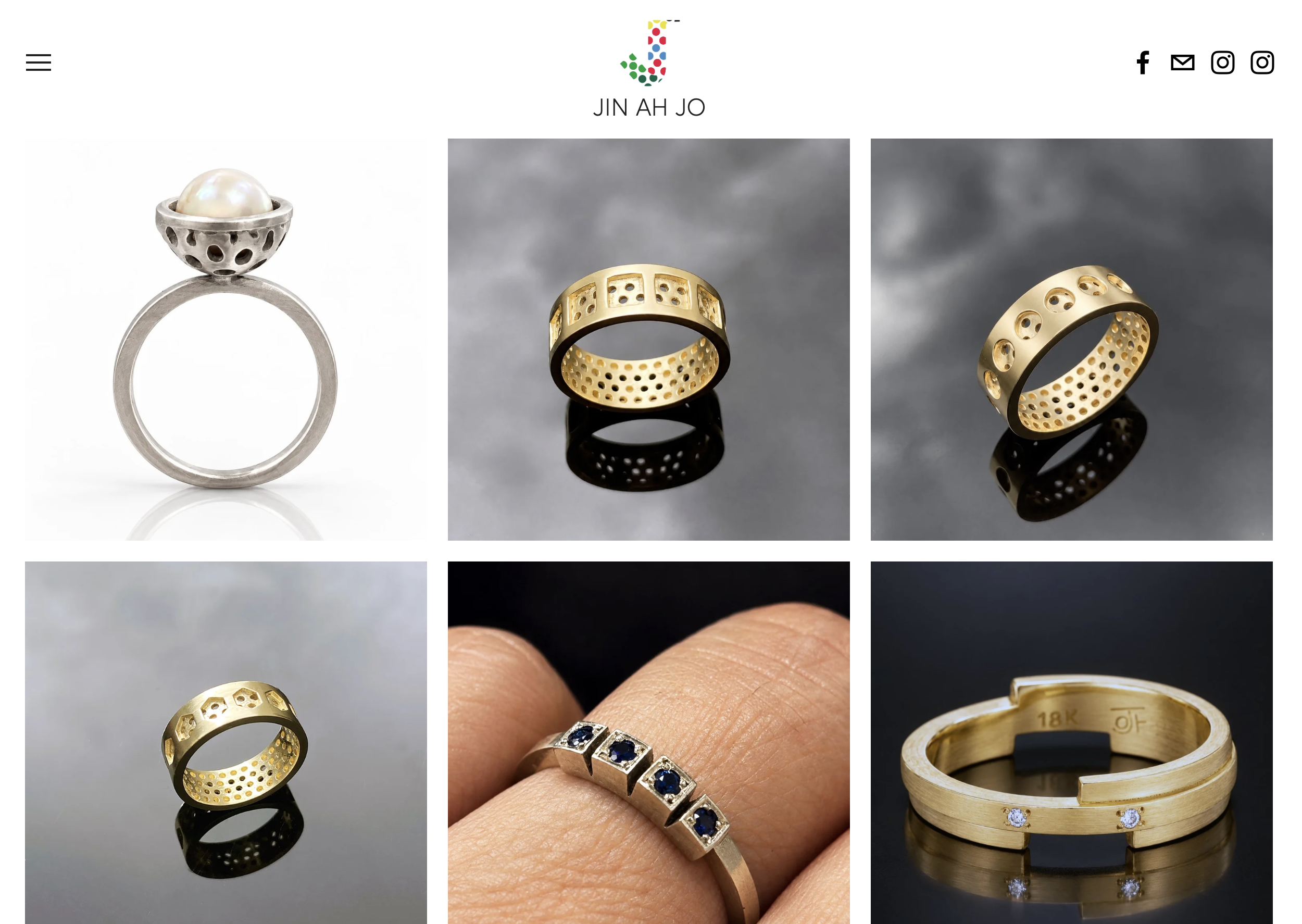
Over the past few weeks, I have been uploading my gold rings and some of my more recent significant ring works to my online shop. Many of these pieces had existed for years, while others were only recently completed. Some had professional photographs, some had quick studio images, and some had images that were useful as records but were not really ready for presentation.
I wanted to bring them together properly before beginning a new ring campaign.
This became another experiment in how AI might work as a studio assistant.
I used GPT to edit many of the photographs — changing backgrounds, cleaning images, removing my fingers when necessary, creating white or darker reflective settings, and helping the rings appear more consistently across the online shop. I also began adding measurements directly onto the images.
This part has been unexpectedly useful.
Jewellery is difficult to understand through a photograph alone. A ring can look large in one image and very small in another. A gemstone might dominate the image even though it is only a few millimetres wide. For each piece I already knew the actual measurements: inner diameter, ring size, wall width, thickness, gemstone size, setting height and overall profile.
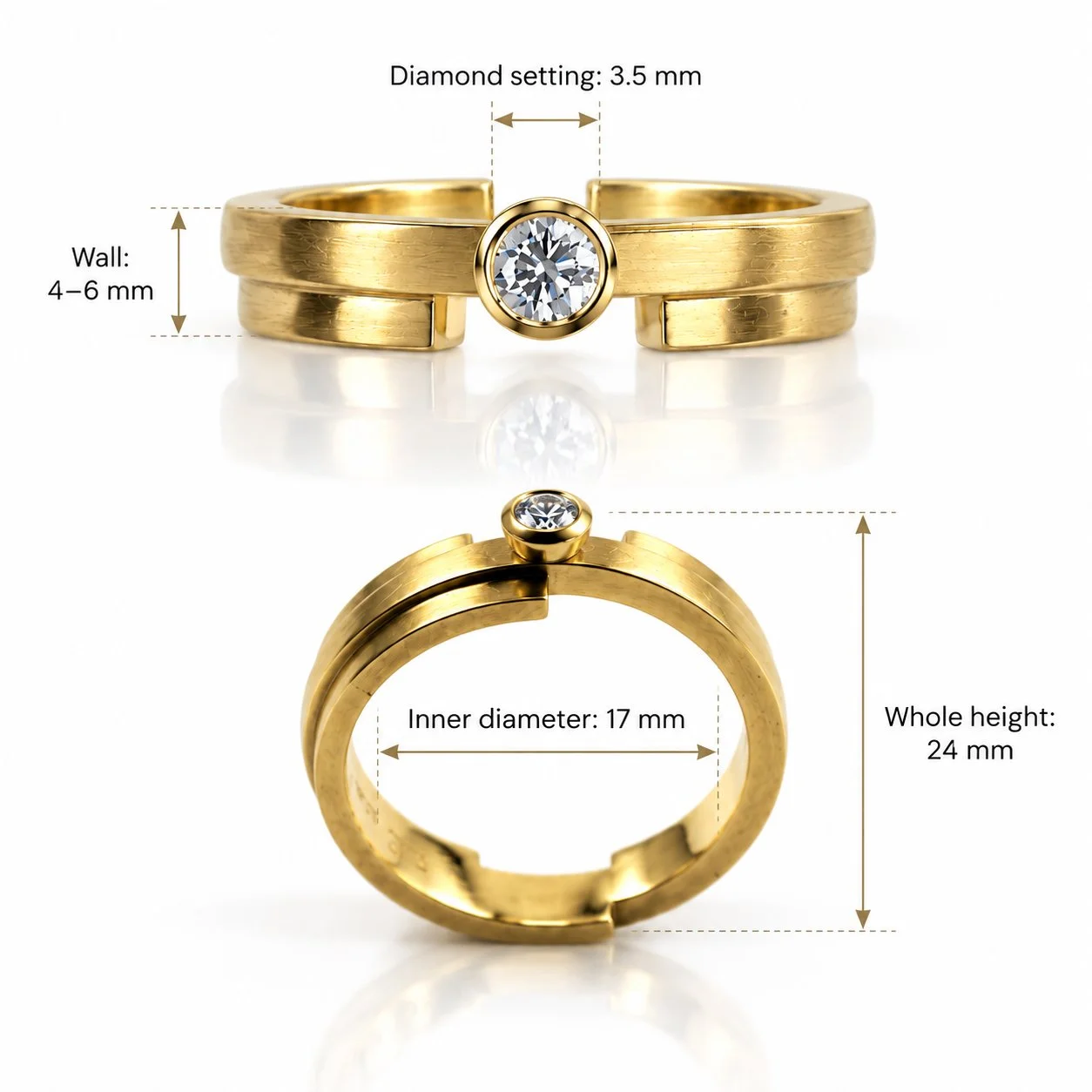
AI allowed me to turn this information into visual measurement images showing the ring from the top, side and profile views.
For someone looking at a ring online, these images can communicate information much more quickly than a long written description.
This is one area where AI genuinely gives me convenience.
But I am becoming more cautious about using the word automation.
People often talk about AI as though it will automate a business and save enormous amounts of time. In my own practice, that does not quite describe what is happening.
My jewellery still has to be made by hand.
I still cut, solder, file, sandblast, form, set stones, polish, powder-coat, photograph, measure, price, upload, write descriptions, answer messages, prepare packaging and organise exhibitions.
AI does not make the ring.
It does not decide when a surface feels right.
It does not know when I should stop filing, when a form is slightly wrong, or whether a new ring belongs within my practice.
The decisions remain mine.
In fact, sometimes AI creates more work because it opens another layer of possibilities.
Once I can edit photographs, I want better photographs.
Once I can generate measurement images, I want every ring to have them.
Once I can create a short video, I begin thinking about how all of my existing images and videos might become something much larger.
Then I have more things to organise, edit, compare and decide.
As a sole artist, that can feel quite heavy.
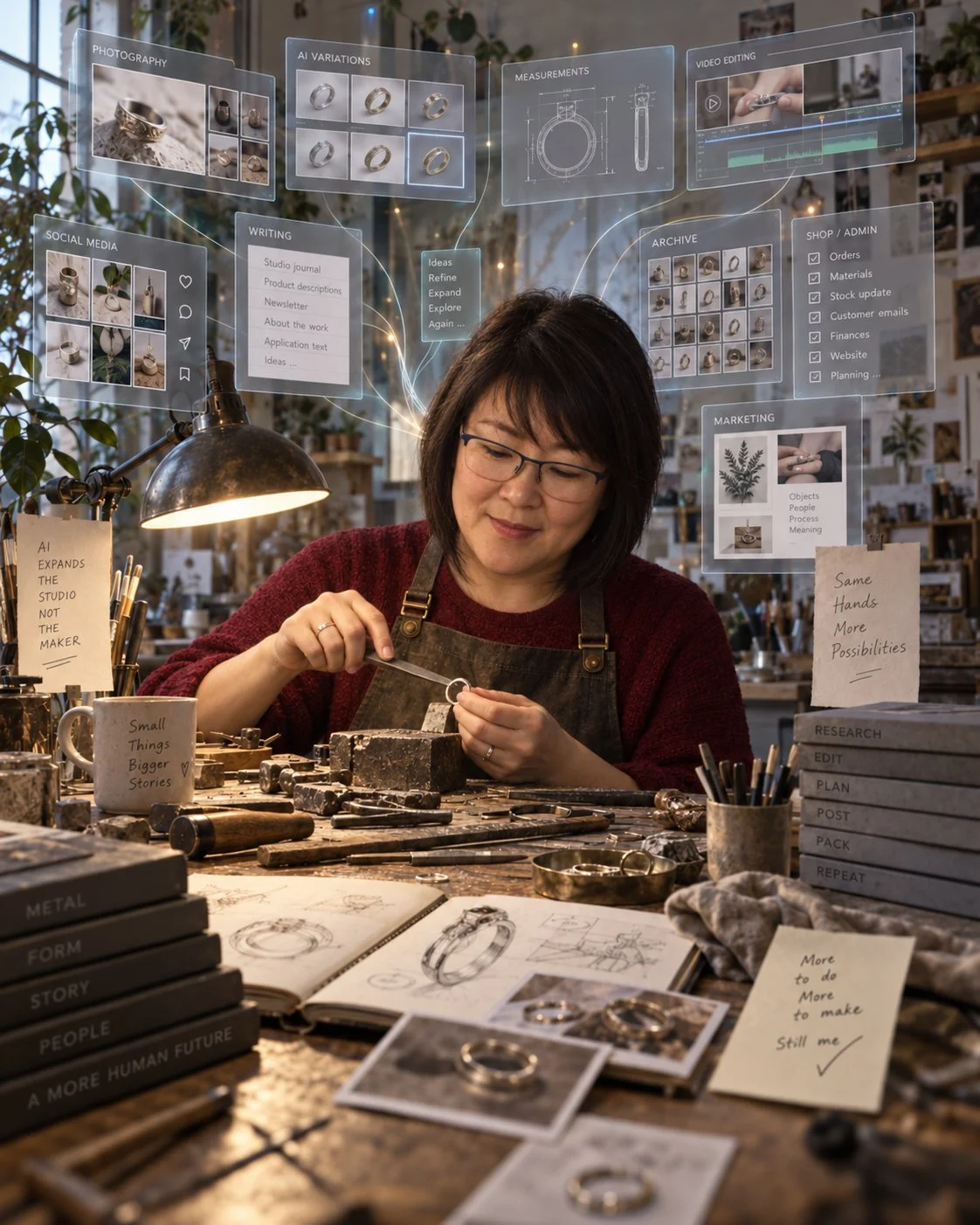
I make the jewellery, but I am also the photographer, shop manager, writer, social-media manager, archivist, marketer and now, increasingly, video editor.
AI may assist each of these roles, but I am still the person moving between all of them.
That is probably the most important thing I am learning.
AI does not necessarily reduce my workload.
Sometimes it expands my capacity.
Why I wanted to learn AI in the first place
One of the significant reasons I began learning AI was because I realised how much material I already have.
After more than seventeen years of making, I have accumulated thousands of photographs, studio images, process shots, exhibition photographs and videos.
These files are not only records.
They are a huge resource.
For a long time, many of them have simply stayed in folders.
I might use one photograph for Instagram, another for a website, and then move on. But now I am beginning to think differently.
What if all this material could become something else?
Could years of making be reorganised into new stories?
Could old process videos become short films?
Could images of materials, tools, unfinished jewellery and finished work be edited together in a way that shows how my practice has developed?
Could I eventually become a much stronger video creator using the archive I already own?
This is where Gemini AI and NotebookLM have started to interest me.
I have been experimenting with using Gemini for video ideas and generation, and NotebookLM for reorganising my own written and visual material into presentations, summaries and other formats.
These experiments are still early.
Some results are useful. Some are strange. Some are too generic. Some still look obviously AI-generated.
But the possibility interests me.
My goal is not to replace the handmade part of my work.
It is almost the opposite.
I want the handmade work to travel further.
I want to become better at communicating what already exists in the studio.
Preparing the gold rings
The immediate result of this experiment is very simple.
My gold rings are finally being updated and prepared properly.
I have been photographing and editing them, checking measurements, creating consistent product images, adding images of the rings being worn, and preparing short videos.
This includes older gold rings that have been part of my practice for some time, as well as newer rings using Australian sapphires, diamonds, black diamonds and other gemstones.
Until recently, they existed as separate pieces.
Now I am beginning to see them as a group.
Not necessarily a collection in the traditional sense, but a body of work that can be presented together through a campaign.
For the ring campaign, I am thinking about a simple sequence:
ingredients → making process → finished ring → ring on the hand.
This structure allows me to show both the object and the making behind it.
The jewellery is still the centre.
AI is helping me build the frame around it.
Expanding my capacity as an artist
I sometimes describe myself very simply as a craftsperson.
I make things with my hands.
That remains true and probably always will.
But I am beginning to understand that I want something broader around this identity.
With AI, I can potentially become a better photographer, editor, writer, archivist, researcher and video maker without needing to become a specialist in every one of those areas.
That does not mean I suddenly become expert at all of them.
But the threshold becomes lower.
I can try.
I can experiment.
I can create something, look at it, reject it, change it and try again.
This is important to me because I want to expand my capacity as an artist.
Not by making the hand less important, but by making the world around the handmade object larger.
A ring may begin at my bench, but it can move into an image, a film, an online exhibition, a story, an archive or a conversation with someone on the other side of the world.
That possibility feels much more open than it did before.
Something I am beginning to recognise about myself
There has also been another unexpected result from this project.
I am learning something about myself.
I have always known that I work hard.
When I look back at my practice, this is obvious. I have continued making through many different studios, jobs, exhibitions, family responsibilities and changes in my life.
But I did not always think of myself as a particularly curious person.
I thought I was persistent more than curious.
Now I am not so sure.
During this project I keep wanting to know what happens next.
What happens if I change the image?
What happens if I give an AI tool a video of my making process?
Can I turn photographs into a stronger story?
Can I use my archive differently?
Can I understand my own ring designs as a system?
Can I learn video editing?
Can I build an online exhibition myself?
Can I combine something extremely old — making jewellery by hand — with something extremely new?
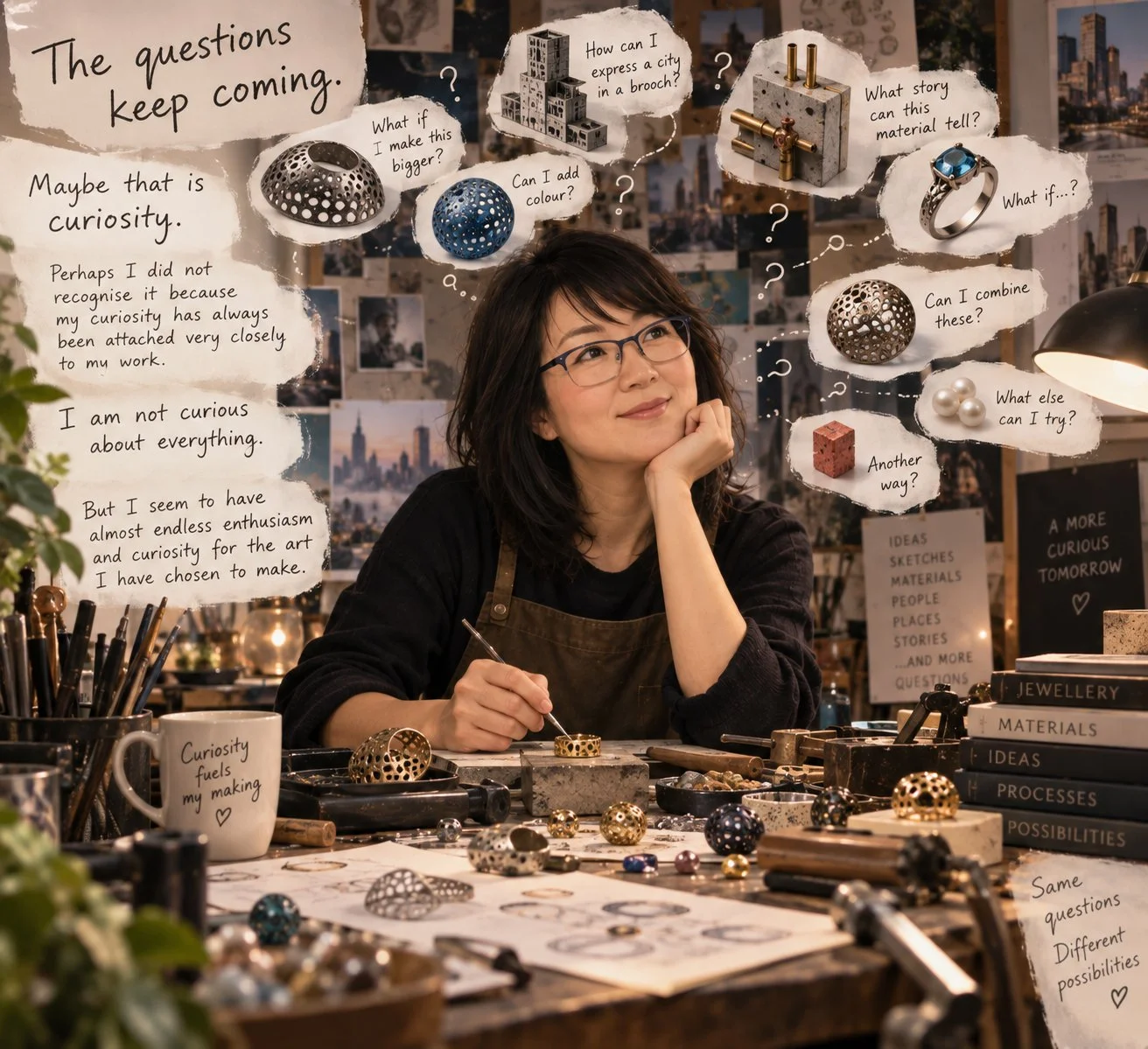
The questions keep coming.
Maybe that is curiosity.
Perhaps I did not recognise it because my curiosity has always been attached very closely to my work.
I am not curious about everything.
But I seem to have almost endless enthusiasm and curiosity for the art I have chosen to make.
That feels significant.
The AI experiment has not made my practice easier in the way I first imagined.
It has made it wider.
There is more to learn, more to organise, more to make and sometimes more pressure because I can suddenly see all the things that are possible.
But I also feel that my capacity is growing.
For now, at least one practical milestone is clear.
The gold rings and many of my recent important rings are finally photographed, measured, edited and updated.
They are ready for the next stage.
And perhaps I am too.