Chapter 4 The Archive, the Algorithm and the Shift -28: Looking at My Rings Again
Recently, I started looking at my rings again.
Rings so far
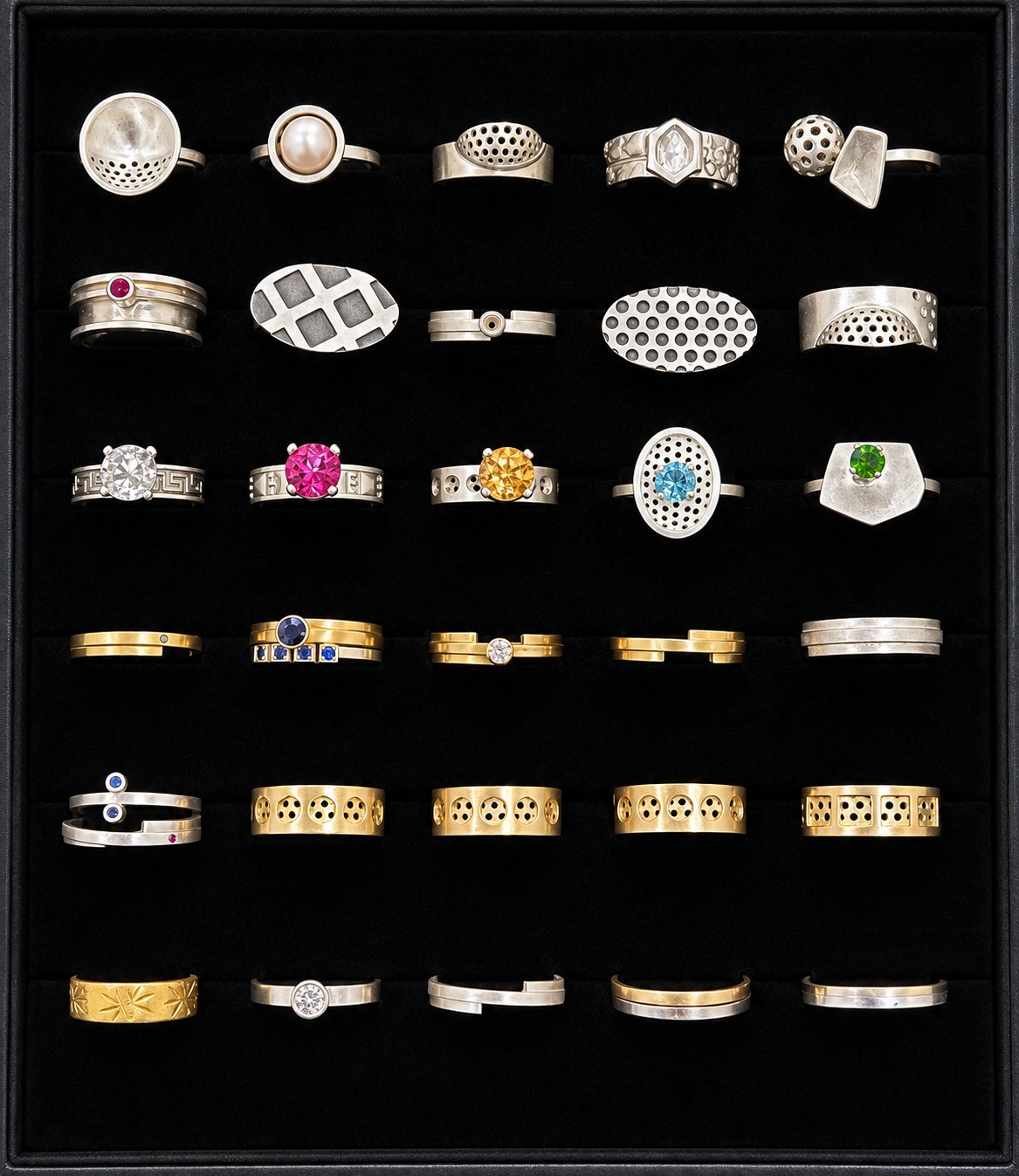
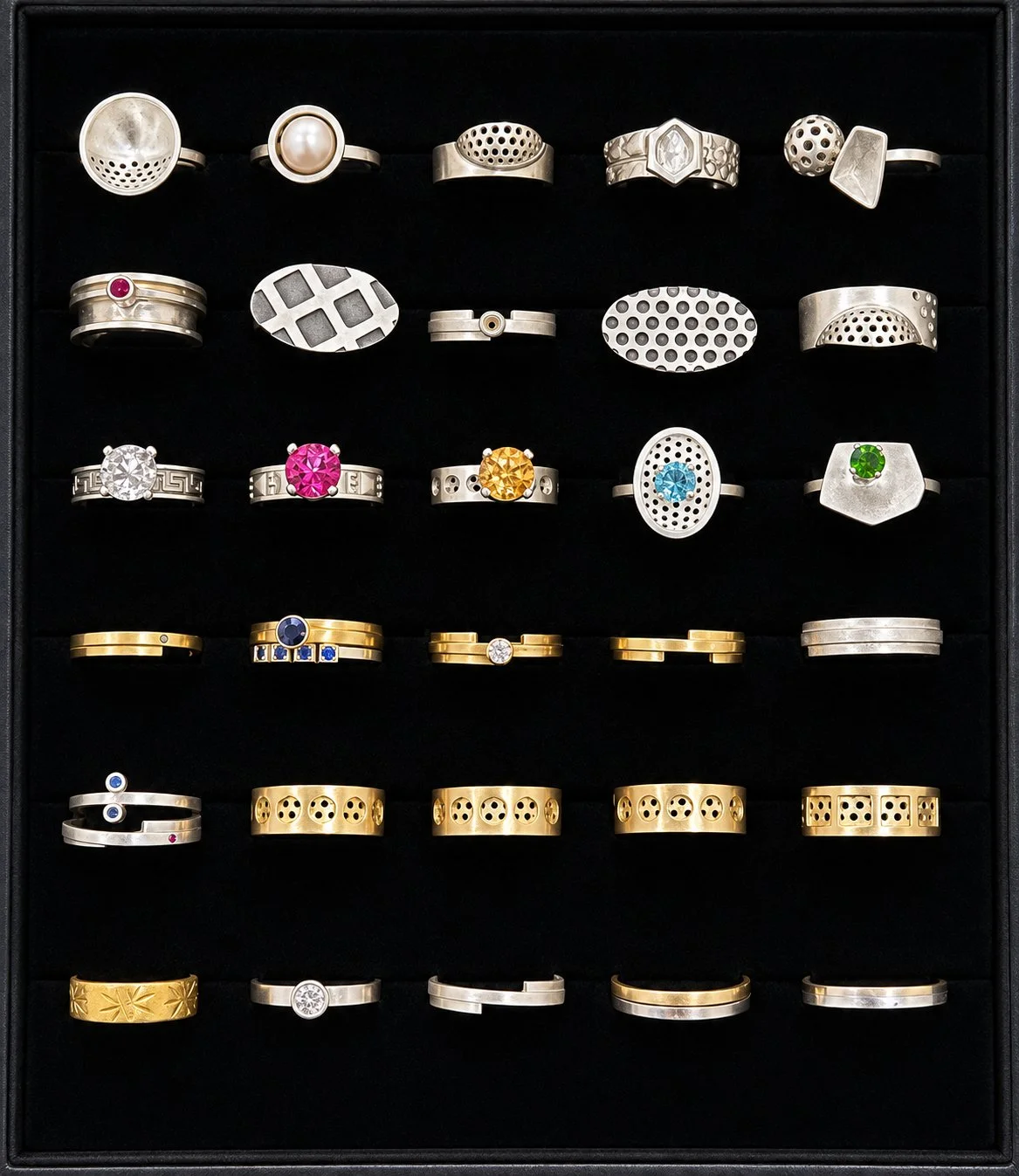
At the moment, I have around 35 rings ready to sell. Some came back to me as returned stock from e.g.etal, where my work had been represented for many years. Others have stayed with me through different stages of my 17 years of making.
Some were once successful engagement rings. Some were experiments. Some belong very clearly to a certain period of my practice. A few have emotional value because I remember when I made them, where I was working, or what was happening in my life at the time.
When I put them together, I realised that they were not simply old stock.
They were part of the journey of my making.
At the same time, I had started making rings again.
This time I was using larger coloured gemstones and returning to something I have always found interesting: the space between a conventional engagement ring, a dress ring and a contemporary ring.
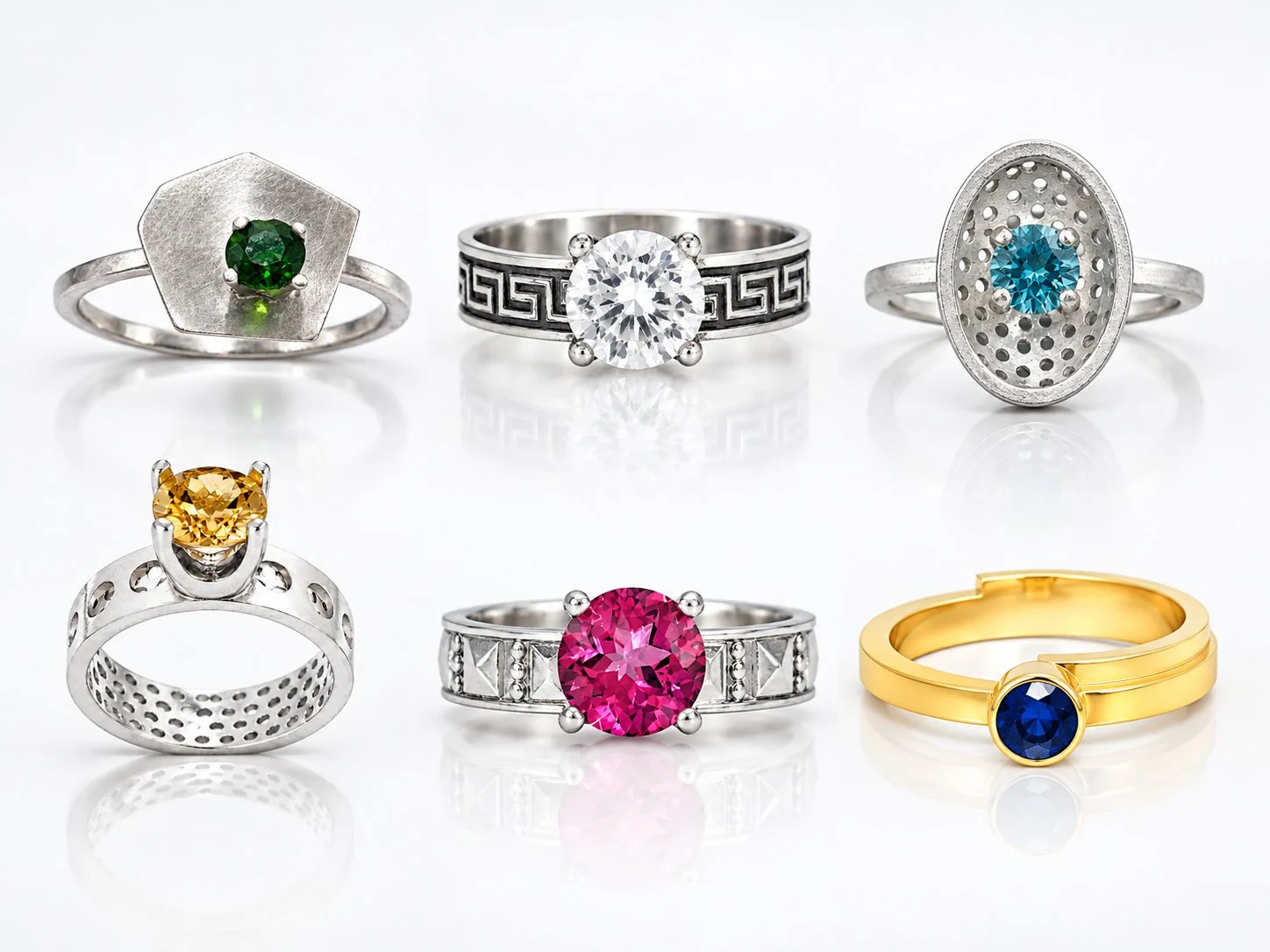
6 colour gems-chrome diopside, white topaz, sky blue topaz, citrine, pink topaz and Australian sapphire
I still like the familiarity of a gemstone.
A stone immediately gives a ring a certain presence and emotional meaning. But I do not necessarily want the structure around it to be conventional.
I am interested in what happens when a familiar gemstone is combined with a wider band, perforated metal, unusual geometry or a slightly unexpected setting.
I still believe there is a lot of room in that space.
Not completely traditional.
Not completely art jewellery.
Something in between.
Learning How to Show the Rings Again
Making the ring is one thing.
Showing it to people is another.
This has always been one of the difficult parts of running a jewellery practice.
Recently, AI has been helping me not with the making itself, but with how I communicate the work afterwards.
For the new rings, I started using a simple sequence for Instagram:
Ingredients → Finished Ring → Ring on a Human Finger
The “Ingredients” image shows the materials before making: silver strip, gemstone, setting, solder, flux and other components.
Then I show the completed ring.
Finally, I show it being worn.
It is such a simple structure, but it helps tell the story of the object.
Instead of only showing a polished final photograph, people can see where the ring came from.
Material becomes process.
Process becomes object.
Object becomes something worn on a body.
I was surprised recently to notice a similar “Ingredients” image format appearing on an online jewellery-supplies account.
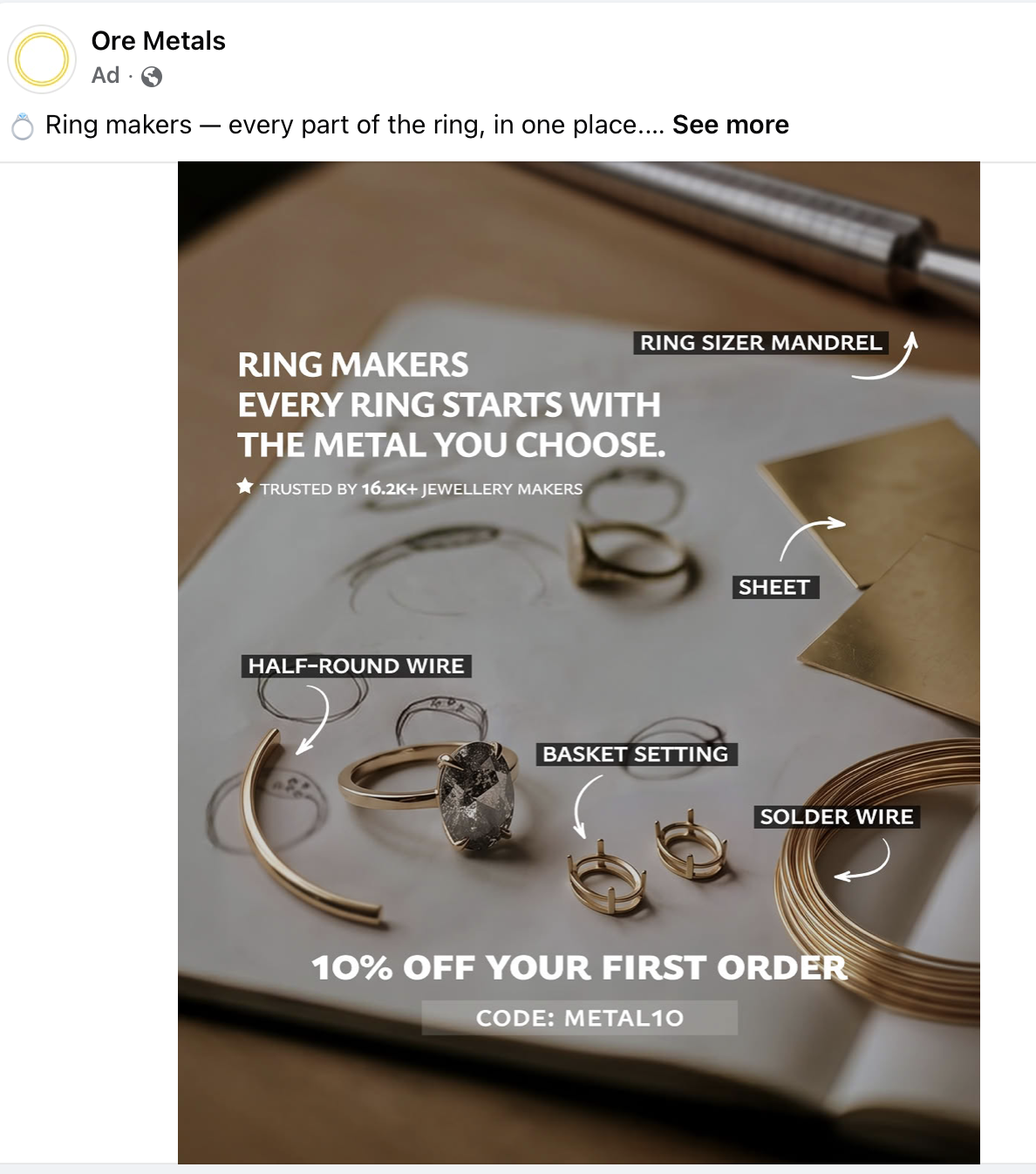
An Ore Metals advertisement I came across on Facebook. Its presentation immediately reminded me of my own ‘Ingredients’ ring-making posts.
Source: Ore Metals Facebook advertisement, viewed 16 September 2026.
My first reaction was honestly: Already?
It felt strange because I had only recently started developing this format as part of my own social-media language.
Of course, online images circulate very quickly, and similar ideas can appear independently or be absorbed into the visual language of social media.
It was still a reminder of how quickly an idea can move once it becomes visible.
That experience made me think again about originality in the age of AI.
AI can help me develop, repeat and refine a format.
But once that format is online, it no longer exists only inside my studio.
AI as a Small Marketing Assistant
This is another area where AI has become useful.
After finishing a ring, I can now get help preparing several kinds of material around the same object.
A clean product photograph.
A worn image.
A measurement image showing the internal diameter, band width, setting height and total height.
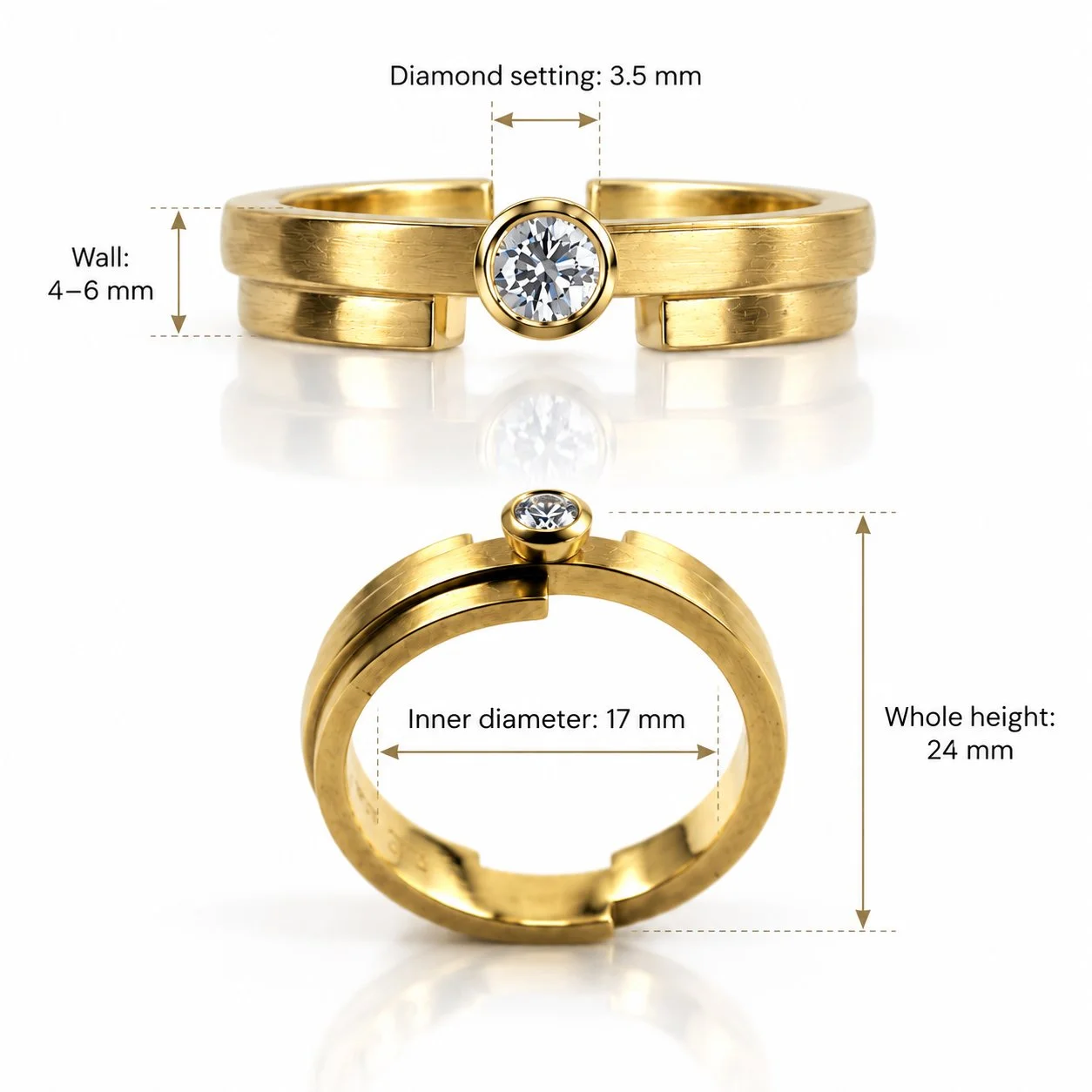
18ct yellow gold with white diamond ring
A short description for my online shop.
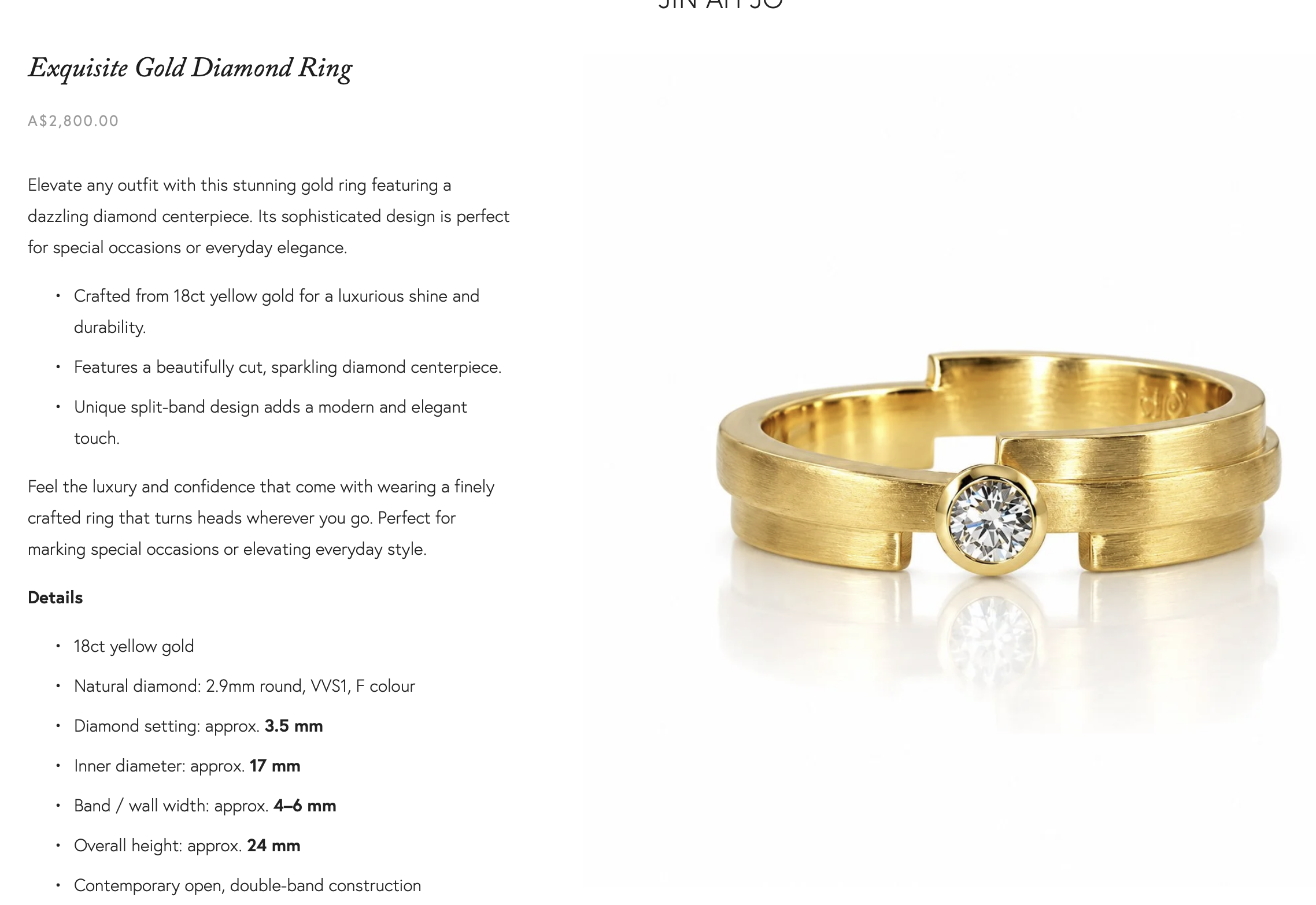
A short Instagram caption.
And sometimes a very short reel.
None of these things changes the ring itself.
But together, they make the ring much easier to understand online.
This is particularly useful for jewellery because scale is difficult to communicate through a photograph.
A ring may look huge in a close-up image even though it is quite small in reality.
A measurement image helps.
A photograph on a hand helps.
A short reel helps even more, because people can see the ring from several angles.
These are very practical things, but they matter.
For many years I concentrated mainly on making the work.
I would finish something, photograph it, send it to a gallery and move on to the next piece.
Now I am trying to think more carefully about what happens after making.
How does someone discover the ring?
How do they understand its size?
How do they imagine wearing it?
How does it reach the online shop?
AI has made some of these small jobs faster.
Not always perfectly, and I still have to check everything.
But it has allowed me to build a more complete story around each ring.
Old Rings, New Rings
At the same time, working on these new gemstone rings made me look back at the older ones.
I could suddenly see relationships between them.
Certain forms had never really disappeared.
Circles.
Ovals.
Perforations.
Layered bands.
Repeated holes.
Gemstones sitting within geometric structures.
Interrupted lines.
Some ideas appeared fifteen years ago and are still present in the rings I am making now.
That was when another question started to emerge.
If I placed all these rings together, could I actually analyse them?
Could I treat 17 years of rings almost like a small archive?
Could I identify the shapes, structures and decisions that I keep returning to?
And if I could see those patterns clearly, could they help me make something new?
That question became the beginning of my next experiment.
The Ring Algorithm.