Chap.3-27: AI as Admin Assistant, Not Studio Master
One of the biggest surprises of my Hand & Algorithm project has been discovering that AI is not necessarily most useful to me at the jewellery bench.
It is most useful beside it.
Over the past months, I have experimented with ChatGPT, Gemini, Claude, NotebookLM and Notion AI. I originally approached AI with many questions about creativity: Can it generate ideas? Can it suggest forms? Can it help me design jewellery? Can it become some kind of studio assistant?
It can certainly participate in those areas.
But increasingly, I have realised that one of its most valuable roles in my practice is much less glamorous.
Administration.
And there is a lot of administration behind being an artist.
The Invisible Work Behind the Jewellery
When someone sees a finished ring, brooch or exhibition, they usually see the object.
They do not see the emails.
They do not see exhibition forms, grant applications, artist statements, agreements, invoices, product descriptions, schedules, website updates, newsletters, image captions, social-media planning, stock lists or endless revisions of short paragraphs.
They do not see me wondering whether an email sounds too direct.
Or too apologetic.
Or whether my English says exactly what I intended to say.
They certainly do not see the hours spent organising the work before and after the actual making.
For years, this administrative work has existed around my studio practice.
I simply accepted it as part of being a professional artist.
But it consumes energy.
Sometimes a surprising amount of energy.
English Is Part of My Administrative Workload
English is my second language.
I have lived and worked in Australia for many years, completed my degrees here and built my professional jewellery practice here. I can communicate perfectly well in English.
But professional writing is different.
An email to a gallery.
A response to an agent.
A grant application.
An exhibition proposal.
A carefully worded question about an agreement.
A statement explaining a new body of work.
These situations require more than simply communicating the basic information. Tone matters. Nuance matters. Confidence matters.
This is one area where ChatGPT has become particularly useful to me.
I often write the email first.
Sometimes it is grammatically imperfect. Sometimes it is emotional. Sometimes it is too long.
Then I ask AI to proofread it.
What I want is not for AI to replace my voice.
I want it to help my voice arrive more clearly.
That difference is important.
From Exhibition Emails to Agreements
During this project, AI has helped me with many very ordinary but important professional situations.
For Radiant Pavilion, there have been forms, exhibition information, promotional material and communication around my project Hand & Algorithm.
When information about my window exhibition at Small Space Jewellery was unclear, I used ChatGPT to help me write a professional email asking for it to be corrected.
The issue was mine.
The request was mine.
The relationship was mine.
AI simply helped me organise the language.
I have also used it during correspondence relating to my new brooch series, The City and Its Uncertain Walls – Brooches, inspired by Haruki Murakami's novel.
Communicating with Haruki Murakami's literary representatives involved something quite different from making jewellery.
There were permissions.
Title wording.
Distribution numbers.
An agreement.
Questions about how the project could be promoted.
These are situations where language needs to be precise.
AI could help me read a paragraph slowly, identify something I should clarify, and draft a response before I made the final decision myself.
This kind of assistance is not visually exciting.
There is no spectacular AI-generated object at the end.
But professionally, it is extremely useful.
AI as the Person Sitting at the Other Desk
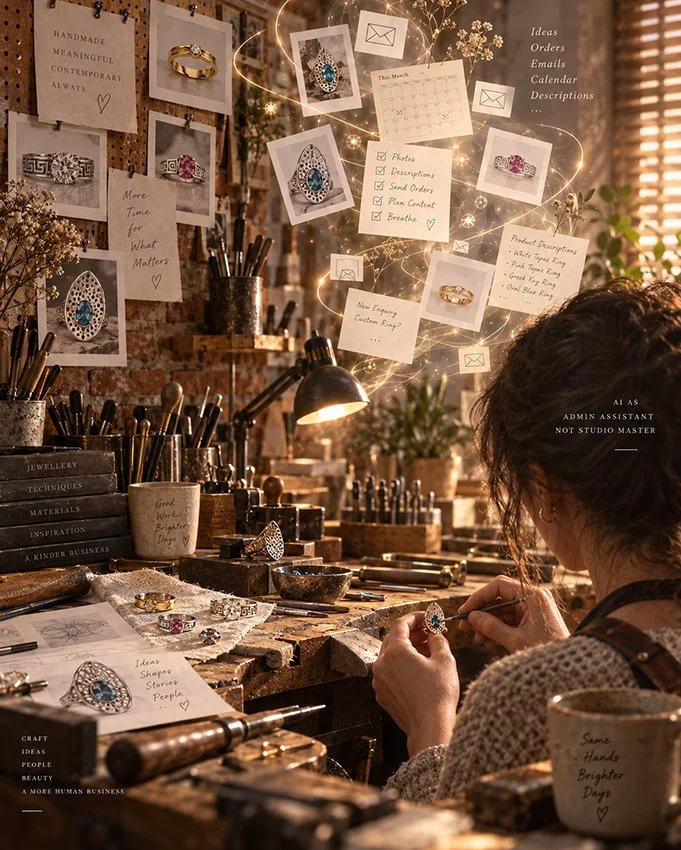
Sometimes I think of AI as someone sitting at another desk in my studio.
I am at the jewellery bench.
It is at the administration desk.
I might ask:
Can you organise this information?
Can you proofread this email?
Can you make this statement shorter?
Can you turn these notes into an exhibition description?
Can you help me structure this application?
Can you create a weekly schedule?
Can you compare these options?
Can you turn the dimensions and materials of this ring into a website description?
Can you help me plan the promotion of this exhibition?
These are not small tasks when they are multiplied across an entire professional practice.
One email might take ten minutes.
One exhibition application might take several hours.
Updating a website might consume an afternoon.
Planning social media can easily expand into another job entirely.
AI does not remove all of this work.
But it can reduce the friction between thinking something and putting it into an organised form.
Five AI Tools, Different Kinds of Assistance
I have not used only one AI platform.
I have moved between ChatGPT, Gemini, Claude, NotebookLM and Notion AI, and I am gradually understanding that they do not need to perform exactly the same role.
ChatGPT has become the AI I use most conversationally. I use it to think through emails, rewrite text, organise schedules, develop promotional ideas, prepare website descriptions and talk through problems as they appear.
Gemini has been another space for experimentation, particularly when I am working across Google-based tools or testing different ways of approaching research and content.
Claude gives me another way of reading and restructuring longer pieces of writing. Sometimes simply asking a different AI the same question reveals a different emphasis.
NotebookLM has been particularly interesting for organising a body of information. Instead of treating every document separately, I can begin to see my own project as a collection of connected material. I have experimented with its summaries, audio discussions and presentations as ways of looking back at the work I have already produced.
Notion AI belongs more to the organisational side: notes, planning, lists and keeping information together.
I do not think I need to choose one AI and declare it the winner.
I am more interested in building a small ecosystem of assistants.
The important question is:
Which tool is useful for which job?
The Business of Being an Artist
There is also another uncomfortable truth.
An artist is often running a very small business.
In my case, I make the jewellery, photograph it, edit images, update the website, write product descriptions, contact galleries, prepare stock, plan exhibitions, answer emails, organise deliveries, promote work on Instagram and write this blog.
Then I go back to the bench and make the next piece.
There is no separate marketing department.
No communications department.
No administrative assistant sitting outside my studio.
For an independent artist, all these roles collapse into one person.
This is where AI starts to become interesting to me economically as well as creatively.
I may not be able to employ five different people to help run my practice.
But I can use AI to help with parts of five different jobs.
Not to replace those professionals entirely.
And certainly not to pretend that AI has the expertise of a lawyer, accountant, curator or experienced arts administrator.
But for the first draft, organisation, comparison, editing and preparation stages, it can be remarkably useful.
Faster Does Not Always Mean Less Work
There is a contradiction here.
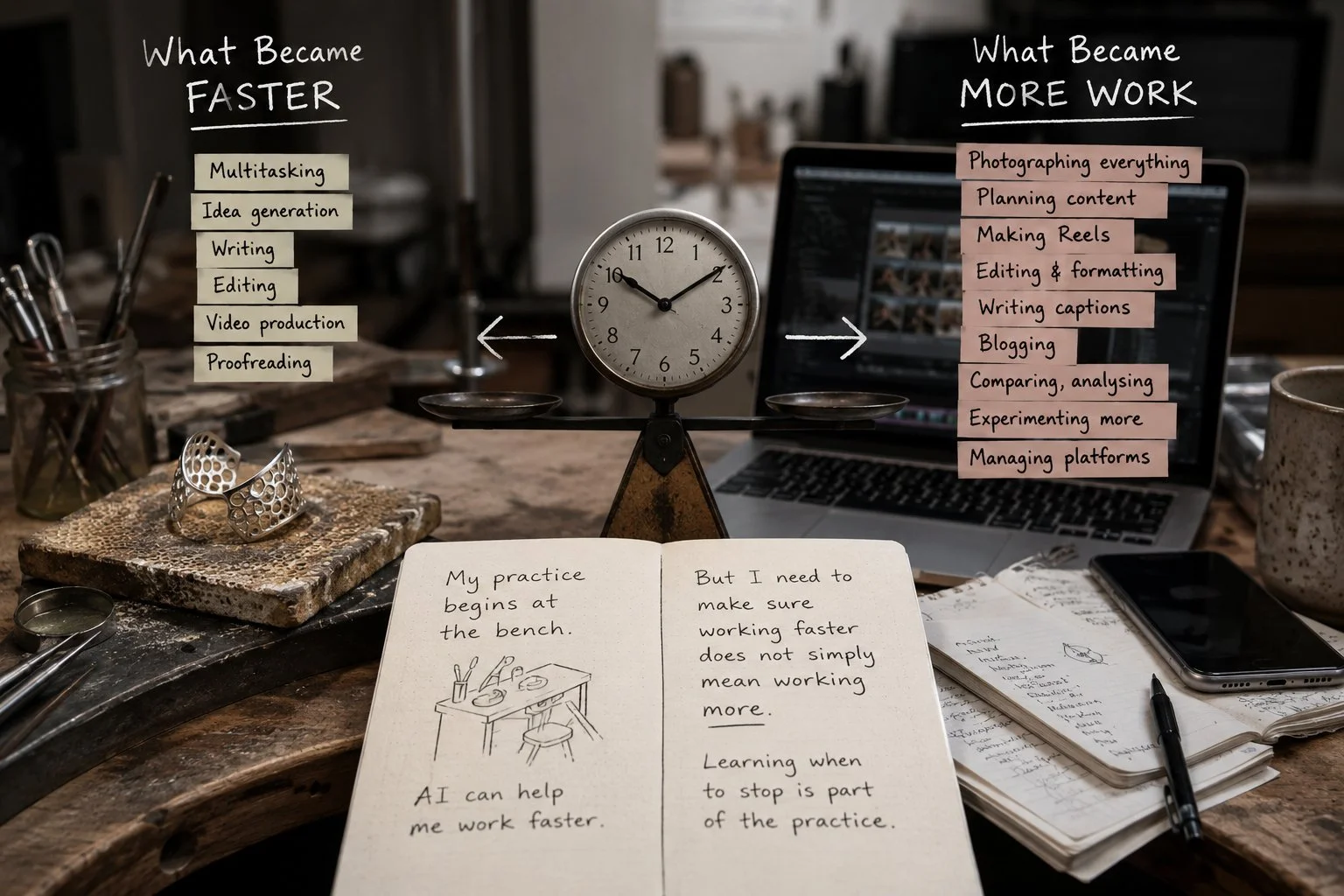
AI makes many administrative jobs faster.
But because they become faster, I can also do more of them.
I can write more blog posts.
Prepare more Instagram material.
Update more products.
Explore more exhibition possibilities.
Rewrite something five times instead of twice.
Generate another version.
And another.
This means AI can reduce workload in one moment while increasing the overall volume of work.
I have already experienced this during Hand & Algorithm.
The administrative machine becomes more efficient.
But the human still has only twenty-four hours in a day.
And eventually I still need to walk away from the computer and return to the bench.
And This Is Where I Draw the Line
AI can organise my week.
But it cannot solder for me.
It can suggest a brooch composition.
But it cannot feel when the balance of the object is wrong in my hand.
It can generate twenty variations of an idea.
But it does not know which one belongs to my practice unless I decide.
It cannot feel the resistance of mild steel.
It cannot judge a solder seam through seventeen years of accumulated making experience.
It cannot understand why I suddenly decide to remove something from a brooch after staring at it for two days.
And it cannot experience that strange moment when an object on the bench unexpectedly becomes resolved.
That remains mine.
This is why I increasingly prefer to describe AI as an admin assistant rather than a studio master.
The distinction matters.
If I allow AI to become the master, I risk reorganising my practice around what the technology can produce.
If I treat it as an assistant, the hierarchy is different.
My practice remains at the centre.
AI works around it.
Perhaps This Is the More Radical Use of AI
There is enormous attention around AI-generated images and AI-generated art.
But perhaps, for a craftsperson, one of the most meaningful uses of AI is much quieter.
Let the machine help with the paperwork.
Let it organise the information.
Let it tidy the email.
Let it make the first draft.
Let it help construct the schedule.
Let it summarise fifty pages.
Let it help prepare the promotional plan.
And then let the maker return to the material.
For me, that may ultimately be one of the most valuable outcomes of Hand & Algorithm.
I do not necessarily need AI to make the work for me.
I need it to help create more space for me to make the work myself.
The hand stays at the bench.
The algorithm can take care of some of the desk.
And perhaps that is exactly the relationship I have been looking for.