DAY 08 · SAT 31 OCT : The City and Its Uncertain Walls: Building the Impossible
DAY 08 · SAT 31 OCT - “Hand & Algorithm — A Nine-Day Online Exhibition”
Chap.6- 49| DAY 08—The City and Its Uncertain Walls: Building the Impossible
Learning 8 — The Intelligence of Materials and the Maker's Hand
Can AI be intuitive? Can it hesitate?
Yesterday, I shared how my new collection, The City and Its Uncertain Walls, emerged from Melbourne's architecture, Haruki Murakami's novel and my personal experiences of memory, migration and belonging.
Today, I would like to take you into the actual making process.
One of the most exciting parts of this project has been introducing unfamiliar materials into my jewellery practice.
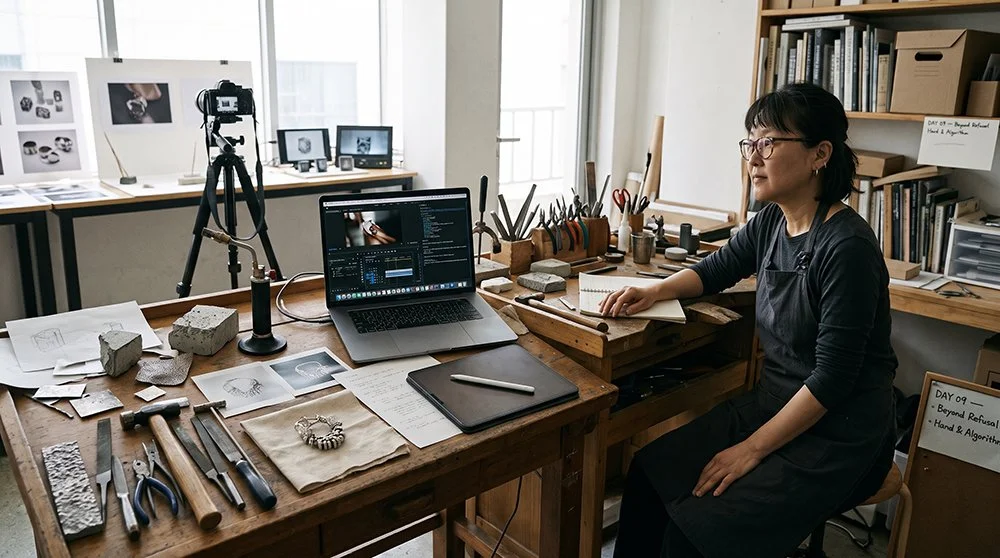
For more than seventeen years, I have developed my techniques through metalworking, particularly with perforated mild steel, silver, brass and geometric structures.
But this time, I wanted to go somewhere different.
I began experimenting with concrete, miniature porcelain bricks, acrylic, plastic pipes and repurposed mechanical components — materials that were not permitted in finished works intended for consignment at the commercial gallery that previously represented me.
I didn't know exactly how these materials would behave or how I could transform them into wearable objects.
That uncertainty was both challenging and exciting.
When Concrete Became Jewellery
Concrete was one of the most unfamiliar materials I decided to explore.
Unlike metal, which I can cut, bend, solder and adjust as I work, concrete requires a completely different approach.
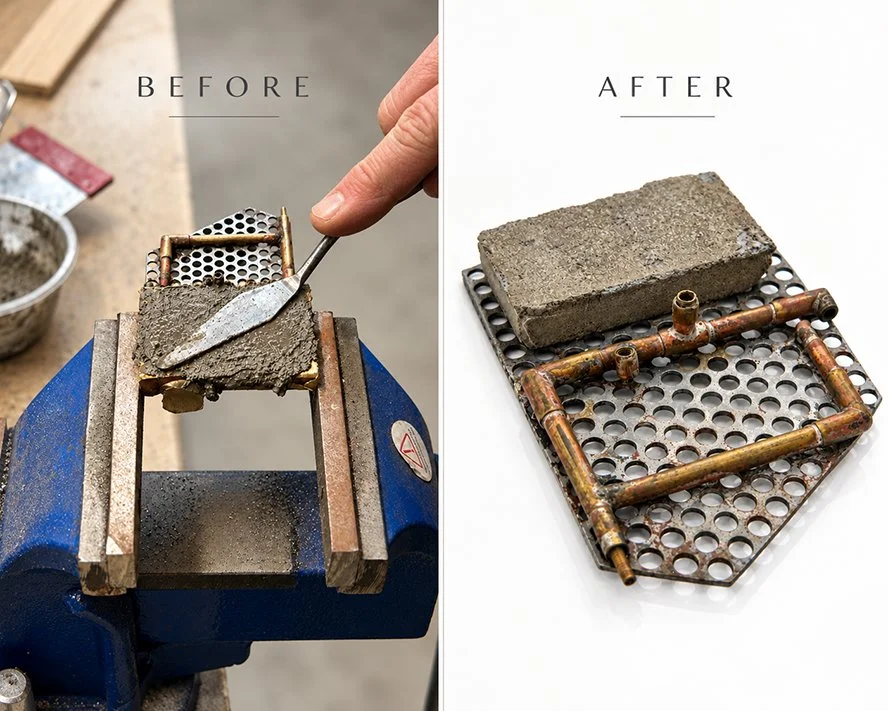
I had to design and construct moulds, prepare the mixture, position the brass components, pour the concrete and wait for it to set.
I couldn't simply solder a mistake back together.
Sometimes I had to rethink how to hold a particular element in place or how to connect it to the rest of the brooch.
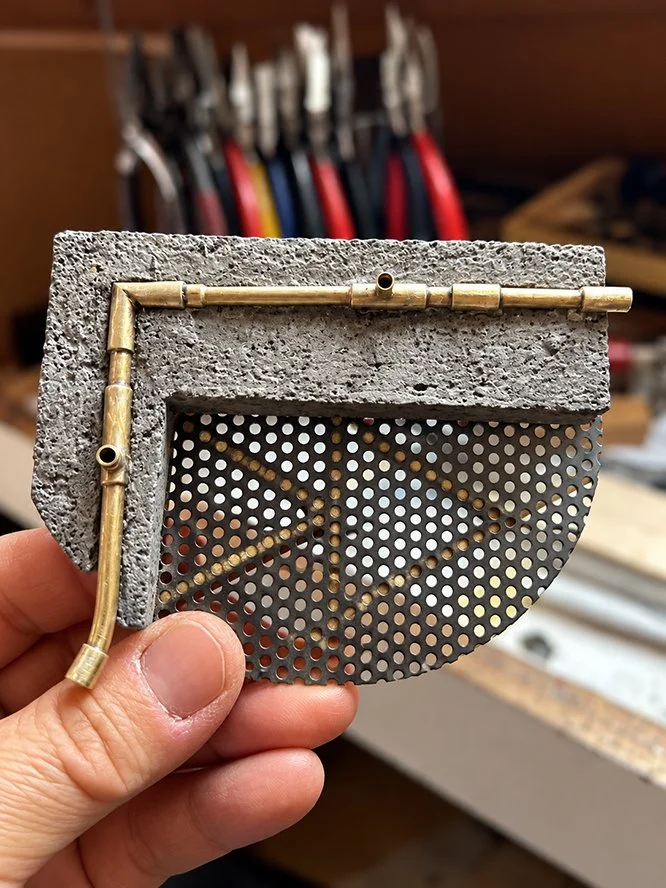
For The Wall Has No Water, I experimented with casting concrete inside a constructed frame, using balsa wood to create the necessary empty spaces. The internal pipe became an important part of the work.
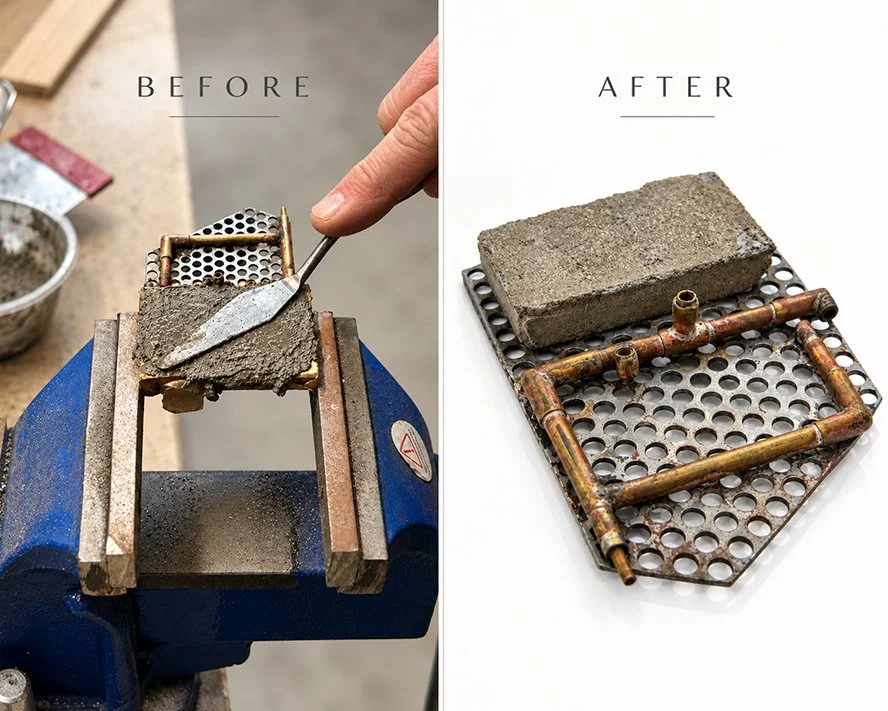
The structure appears to belong to an architectural water system, yet it is not designed to function as one.
I liked that contradiction. Combined with the concrete wall, it looks as though the entire water system has dried up.
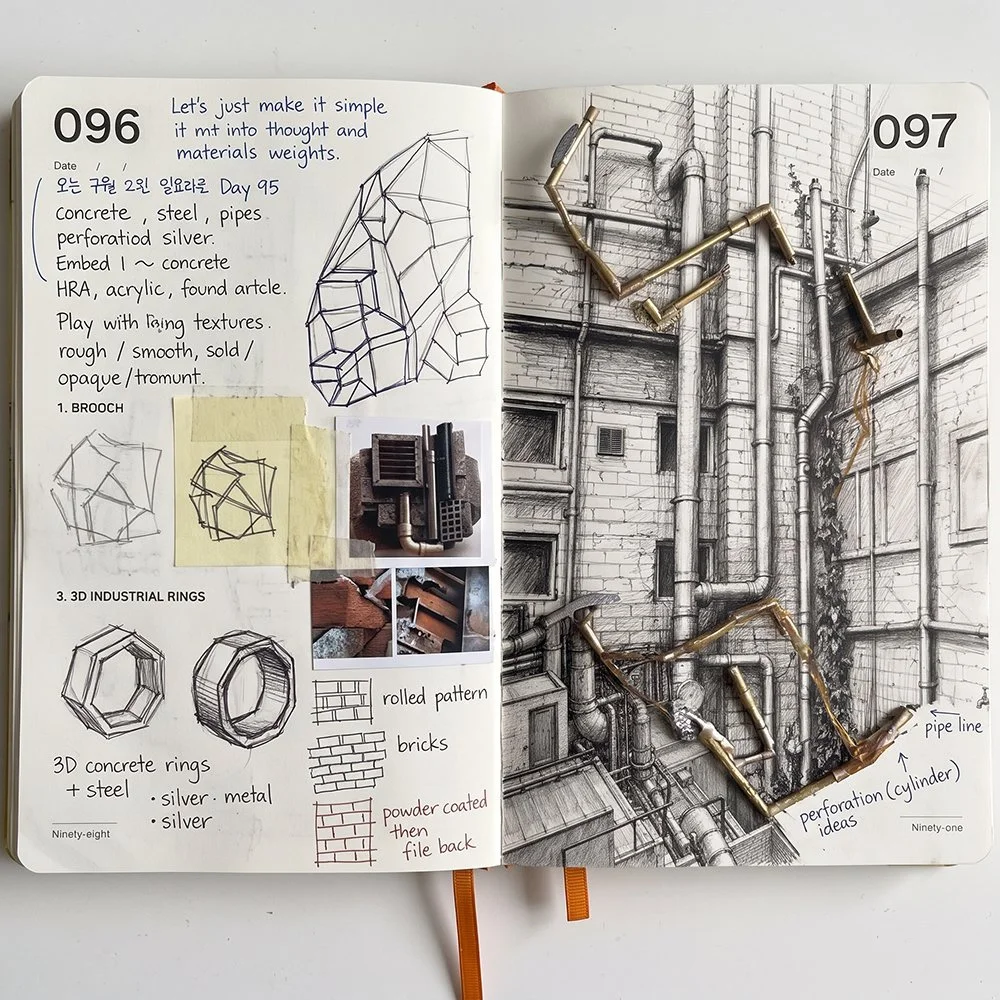
In Poetry of the Wall, I constructed brass pipe structures using three different pipe sizes that could fit into one another. By combining soldering with threaded connections made using taps and dies, I developed small components that could be changed or repositioned.
These were not simply decorative elements.
Their construction became an important part of the design.
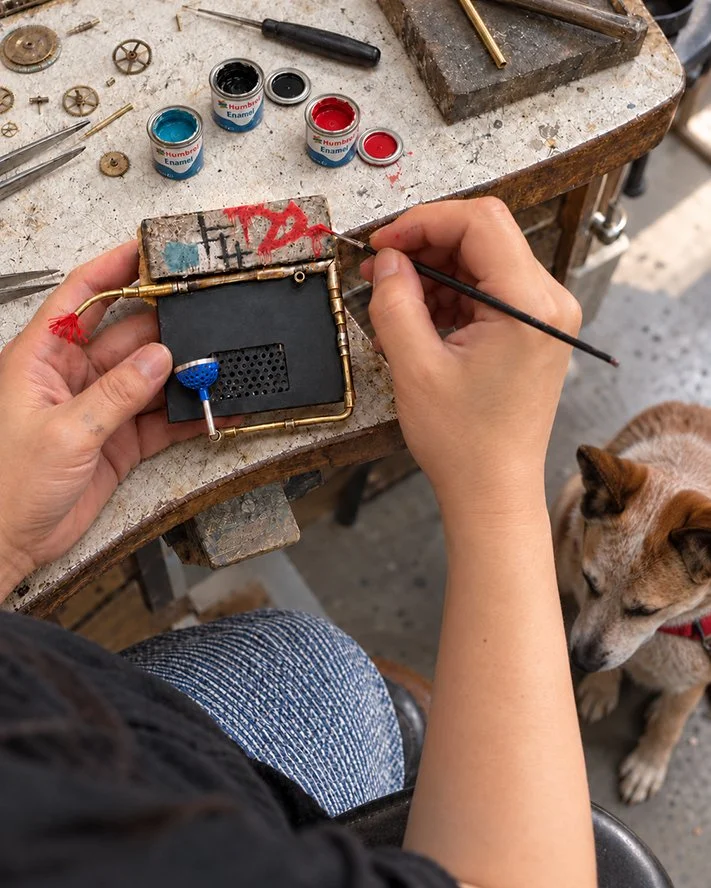
And for Graffiti Wall, I introduced enamel paint onto the concrete surface, recalling the marks and layers of expression found on the walls of Melbourne.
I began to see concrete differently.
What had seemed like a heavy and ordinary building material was becoming something intimate enough to carry on the body.
Miniature Bricks and Uncertain Foundations
Another experiment involved miniature porcelain bricks.
I have always been interested in traditional jewellery techniques, including stone setting. But rather than setting a gemstone, I wanted to hold miniature bricks within a jewellery structure.
For The Wall Remembers Every Brick , I used a four-claw setting to secure the porcelain brick structure, combining it with patinated brass pipes and other architectural elements.
This unusual combination interested me.
A setting traditionally used to secure something precious was now holding a small section of an imaginary wall.
Perhaps the bricks were precious in another way.
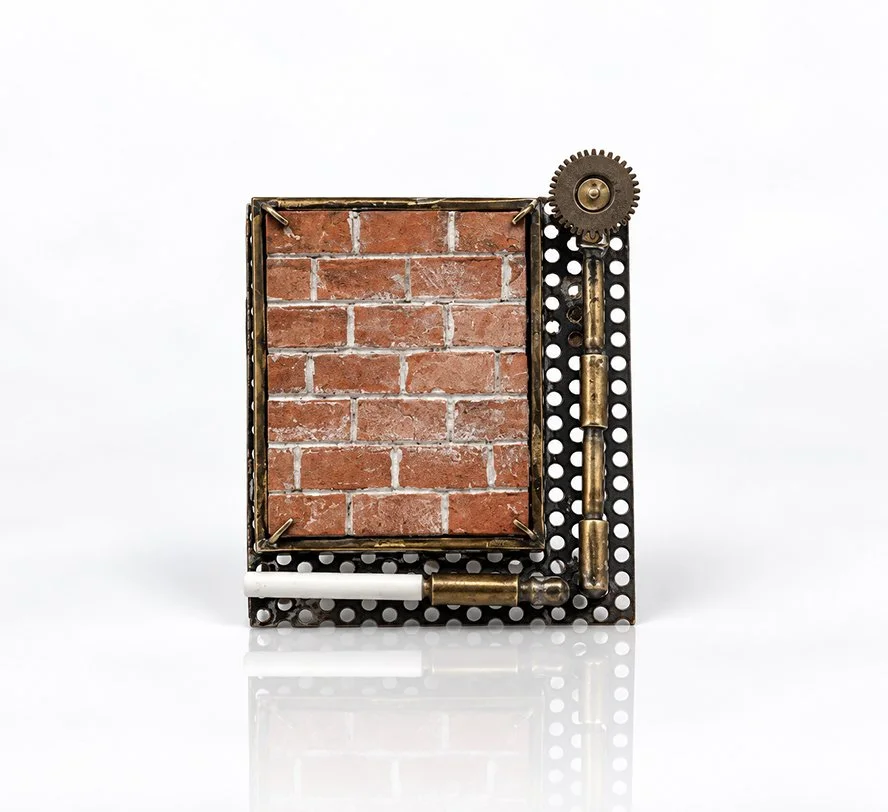
They could represent the places we leave behind, the homes we remember or the structures that appear permanent but can change around us.
It was also satisfying to bring familiar jewellery skills into an unfamiliar context.
I wasn't abandoning my knowledge as a jeweller. I was finding new ways to use it.
Windows, Transparency and What We Cannot See
Not all the pieces involved heavy architectural materials.
I also began working with acrylic.
Red Chamber
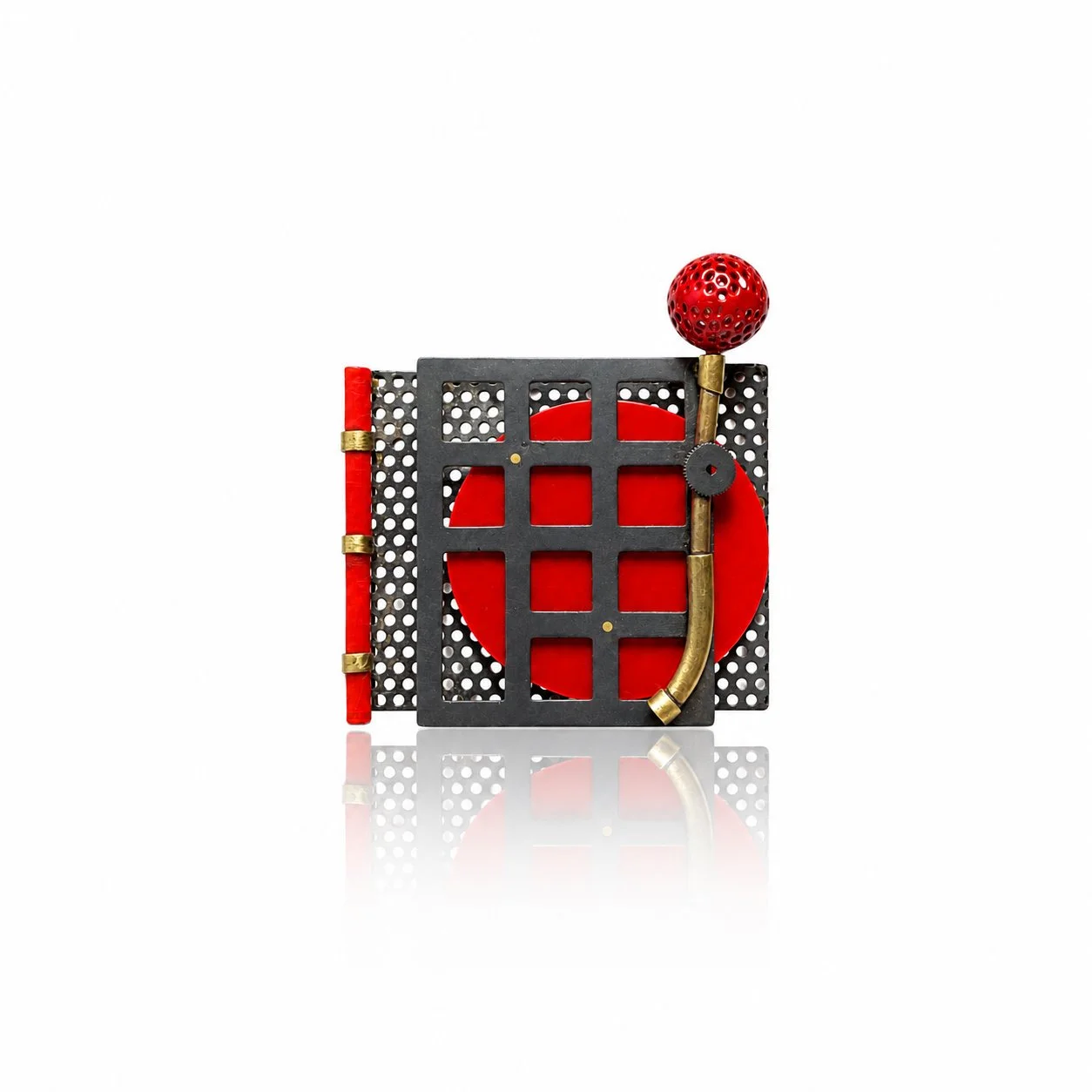
Transparent acrylic offered something that concrete and steel could not: the possibility of looking through a structure.
For Red Chamber, I was interested in how colour and transparency could transform the experience of a small space. Memories of the red interior at the National Gallery of Victoria and the experience of looking through its watery entrance windows became part of my thinking.
In Foggy City — Half Seen, I experimented with frosted acrylic to suggest a city that could not be seen completely.
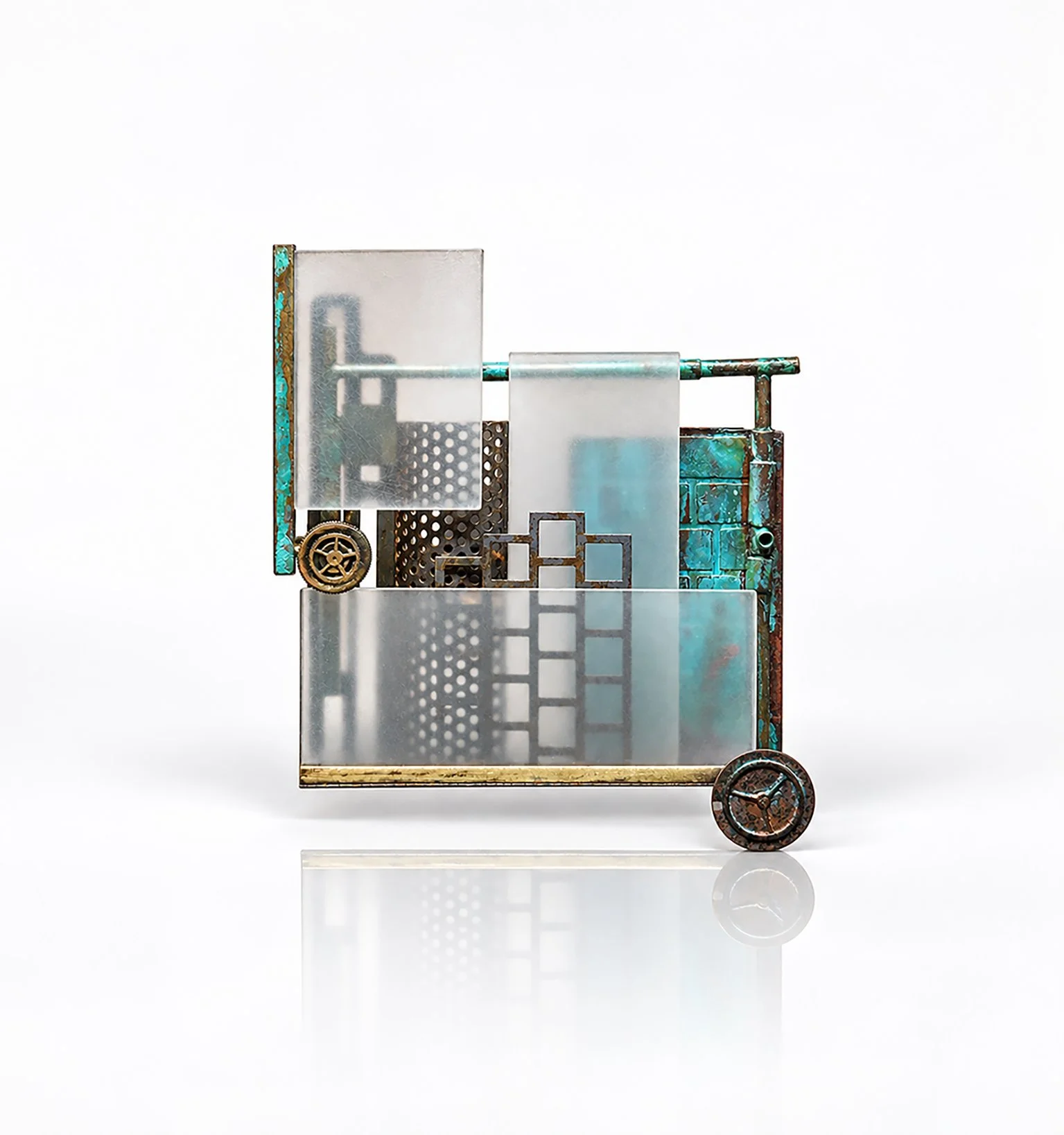
By rubbing the surface with emery paper, I could change the transparency of the material. The transparent acrylic has been frosted.
Some parts remained visible, while others became blurred.
I liked how such a simple physical action could change the meaning of the object.
It made me think about memory.
We rarely remember a place with complete accuracy. Some details remain vivid, while others gradually disappear.
Perhaps a window in my jewellery could represent that uncertain relationship between seeing and remembering.
The Architecture of Leakage — Making Without Knowing Everything
Another important work in this development is The Architecture of Leakage, a pendant made from three perforated elliptical steel cylinders connected through brass pipes and other components.
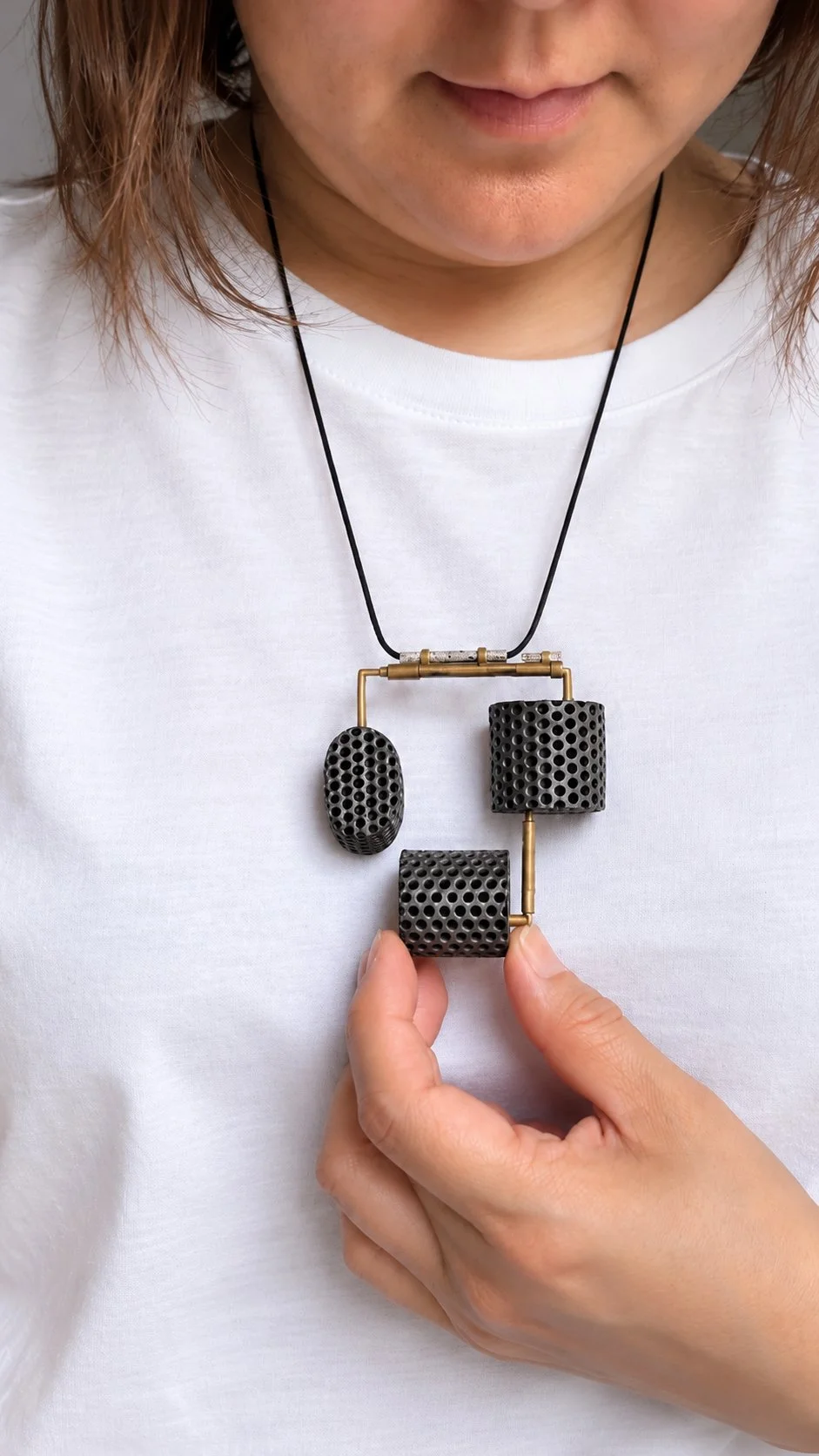
The Architecture of leakage
I began with familiar materials and construction methods, but I allowed the structure to develop through making.
The perforated vessels suggest tanks or containers, yet they cannot hold water.
The brass pipes suggest a system of circulation, but its purpose remains uncertain.
There is something slightly absurd about building an elaborate structure that cannot perform its apparent function.
But perhaps that is also what interests me.
Not everything has to behave as it appears.
The work developed through a series of decisions about proportion, balance, connection and material relationships.
At certain points, I had to stop and reconsider what I was doing.
Sometimes an unexpected arrangement was more interesting than my original idea.
And after making the pendant, AI helped me develop language around the work and find a title that expressed its contradiction.
This was another example of AI assisting my reflection rather than designing the object itself.
What Happens When AI Meets the Finished Work?
Throughout this project, I also experimented with AI-generated design variations and visual presentations.
Initially, I asked AI to interpret architectural photographs and imagine possible jewellery designs.
Some results were fascinating.
Others looked more like decorative collages than objects that could realistically be constructed.
Later, I reversed the process.
I made the jewellery first and then asked AI to generate variations based on photographs of my finished work.
It was interesting to see how quickly AI could rearrange forms, materials and structures.
But I noticed that many of the variations ignored the reasons behind particular construction decisions.
A pipe might appear to connect two components, but the joining method was unclear. A structure could look beautifully balanced in an image but be impractical when considered as a physical object.
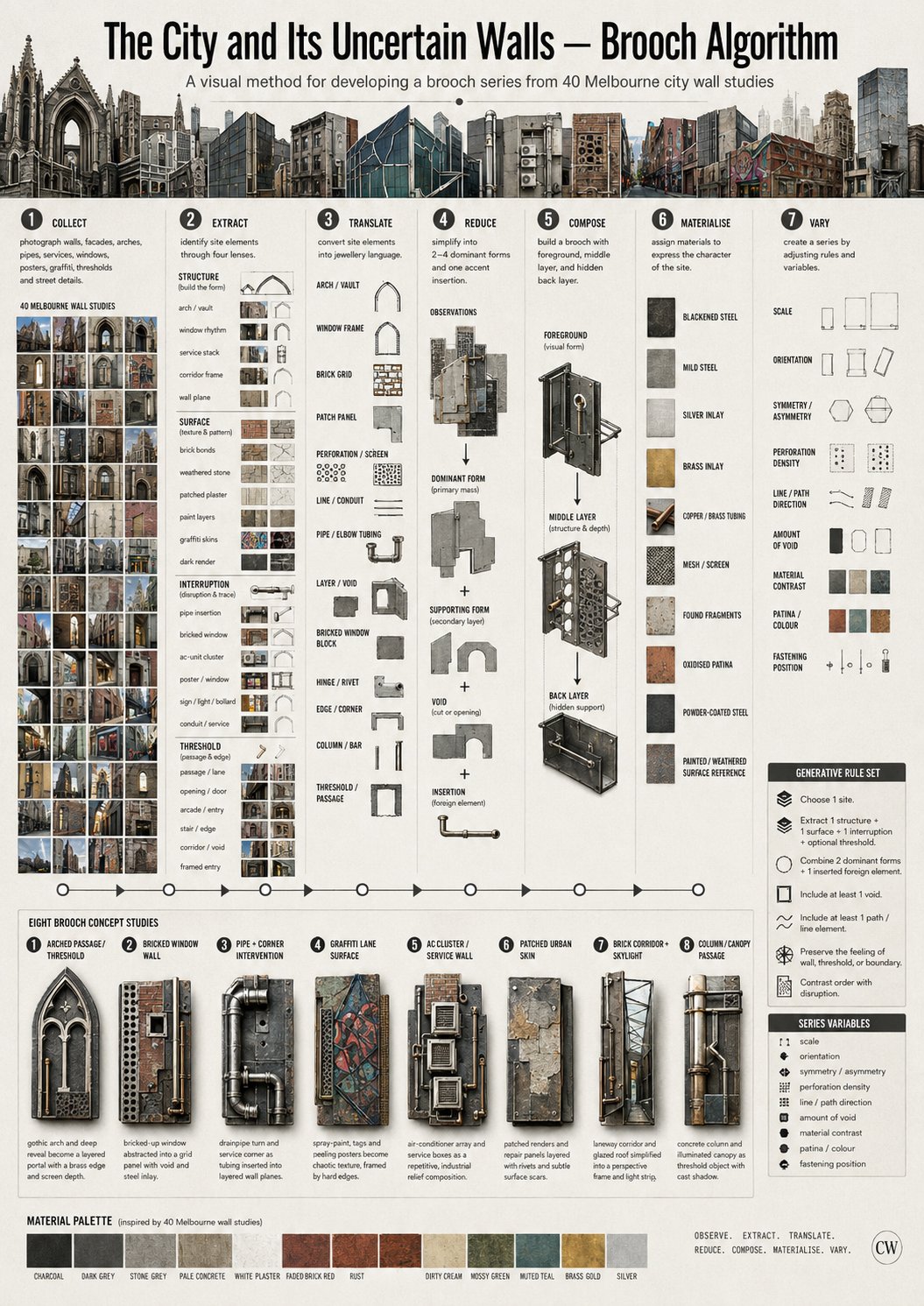
The algorithm AI found from my photos of the city
AI could suggest visual possibilities, but I had to question whether those possibilities made sense.
This helped me recognise how much knowledge I have accumulated through years of making.
Can AI Hesitate?
This question has stayed with me throughout the collection.
When I make jewellery, I often pause because something doesn't feel quite right.
A proportion might seem awkward. A component may feel too heavy. A connection may not behave as expected.
Sometimes I change my mind halfway through making.
I might remove something, reposition it or even leave an unexpected imperfection because it makes the work more interesting.
These decisions are not always easy to explain.
They come from experience, physical observation and intuition.
AI can produce many alternatives almost instantly. But the speed of generating possibilities is different from understanding why one particular decision matters to me.
I don't know whether AI can truly hesitate in the way a maker does.
And perhaps I don't need it to.
Finding a New Direction Through Making
Looking at this collection now, I realise that introducing new materials has given me more than new technical challenges.
It has also changed how I think about jewellery.
Concrete, bricks, pipes and acrylic are ordinary materials in our built environment. But when they become small wearable objects, their familiar meanings begin to shift.
A wall can become a brooch. A water system can become a pendant. A window can become a memory.
And the body becomes another place where these stories can exist.
This collection has also encouraged me to think beyond jewellery as an object alone.
I have begun imagining how these works could develop through photography, moving images, storytelling and perhaps video art.
AI may become useful in exploring those possibilities, but the physical works and the experiences behind them remain the starting point.
Through Hand & Algorithm, I have discovered that new technology can help me reflect on my practice and imagine unfamiliar directions.
But it has also reminded me how much I value the intelligence of materials, the patience of making and the freedom to change my mind.
AI can generate possibilities, but my hands discover what those possibilities can become.
And perhaps that uncertainty is exactly what keeps me making.
Related Reading — From My Studio Journal
Explore the original chapters behind Day 08, documenting my experiments with concrete, porcelain bricks, acrylic, perforated steel and brass pipes, alongside my ongoing questions about AI, intuition and the intelligence of the maker's hand.
Chap. 5–36 — Can AI Be Intuitive — or Does It Simply Generate?
An experiment comparing AI-generated design suggestions with my completed handmade brooch. Can AI understand the material knowledge and intuition behind making?
Chap. 5–37 — Finding Freedom in New Materials: The First Two Brooches
The beginning of my experiments with unfamiliar materials and the creative freedom of moving beyond conventional commercial jewellery expectations.
Chap. 5–38 — The Architecture of Leakage
How three perforated steel cylinders, threaded brass pipes and intuitive construction developed into a pendant representing imaginary water tanks that cannot hold water.
Chap. 5–39 — Concrete and Red Bricks: The Foundation Has Moved
Experimenting with miniature porcelain bricks, concrete, claw settings and repurposed components to explore shifting foundations, memory and belonging.
Chap. 5–40 — Concrete Walls: From Industrial Structures to Poetry and Graffiti
The making processes behind The Wall Has No Water, Poetry of the Wall and Graffiti Wall, including concrete casting, brass pipe construction and enamel painting.
Chap. 5–41 — Through the Windows: Red Chamber and City Half Seen
Exploring transparent and frosted acrylic as a way of expressing windows, memory and the uncertain relationship between what we see and what remains hidden.
These chapters are part of my eight-month Hand & Algorithm studio journal, documenting the experiments, discoveries and decisions behind my new body of contemporary jewellery.
Jin Ah Jo
Hand & Algorithm — Radiant Pavilion 2026
Inspired by the novel THE CITY AND ITS UNCERTAIN WALLS by Haruki Murakami. This is an independent artistic interpretation and is not endorsed by the author.