DAY 09 · SUN 30 OCT : Beyond Refusal: The Future Is Upon Us
DAY 09 · SUN 30 OCT - “Hand & Algorithm — A Nine-Day Online Exhibition”
Chap.6- 50| DAY 09—Beyond Refusal: The Future Is Upon Us
Learning 9 — Curiosity, Authenticity and the Freedom to Create
After eight months of learning AI, what will I keep? And where will I go next?
Today is the final day of Hand & Algorithm, my nine-day online exhibition for Radiant Pavilion 2026.
Over the past eight months, I have written more than forty blog posts, explored different AI tools, organised seventeen years of my jewellery archive, analysed my business, experimented with images and videos, and developed a new body of contemporary jewellery.
And I am exhausted! Really exhausted!!
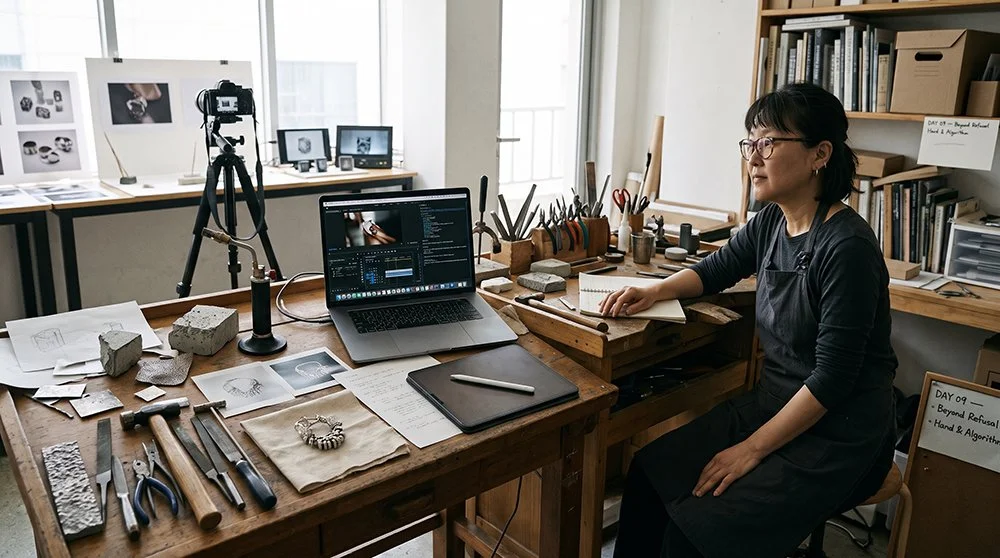
I have been working at my jeweller's bench while simultaneously learning AI, writing, researching, editing photographs, generating videos, updating websites and preparing exhibitions.
Sometimes I wondered whether AI was actually saving me time or creating even more work.
The answer is probably both.
But I have enjoyed the journey enormously. Every new discovery has made me curious about what might come next. Whenever I learned to use a new tool, I became excited about imagining how I could apply it to my own practice.
What AI Can Do — And What It Cannot
There is no doubt that AI has been useful as my studio assistant.
It has helped me with administrative tasks, communication, research, organising information, analysing data and preparing visual presentations.
For an independent artist managing almost every aspect of a professional practice, these capabilities are valuable.
But using AI for office work and using it for art are two very different things.
Writing a better email is relatively straightforward. Creating something meaningful with AI is much more complicated.
AI can generate images that look convincing but misrepresent my jewellery. It can suggest structures that are physically impossible. It can produce impressive videos that have little connection to my actual making process.
Sometimes it gets things completely wrong.
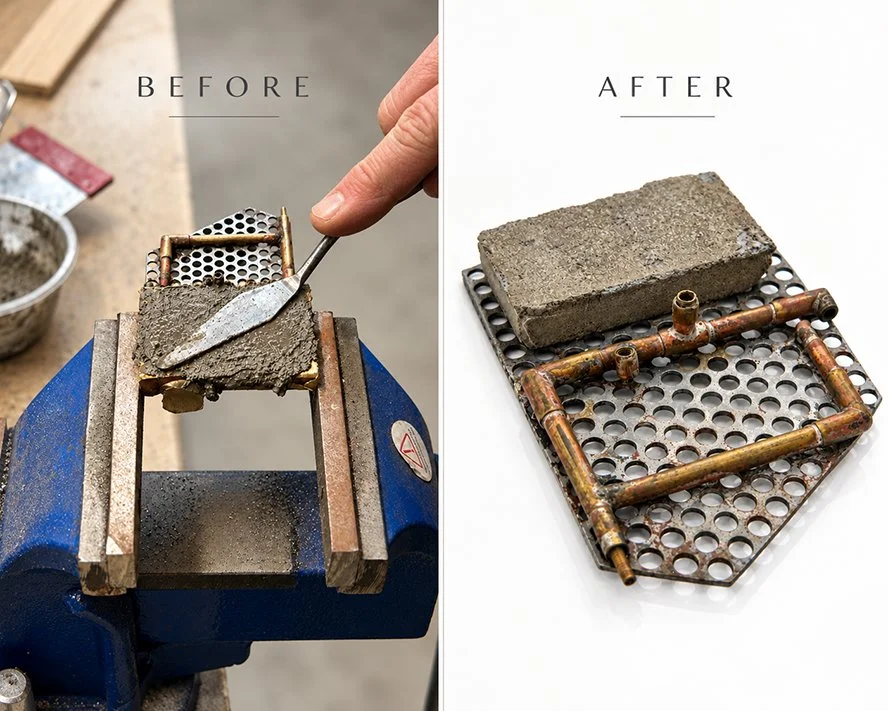
It does not experience the weight of concrete, the resistance of steel, the difficulty of soldering or joining materials, or the uncertainty I feel when making a decision at the bench.
And while AI can help me research and explore possibilities, its answers still need questioning and verification.
Sometimes I felt completely overwhelmed by the sheer volume of information AI could generate. Words, sentences and paragraphs kept coming, often faster than I could read, question or absorb them. I even had nightmares about falling behind, surrounded by so much information that I couldn't make sense of any of it.
I began to realise that having access to more information doesn't necessarily mean gaining more knowledge or understanding.
I have learned that being able to generate something quickly is not the same as creating something meaningful.
This journey has been a strange mixture of frustration, occasional resentment and enormous joy.
The creative challenge is not simply what AI can do, but what I can do with AI.
Why Are We So Afraid?
One of the most interesting, and sometimes disappointing, parts of this project has been observing how people respond to AI.
I have encountered reactions such as, "I don't like AI," or simply, "No."
I understand that there are genuine concerns surrounding copyright, artists' livelihoods, environmental costs, misinformation and the use of creative work in AI training.
These questions deserve serious discussion, and I share some of those concerns.
But I am curious about what happens when refusal comes before understanding.
What exactly are we afraid of?
Is it the technology itself? The possibility of losing our skills, livelihoods or originality? Or perhaps the uncertainty of how our established ways of working might change?
I don't pretend to have all the answers.
But I find it difficult to believe that refusing to learn will give us a better understanding of what is happening.
The future is already upon us.
Rather than allowing fear alone to shape my position, I want to investigate, experiment, criticise and decide for myself.
That was my starting point eight months ago, and it remains my position today.
Who Decides What Is Valuable Art?
This journey has also made me question something beyond AI.
How do artists become visible? Who decides which artists are worth supporting, exhibiting or collecting?
Contemporary jewellery has a passionate and knowledgeable community, but like many specialised art fields, it can also feel difficult to enter or move within established networks.
Sometimes recognition seems closely connected to particular galleries, institutions, relationships and professional circles.
I have spent many years building my practice within this world, and I value the people, galleries and organisations that have supported me.
But I no longer want my artistic future to depend entirely on being accepted or recognised by a particular group.
The wider possibilities of digital technology interest me partly because they may allow independent artists to find audiences, build connections and share their work beyond traditional gatekeepers.
AI alone will not make the art world more democratic. Technology has its own inequalities, limitations and concentrations of power.
But perhaps it can offer additional ways to research opportunities, communicate ideas, develop projects and reach people who might never otherwise encounter my work.
I don't want to challenge existing structures simply to reject them.
I want to discover what becomes possible when I no longer allow those structures to define the limits of my ambition.
And if the knowledge I gain can help other independent artists find opportunities, that would make this journey even more meaningful.
Beyond Administration — Towards New Artistic Possibilities
I don't intend to spend the next few years being satisfied with AI simply helping me write emails, improve photographs or produce amusing videos.
Those things have been useful, and sometimes great fun, but they are only the beginning.
I am becoming increasingly interested in moving images, video art and storytelling.
Through The City and Its Uncertain Walls, I have begun exploring architecture, memory, migration and identity through physical jewellery objects.
What if those objects could become part of a larger visual world?
What if I could use my existing archive, material knowledge, photographs, research and imagination to create stories that move beyond the physical limitations of jewellery?
I want to investigate these possibilities more deeply.
I want to learn more AI tools, undertake deeper research, experiment with video and discover different ways to present my work.
I also want to continue making jewellery with my hands.
For me, these two directions do not need to compete.
They might extend one another.
Authenticity Is Not the Absence of Technology
Throughout this exhibition, I have repeatedly returned to the question of authenticity.
What makes an artwork genuine? Is authenticity determined by the materials, the process, the artist's intention or the origins of an idea?
I don't think authenticity automatically disappears when AI becomes involved.
But neither does using AI automatically make something original or meaningful.
For me, authenticity comes from the connections between my lived experiences, artistic intentions, material knowledge, handmade objects and the decisions I take responsibility for.
It also requires honesty about what I have physically made and what technology has helped me produce.
My work should remain recognisably mine, even as the tools and methods evolve.
Perhaps authenticity is not a fixed boundary that technology must never cross.
Perhaps it is something I continue to establish through the choices I make and the relationships I build between different ways of creating.
What Comes Next?
I still have many questions.
How can I develop my artistic practice in ways I haven't yet imagined?
How can I publish and share my work more widely, find new audiences and opportunities, and create meaningful connections beyond my existing community?
And how can the knowledge and opportunities I discover benefit other artists who may not have access to established networks?
I want to continue exploring contemporary jewellery, new materials, AI-assisted research, digital storytelling and possibly video art.
I want to be more independent, more ambitious and more open to unexpected directions.
I also know that I will make mistakes, waste time, question results and sometimes become frustrated.
That is part of learning.
Eight months ago, I decided not to reject something simply because I didn't understand it.
Today, I am even more convinced of the value of that decision.
Hand & Algorithm is ending its nine-day exhibition.
But I have no intention of stopping.
The future is upon us.
And I want to be part of creating it.
Jin Ah Jo
Hand & Algorithm — Radiant Pavilion 2026