DAY 03: What the Numbers Revealed — And What They Couldn't
DAY 03 · MON 26 OCT - “Hand & Algorithm — A Nine-Day Online Exhibition”
Chap.6- 44 | DAY 03— What the Numbers Revealed — And What They Couldn't
Learning 2: Numbers can reveal patterns, but they cannot predict creativity. Curiosity keeps me moving forward.
When I began working with AI as my studio assistant, I was curious about what it could teach me about the business side of my jewellery practice. After seventeen years of making, selling and exhibiting, I had accumulated an enormous amount of experience, but I had rarely stopped to examine the business as a whole.
Earlier this year, I lost one of my longest-standing gallery stockists, e.g.etal, after seventeen years of working together. It was disappointing, but it also forced me to reconsider how I had managed my practice and how much I had depended on an established gallery relationship.
One unexpected discovery came from something I had almost forgotten about: seventeen years of sales invoices.
With the help of ChatGPT, Claude and Google Gemini, I transformed these records into detailed sales reports, graphs and business analyses. Information that had remained buried in years of paperwork suddenly became visible.
The results were fascinating.
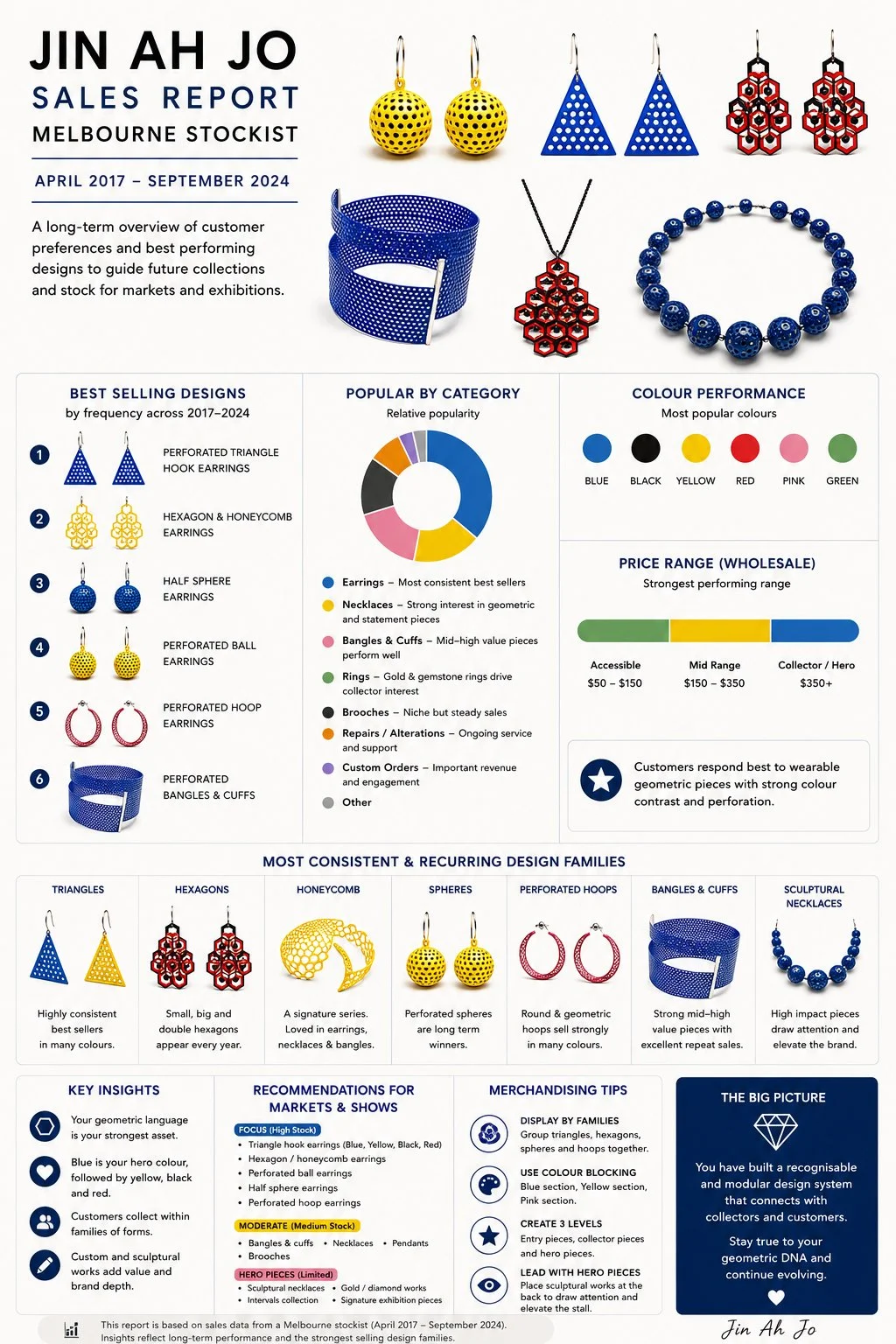
Sales report for 17 years of practice
My affordable, wearable earrings had consistently performed well. (The price between AUD 100~ AUD 200) Blue and black were among my most successful colours. Certain familiar shapes appeared repeatedly in the sales history. So far I didn’t even realise the blue perforated triangle earrings are champion. AI also identified potential for newer collections, including my silver inlay work, gold and blackened steel combinations, and rings.
ChatGPT produced a twelve-part business report, while Claude offered visual comparisons and price analysis. Gemini explored opportunities for developing new collections and communicating my work through storytelling.
For someone who had spent most of her professional life concentrating on making jewellery, this was an extraordinary experience. I felt as though I had suddenly gained access to several business consultants.
But the most important discovery was not what the AI reports recommended.
It was how I responded to them.
The Problem with Making More
According to the sales patterns, the logical business strategy was relatively simple: continue producing the most successful earrings, repeat popular colours, concentrate on affordable pieces and increase production. From a commercial perspective, this made perfect sense.
But I began to ask myself whether this was really what I wanted to do for another seventeen years.
Jewellery making is physically demanding. Cutting, forming, soldering, sanding, polishing and assembling require concentration, time and the continuous use of my hands. Repetition is part of developing technical skill, but endlessly reproducing familiar designs can become exhausting.
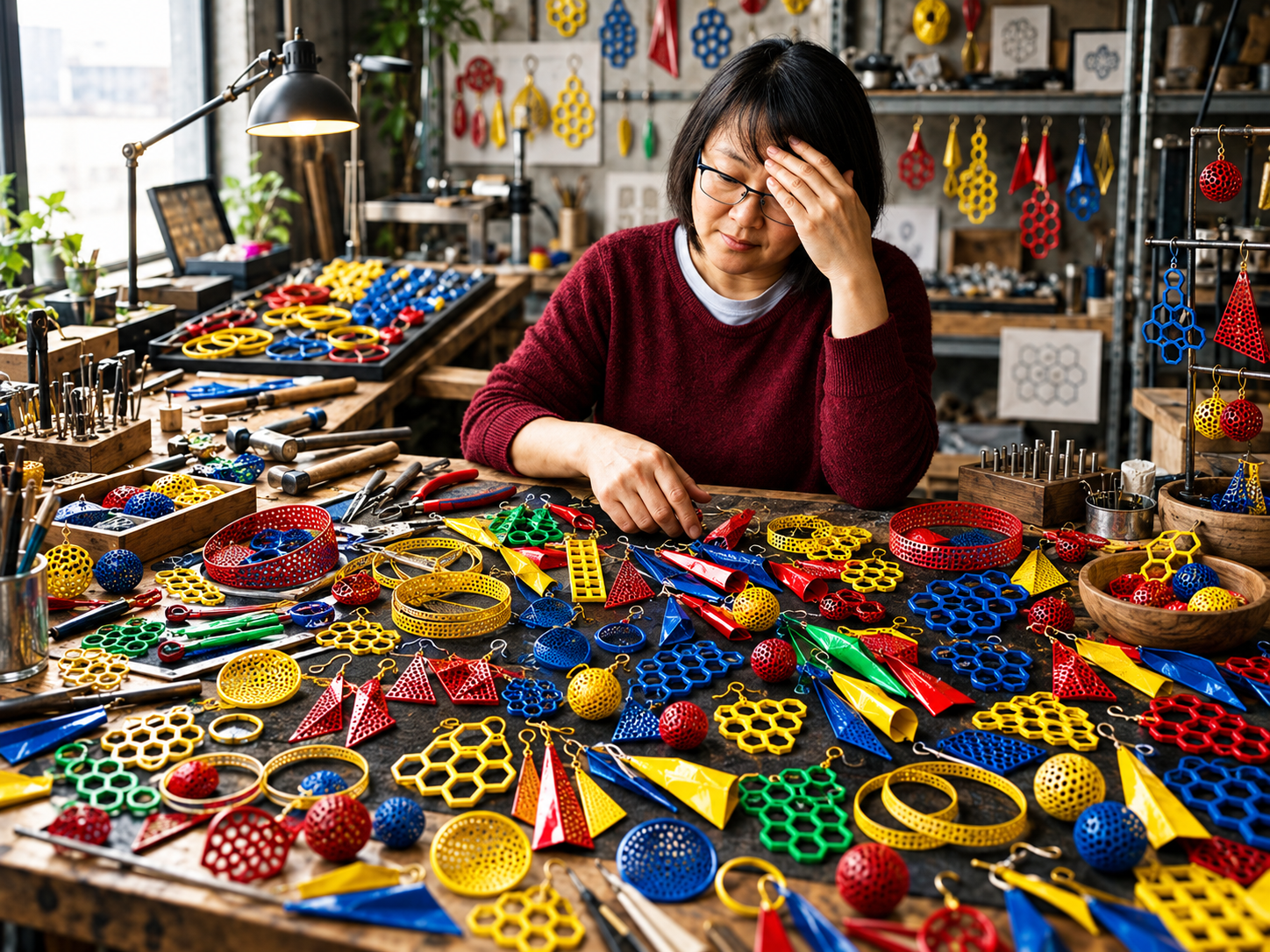
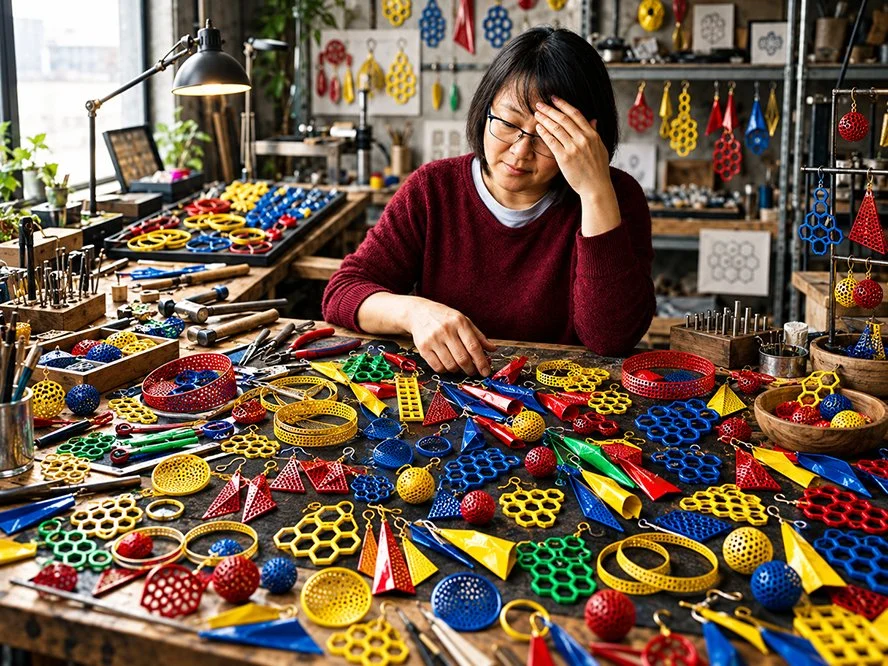
Imaginary bench with all the production for 17 years! Otherworldly!
I am grateful for every piece of jewellery that has sold. Those pieces supported my practice, developed my skills and connected my work with the people who wear it.
However, I have never wanted to be only a manufacturer of jewellery.
I am an artist, a maker and someone who remains curious about materials, techniques and unfamiliar forms.
I could say that this is my first step towards becoming someone who exists between boundaries — a 경계인 (a person who moves between different worlds). I see myself as a liminal artist, standing between the handmade and the algorithmic, exploring what lies beyond both.
I want to look beyond the numbers, the data and the algorithms. More than anything, I want to discover who I really am as an artist.I began to realise that commercial sustainability and artistic sustainability are not necessarily the same thing.
A design can be commercially successful while the process of repeatedly producing it becomes physically and creatively unsustainable.
And a difficult experimental piece that never sells might lead to an important discovery that changes the direction of an entire body of work
Sales records cannot measure these kinds of achievements.
What AI Could Not Measure
AI was excellent at identifying patterns in my sales history. It could compare product categories, suggest price structures, recognise popular colours and organise large amounts of information.
But it could not measure the satisfaction I feel when two difficult materials finally come together.
It could not understand why I might spend hours experimenting with an unfamiliar technique, even when I have no idea whether the finished object will be successful.
It could not measure the emotional importance of a piece, the knowledge gained through failure, or the excitement of discovering something unexpected at the bench.
These are fundamental parts of my artistic practice.
Choosing a Different Direction
This discovery arrived at an important moment.
Rather than immediately developing another commercially successful collection, I decided to begin a new body of work: *The City and Its Uncertain Walls – Brooches*.
Inspired by Haruki Murakami's novel of the same title and the architecture of Melbourne, I began experimenting with industrial structures, concrete, miniature porcelain bricks, perforated steel, brass pipes and found components.
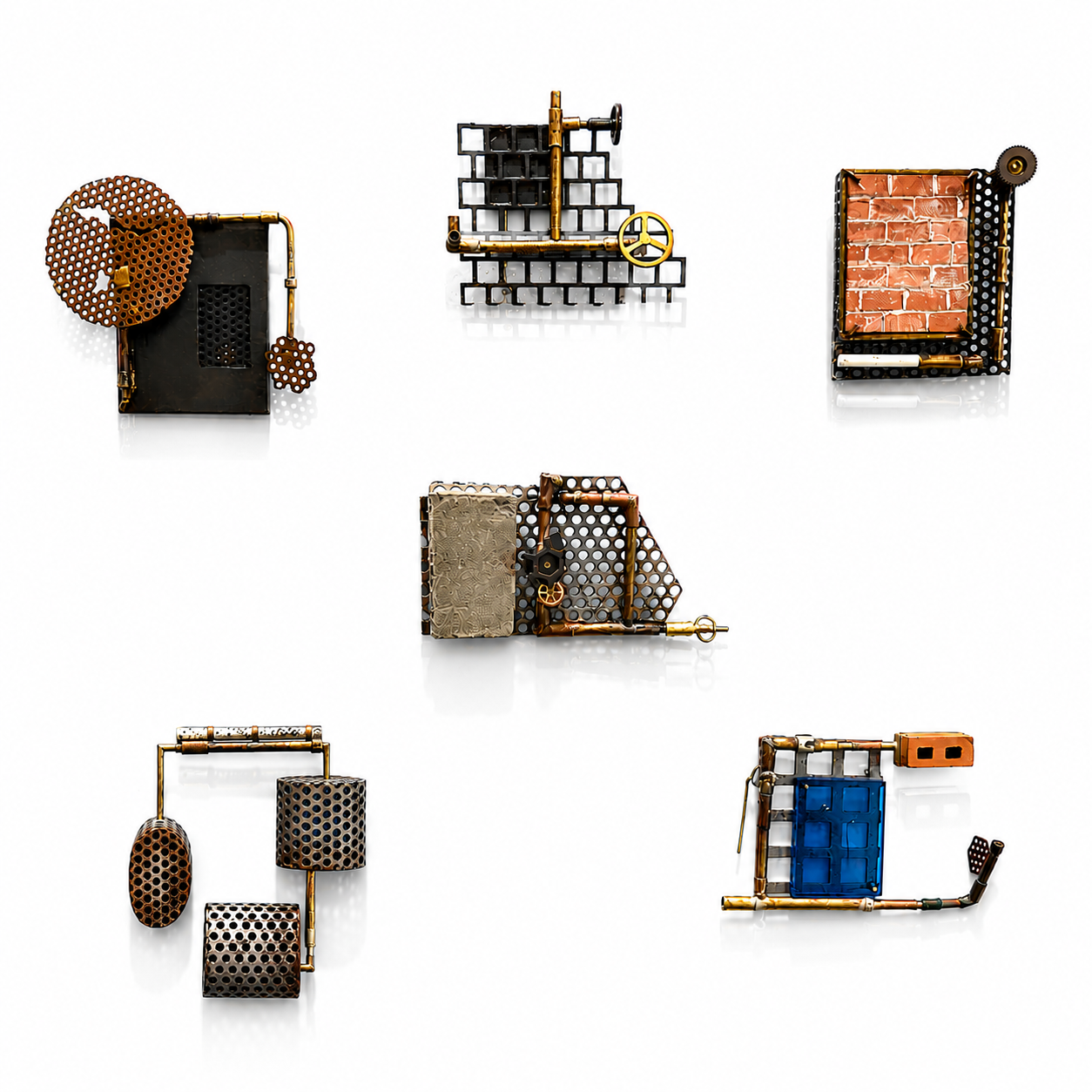
Work in progress
Unlike the familiar earrings I could produce with confidence, these brooches required new solutions.
How could I securely connect concrete to metal? How could I set miniature bricks without breaking them? How could I transform something as heavy and architectural as a wall into an object that could be worn on the body?
There were no sales figures to predict whether these experiments would succeed.
I had to rely on my material knowledge, curiosity and willingness to fail.
AI remained part of the process. It helped me explore ideas, question compositions and reflect on the relationship between architecture, memory and identity. But the decisions at the workbench were still mine.
As the collection developed, the questions became less about what the objects should look like and more about what they might communicate. A disconnected pipe, a blocked opening or a damaged wall could suggest uncertainty, displacement or a memory of something that had disappeared.
Through this work, I began exploring a different kind of value—one that could not be expressed in a sales report.
Redefining Success
My sales analysis also encouraged me to reconsider how I communicate my work.
For many years, I relied on galleries to present and sell my jewellery. Now I want to build a stronger independent voice, share the knowledge behind my practice and reach collectors, curators and audiences beyond Australia.
I want people to see not only the finished jewellery, but also the thinking, experimentation, technical intelligence and accumulated experience that make each piece possible.
This does not mean I intend to stop making affordable jewellery or ignore commercial opportunities. Selling remains important. I am preparing for The Big Design Market, developing new rings and continuing to work with familiar designs. But I want sales to support my artistic development, rather than determine its direction.
Perhaps success can also mean having enough time to experiment, protecting my physical wellbeing, finding an unexpected artistic connection, or making a piece that challenges everything I thought I already knew.
What I Learned
This experience changed my understanding of AI as a studio assistant.
At first, I was impressed by its ability to analyse years of financial records and produce sophisticated business recommendations.
But its greater value was helping me recognise the questions hidden behind those numbers.
What kind of practice do I want to sustain? What do I want to keep making? What am I ready to leave behind? And how can seventeen years of accumulated knowledge become the foundation for something new?
Data is valuable. It reveals patterns, documents history and helps us make informed choices. But an artist's future cannot be determined entirely by what people have purchased in the past.
The numbers told me what had been successful.
They could not tell me what I still needed to explore.
And perhaps that is where the artist must make the most important decision.
Chapter 2–14 — The beginning of your business and sales analysis.