Chap. 2-15: What My Sales Data Revealed About My Work
What My Sales Data Revealed About My Work
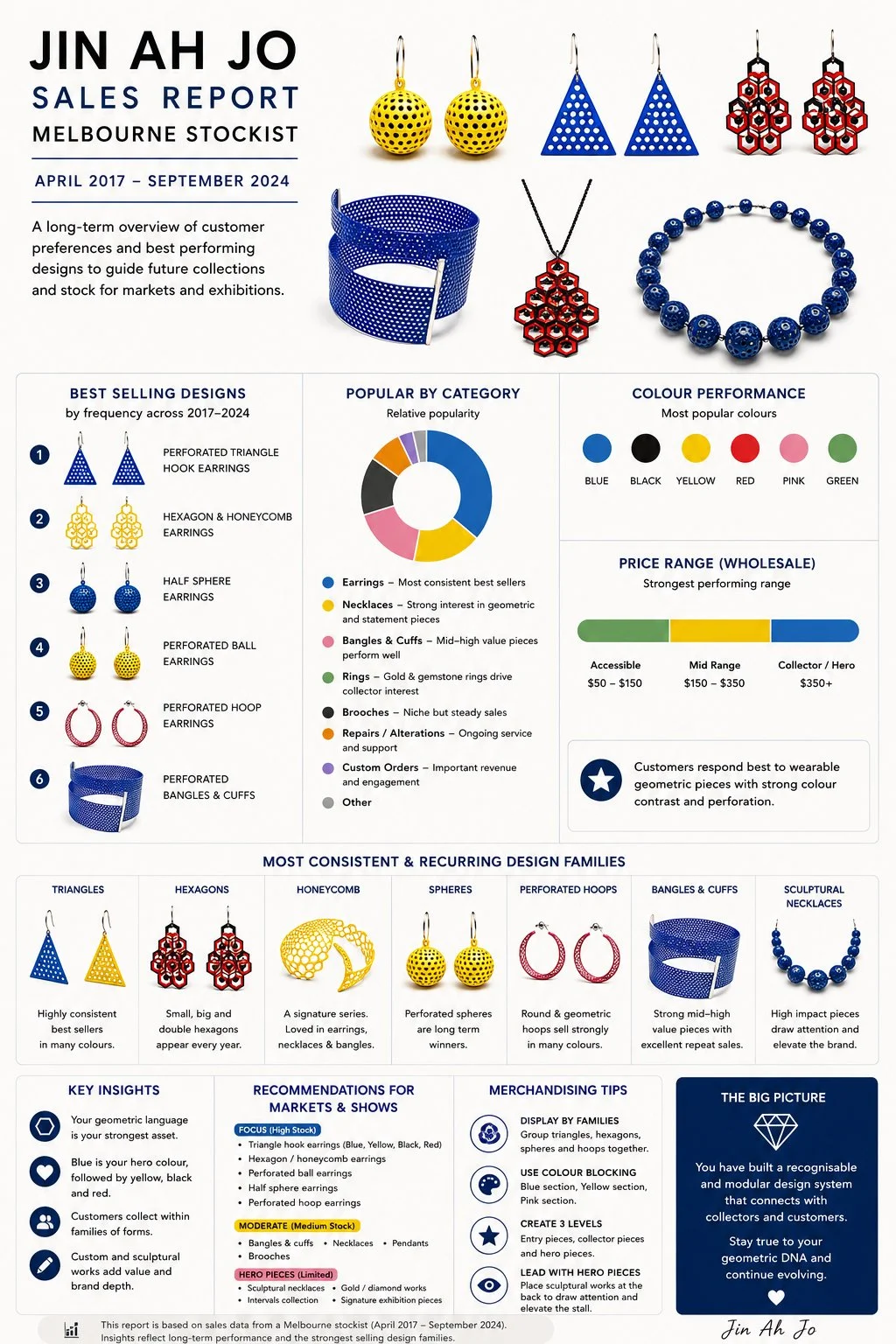
When I first examined seventeen years of sales records, I expected the numbers to tell me what I should make next.
In one sense, they did. The data showed clear patterns. Wearable, affordable earrings sold consistently. Certain forms and colours—particularly my blue and black pieces—returned again and again among the strongest sellers. These works helped me build a sustainable practice and a recognisable visual language.
The simplest business conclusion would be obvious: make more of what sold.
Produce more earrings. Repeat the popular colours. Increase the quantity. Sell more.
But that is not the future I want.
The danger of “make more to sell more”
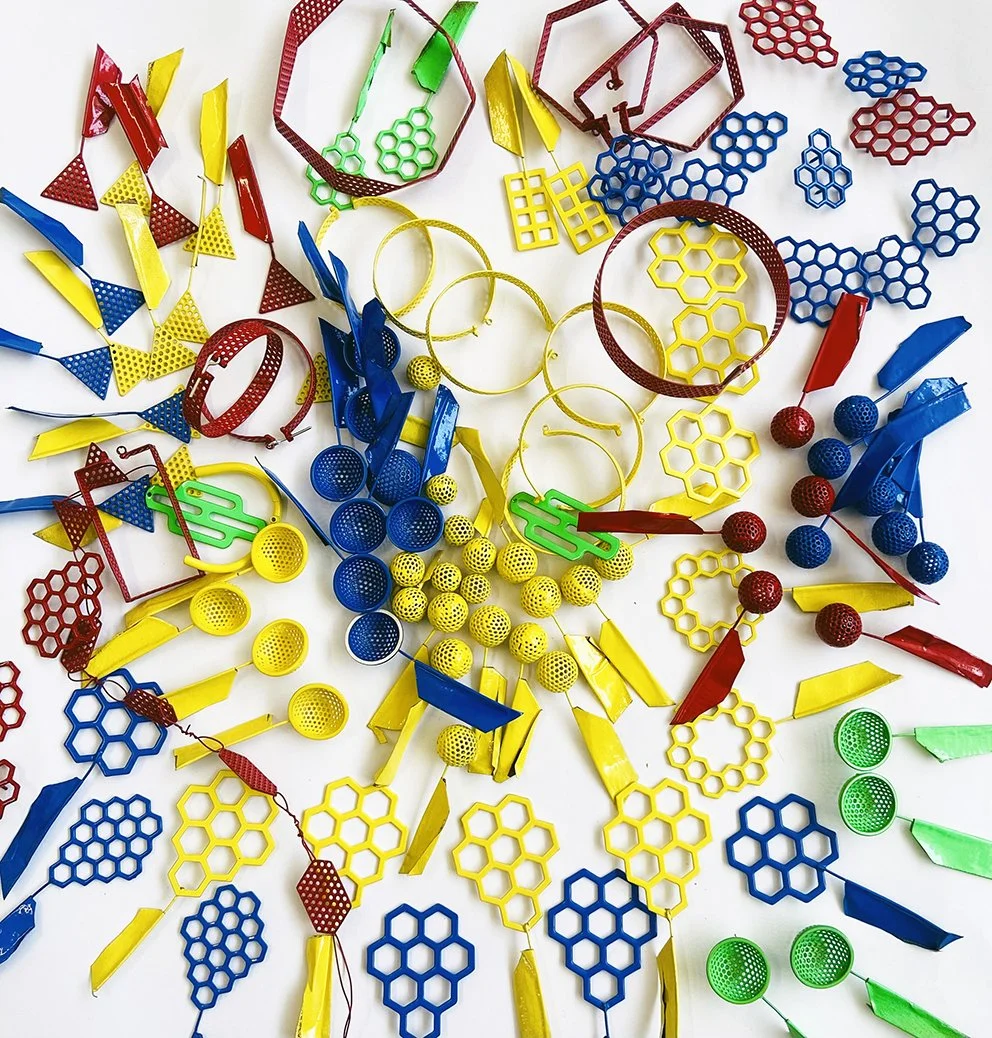
I am grateful for every piece of jewellery that sold. None of these works was meaningless or unimportant. Together, they supported seventeen years of my practice. They developed my technical knowledge, strengthened my relationship with materials and allowed my work to enter people’s everyday lives.
However, my sales data also revealed the limitations of the production model I had built.
If I treat past sales as instructions, I could spend the next seventeen years making larger quantities of the same affordable earrings. Perhaps this would produce steady sales, but it could also lead me towards a destination I no longer want: constantly making more simply to sell more.
There is a physical cost to this model. Jewellery production is repetitive and demanding on the body. There is also a creative cost. When production becomes the main purpose, curiosity can gradually be replaced by efficiency. The maker becomes responsible for feeding a system that always needs another object.
I do not want to ruin my body or exhaust my creative spirit in order to maintain a cycle of low-priced production.
The data showed me what worked in the past, but it does not have the authority to decide my future.
Every work contributed to the practice
Sales numbers can make us think that one object matters more than another. A popular earring appears successful, while a difficult exhibition piece that receives little public attention may appear unsuccessful.
But an artistic practice cannot be understood through sales alone.
Some works sell repeatedly. Others open a new technical or conceptual direction. Some are noticed by curators or galleries. Some help me understand a material. Others remain quiet for years before their importance becomes clear.
All of these works have meaning, worth and value because they belong to the same evolving practice.
The earrings that sold supported the development of larger and more experimental work. The exhibition pieces expanded the ideas behind the wearable pieces. The failures, tests, repeated forms and unresolved experiments all contributed to the artist I have become.
My sales history is therefore not simply a record of products purchased. It is evidence of seventeen years of persistence.
I need a different kind of growth
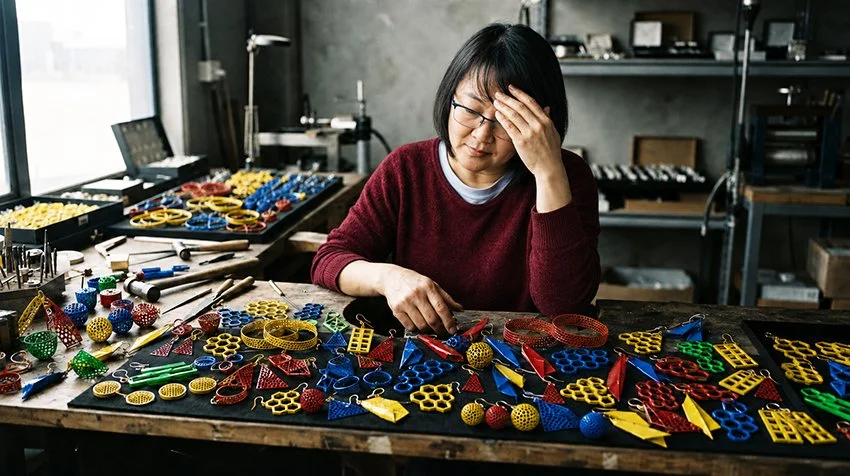
What I want now is not simply a larger number of customers. I want my work to reach the people who may connect with the full depth of my practice: collectors, curators, galleries, jewellery artists, design lovers, and people interested in the relationship between craft and artificial intelligence.
I currently have more than 2,000 authentic Instagram followers, and I value the community already surrounding my work. But if I want greater opportunities, I need to communicate beyond the familiar circle that already knows me.
My challenge is not that I have nothing to show. I have seventeen years of work, material knowledge, failures, discoveries and stories. The challenge is learning how to communicate this body of knowledge clearly and consistently.
A beautifully finished piece of jewellery may receive little attention online unless it is presented with a strong image, story or context. This does not mean the work lacks value. It means that making good work and helping people discover its value are different skills.
For a long time, I concentrated primarily on making. Now I need to become a better communicator as well.
From maker to author
This year, my focus is on Hand & Algorithm and preparing for The Big Design Market. The market is still important to me, and selling remains part of sustaining my practice. But I no longer want individual sales to be the only measure of progress.
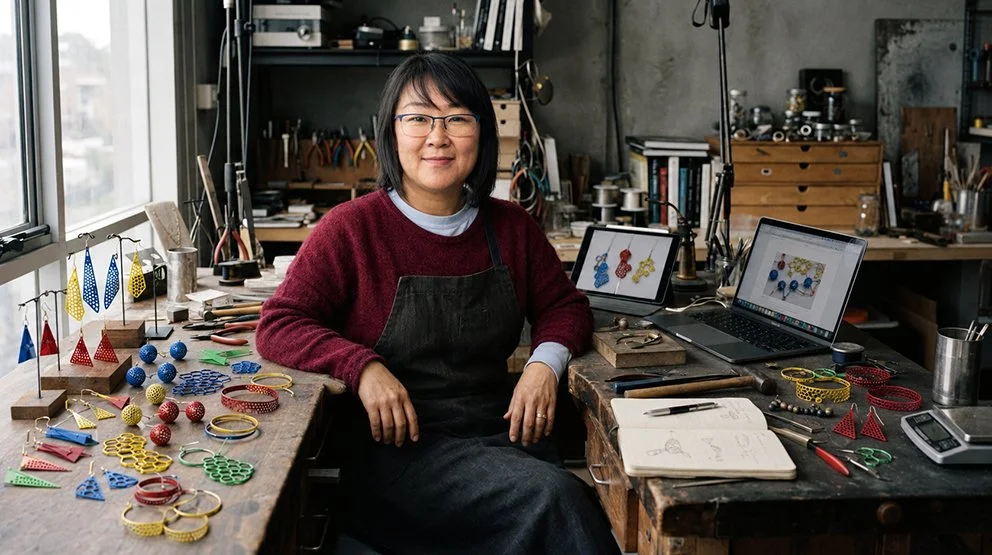
Through Hand & Algorithm, I am learning to examine and communicate my practice differently. I am documenting how I think, how I work with materials, what AI can and cannot understand about making, and how seventeen years of experience shapes every decision at the bench.
The making process has always interested people. Hands, tools and materials communicate something that a finished product photograph cannot show on its own. But I do not want to present process merely as entertaining content. I want to reveal the intelligence within making: the accumulated knowledge, judgment, uncertainty and persistence behind each object.
In this sense, I am moving from being seen only as a maker of jewellery towards becoming an author of my practice.
I am still an artist, designer and maker. But I also want to become a researcher, storyteller and content creator—not as separate identities, but as connected parts of Jin Ah Jo Jewellery.
My experience as an immigrant is also part of this identity. Ideas of borders, belonging, displacement and transformation have shaped both my life and my work. My position between artist, designer, maker and communicator is another kind of border: not a limitation, but a space from which I can create something distinctive.
Looking beyond the safe zone
For many years, galleries and stockists such as e.g.etal provided a trusted structure around my practice. I am deeply grateful for that history, but it also became a comfortable and familiar zone.
The Australian contemporary jewellery market is relatively small. From next year, I want to begin knocking on doors overseas. I want to seek international galleries, exhibitions, publications, collaborations and other opportunities that may place my work within a wider conversation.
This does not mean abandoning Australia or rejecting the jewellery that has supported me. It means allowing the foundation I have built here to take me somewhere new.
There are more opportunities than the ones already familiar to me. Reaching them will require a clearer personal brand, stronger documentation and more confident communication. With the help of AI and Lizzy Park’s Instagram branding course, I want to understand how to present my practice without simplifying it into a stream of products.
I do not want Instagram to say only, “Here is another earring for sale.”
I want it to say: this is how I think; this is how I make; this is what I have learned; and this is the artistic world I am building.
A new meaning of success
My sales data gave me something more valuable than a list of bestsellers. It showed me the structure of the career I have already built—and helped me recognise which parts of that structure I want to change.
The next stage of my practice cannot be based only on producing more objects at lower prices. It must create greater opportunities from the knowledge, identity and body of work I already possess.
Success may now mean reaching a curator who understands the work, beginning a relationship with an international gallery, entering an important exhibition, developing a new collector audience, or publishing an essay that gives another maker a way to think about their own practice.
It may also mean protecting my body, preserving my curiosity and giving myself enough time to make work that I do not yet know how to make.
The jewellery I sold over seventeen years brought me here. I respect that history, but I do not have to repeat it indefinitely.
My sales data revealed what people bought. More importantly, it made me ask what kind of artist and creator I want to become.
I do not want simply to make more.
I want to make my experience, knowledge and ideas more visible. I want Jin Ah Jo Jewellery to become not only a recognisable product brand, but a clear and evolving artistic voice.
That is the long-term practice I want to build.