DAY 02 · SUN 25 OCT Seventeen Years of Making: Discovering My Own Archive
DAY 02 · SUN 25 OCT - “Hand & Algorithm — A Nine-Day Online Exhibition”
Chap.6- 43 | DAY 02 — Seventeen Years of Making: Discovering My Own Archive
Learning 2: The Value of Looking Backwards
When I started learning AI, I thought I would mainly discover new technology and learn some useful skills for my jewellery practice. I didn't expect that one of the most meaningful experiences would be looking backwards, through seventeen years of my own work.
I have been making contemporary jewellery professionally for more than seventeen years. During this time, I have accumulated hundreds of photographs, exhibition records, invoices, artist statements, sketches and unfinished ideas. They were scattered across different computers, folders, boxes, galleries and sometimes just in my memory.
I knew they existed, but I had never properly brought them all together.
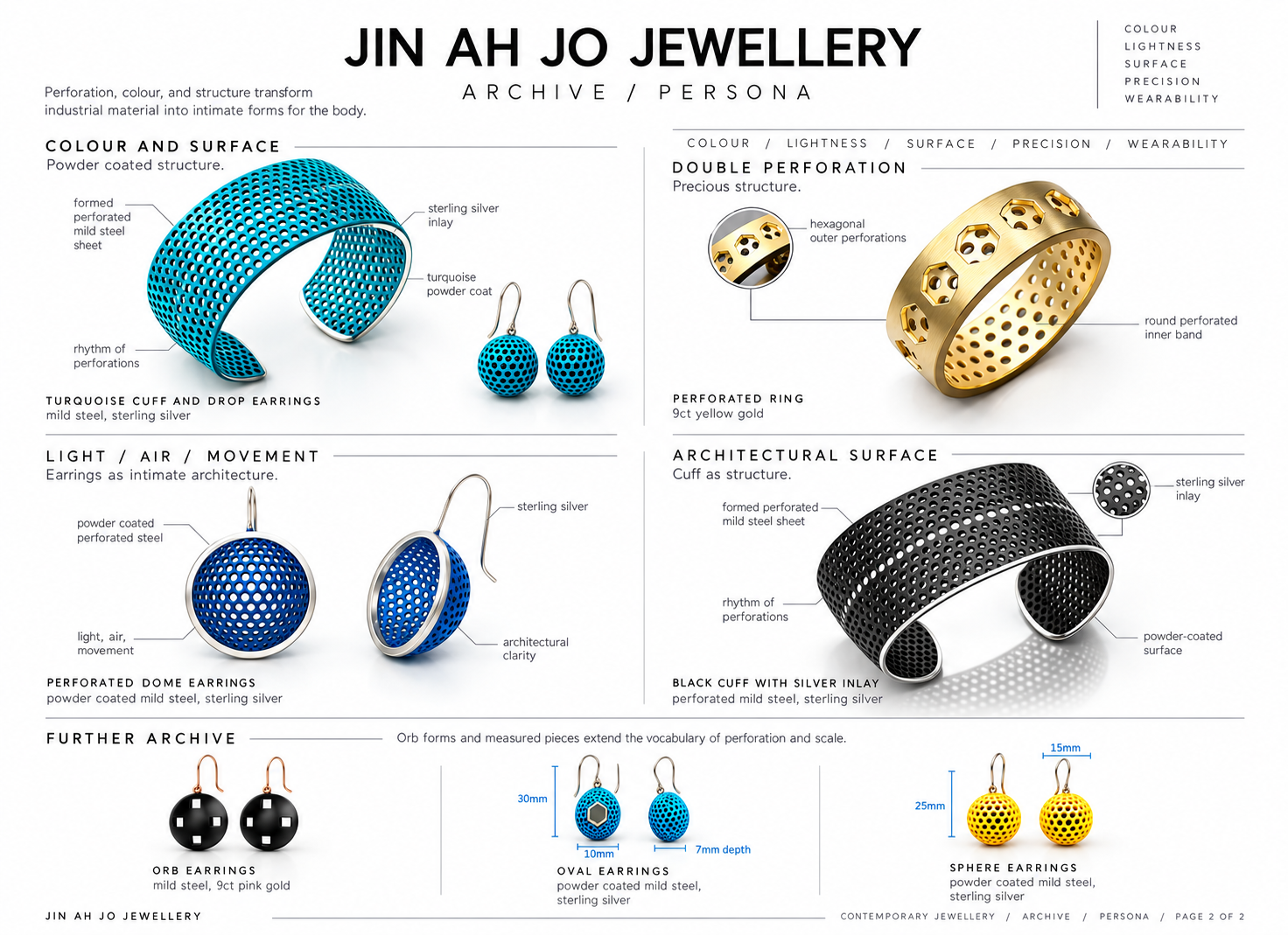
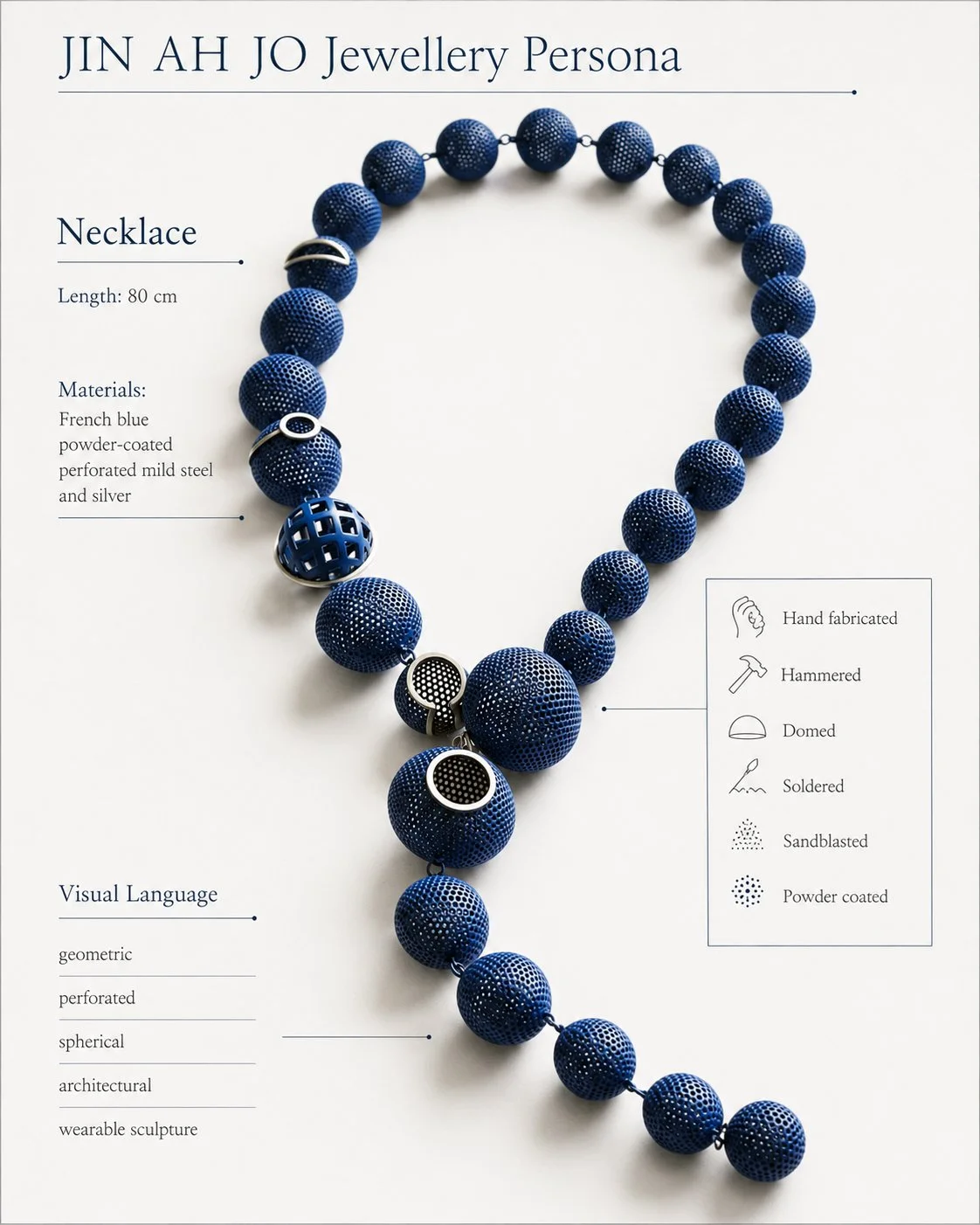
Jin Ah Jo Jewellery Persona no.1
Like many independent makers, I was always busy producing the next collection, preparing for an exhibition, delivering orders or solving a technical problem at the bench. There was rarely enough time to look back.
Perhaps I was too busy making jewellery to see what I had already made.
Seventeen Years Are Not Just Numbers
In my studio in Fawkner, I still have my old jewellery tools hanging on a pegboard. Some of them have been with me for decades, including my first Korean-made pliers and worn bench files.
When I look at these tools, I can remember the things I have learned through them. They have been part of my life for a very long time.
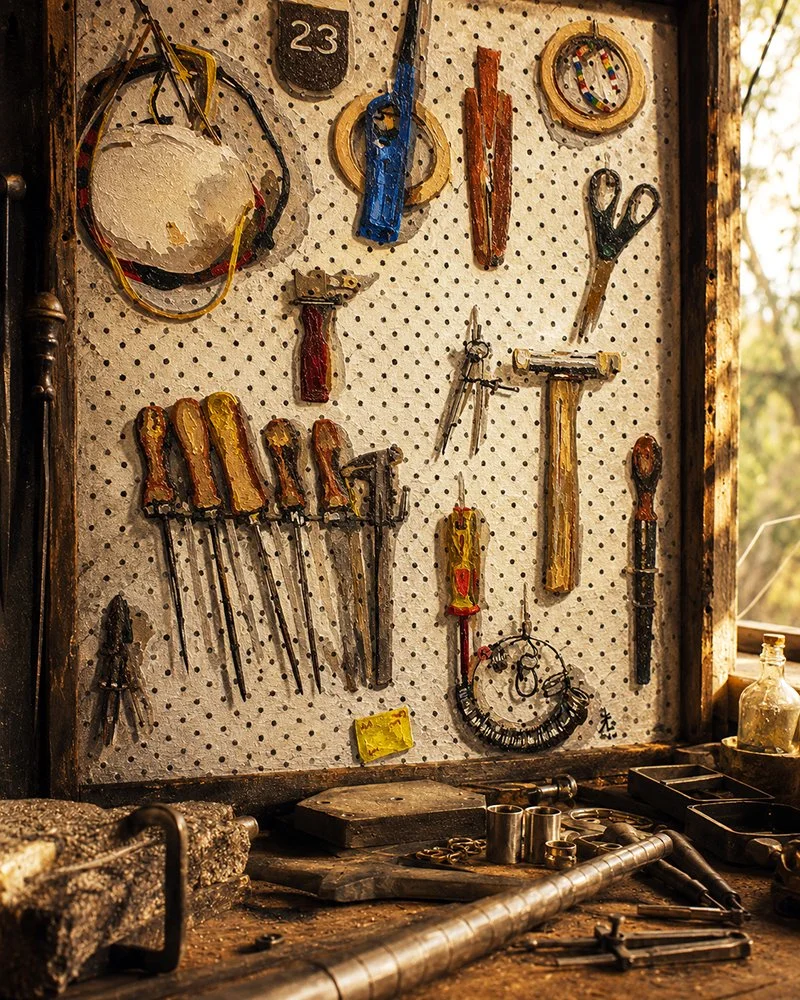
My Pegboard painting + AI Interpretation
I migrated from Korea to Melbourne in 2000, studied jewellery at university, established my studio practice and gradually developed my own visual language.
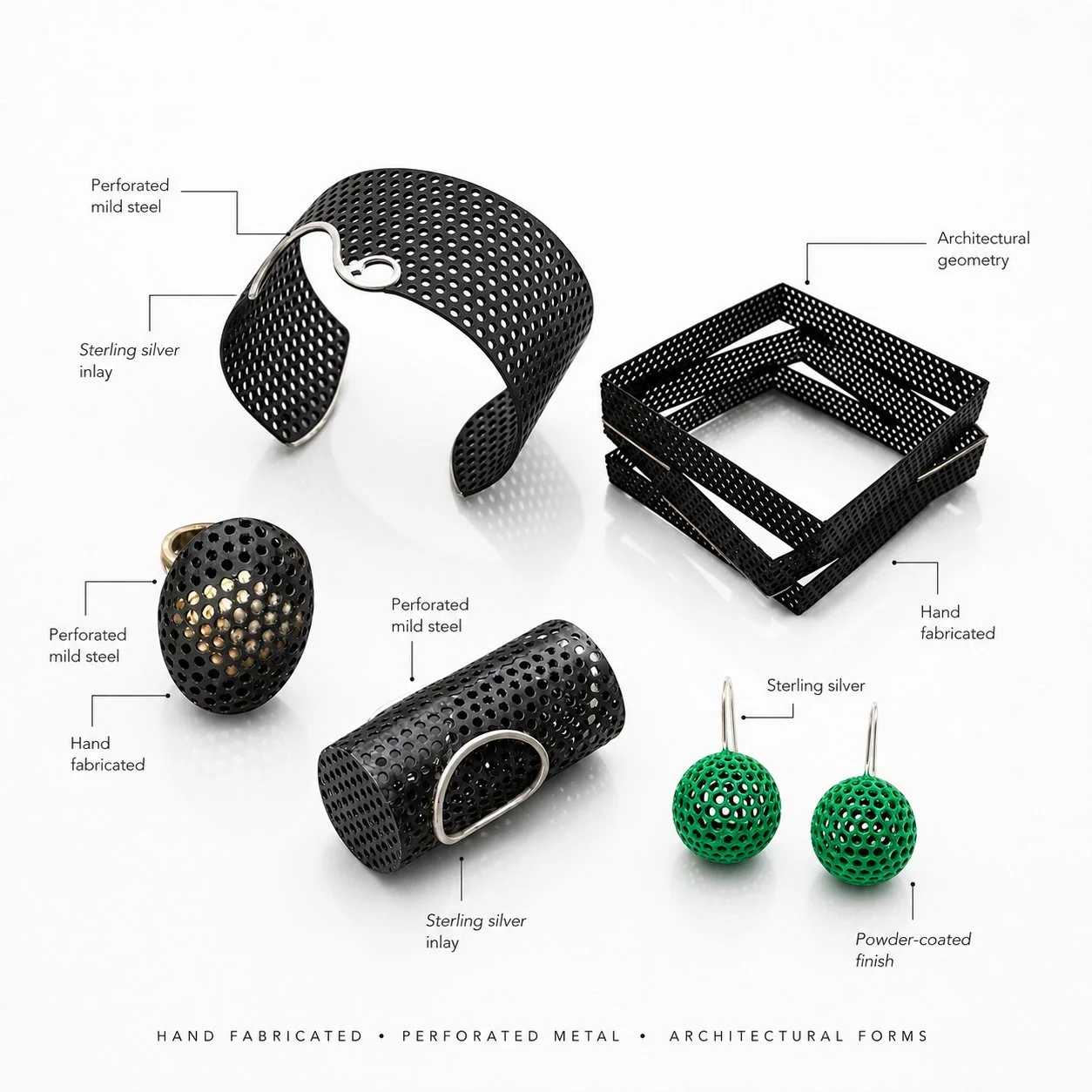
Perforated mild steel, geometric forms, repetition, colour, silver and brass inlays have become recognisable elements of my work. But none of this happened overnighThere were countless experiments, failures, discoveries and small decisions. Some techniques took years to develop. Others happened unexpectedly when I was simply playing with materials.
How could I possibly explain all of this to AI?
And why would I want to?
Building My Second Brain
One of the ideas I encountered while studying AI was the concept of a *second brain* — a system for collecting, organising and connecting information that might otherwise remain scattered or forgotten.
I began to think that I needed one for Jin Ah Jo Jewellery.
I started gathering information about my education, exhibitions, materials, techniques, achievements and the different collections I had made over the years.
One photograph led to another memory.
For example, I rediscovered images of *Big Apple*, a necklace I exhibited at LOOT at the Museum of Arts and Design in New York in 2015. It sold on the opening night. At the time, this was a significant moment in my career, but the photograph had simply become another file among thousands.
“Big Apple”- 2015 For LOOT at Museum of Art and Design in NYC
Now it has a place in my archive.
I also began experimenting with NotebookLM and ChatGPT to organise information and research ideas. I discovered that AI could help me find connections, structure information and ask questions about my own practice.
It was fascinating to see how much material I already had.
But the information wasn't new. I had created it all through years of work.
AI was helping me see something that was already there.
Looking back at my old work and remembering the times when I created it is not simply about nostalgia or longing for the radiant moments of my life.
Thanks to all the resources now available to me, I can dare to dream of new forms of artistic expression and imagine possibilities I once thought were beyond my reach.
I feel a deep appreciation for the digital revolution I have witnessed since 2005, and now, with the help of AI, even the smallest creative moments can be brought back to the surface, rediscovered and given new life.
That feels incredibly promising and encouraging. Rather than simply looking back at what I have achieved, I find myself excited about what might still be possible.
Creating Jin Ah Jo and Jin Ah Jo Jewellery Personas
Another experiment was creating two different personas using AI.
One was Jin Ah Jo, the artist — including my background, experiences, interests and thoughts about making.
The other was Jin Ah Jo Jewellery — representing my work, collections, materials, techniques and visual language.
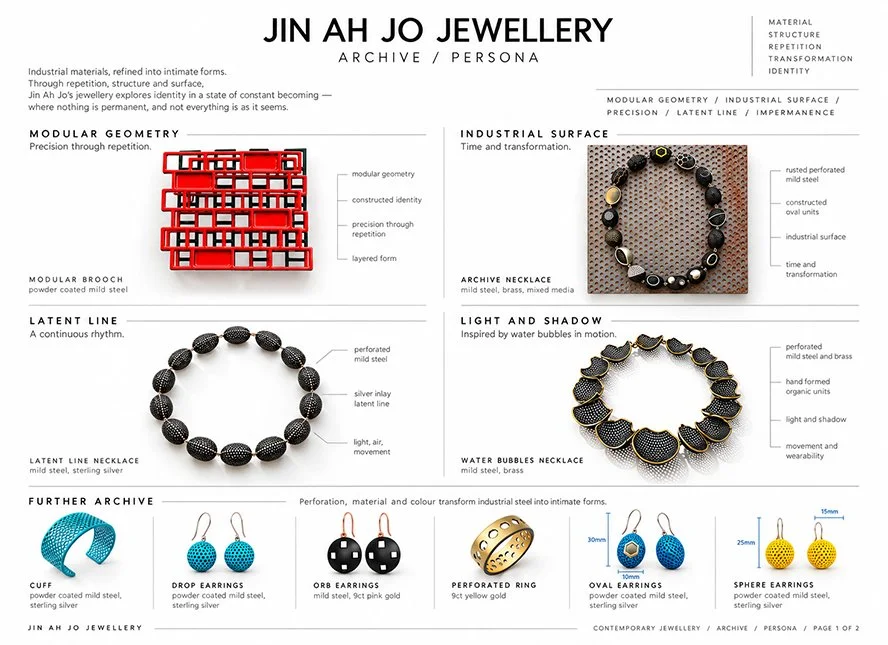
Jin Ah Jo Jewellery Persona no.2
I began introducing myself to AI almost as if I were introducing myself to another person.
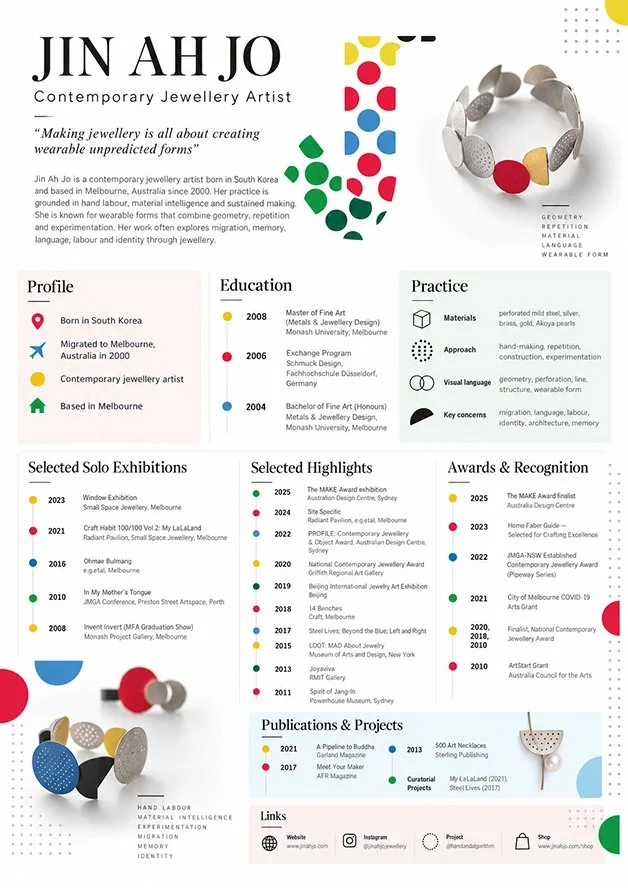
I explained what I make, how I make it, why I use certain materials and what I value as an artist. I used prompts and project instructions to develop a system that could assist with writing, organising images and presenting my work.
It was an unusual experience.
I had never needed to describe my entire practice in such a systematic way before. Usually, I just make things. I know what I like and what I don't like. I know when something feels right, even if I cannot immediately explain why.
But AI needed words and information.
I would say that the process of archiving my work feels like being a novelist, piecing together fragments of a story and weaving different plots into a complete nove
This made me think more carefully about my own artistic language.
Of course, an AI persona is not me. It cannot hold my memories or understand the physical experiences behind my work in the same way I do. It is a representation made from the information I choose to provide.
Still, creating these personas helped me identify what matters to me and what has remained consistent throughout my practice.
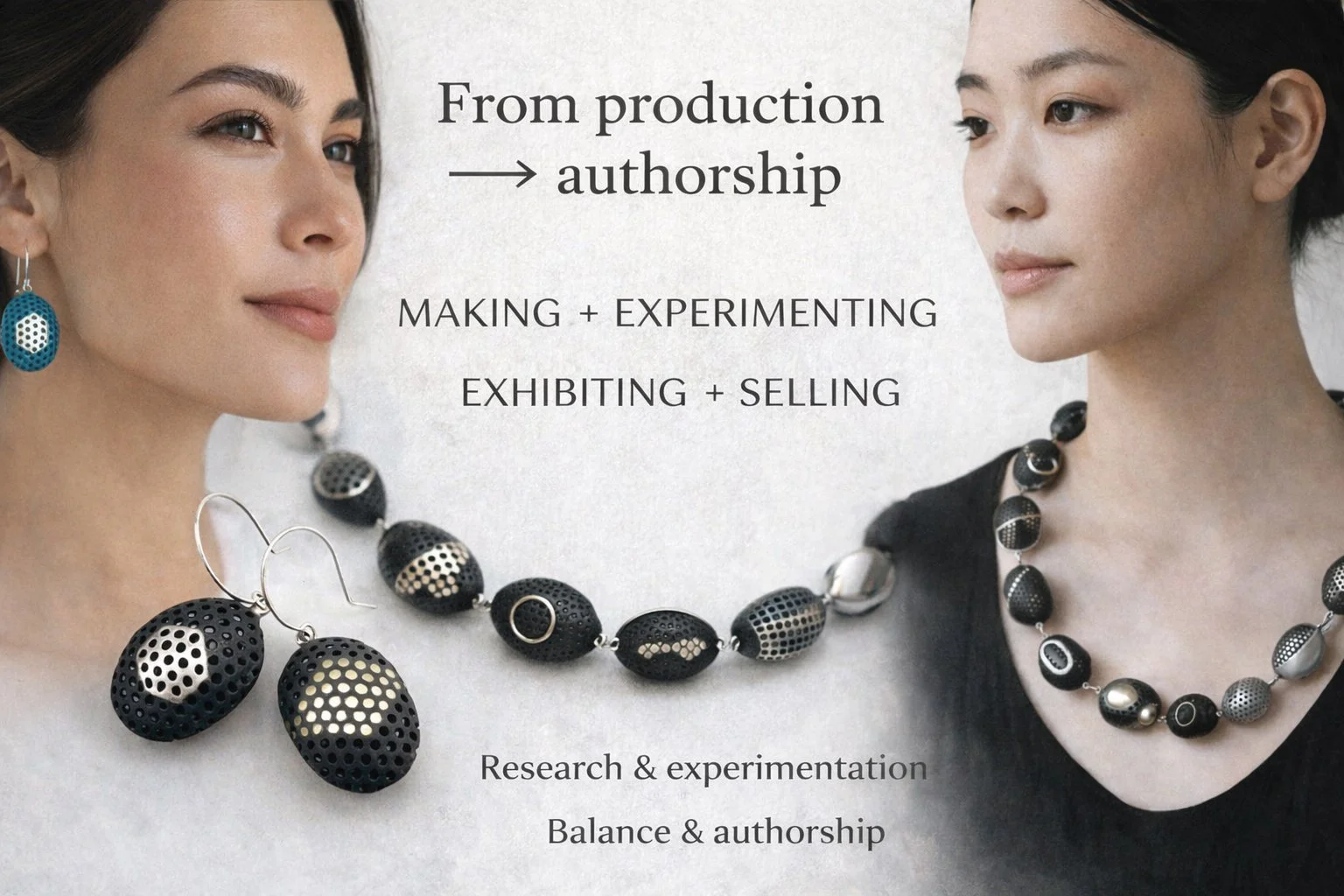
Taking Ownership of My History
There was also a practical reason for this change.
Earlier this year, my long relationship with e.g.etal, my main Melbourne stockist, came to an end.
For seventeen years, the gallery had represented an important part of my professional life. When the work was returned, I realised that it was time to take greater responsibility for my own archive, presentation and business.
Initially, it felt as though I had to start again.
But looking through the photographs, exhibition records and old work reminded me that I wasn't starting from zero.
I had seventeen years of experience, technical knowledge, relationships, exhibitions and achievements behind me.
I simply needed to bring them together in a way that belonged to me.
I used to think an archive was something museums, galleries or institutions created. Now I realise that an independent artist can begin building one, slowly and imperfectly.
It is still a work in progress, and I have many more photographs and records to organise. But at least I have started.
So here is an important question.
Questions: Can an Algorithm Help an Artist Understand Their Own Identity?
Eight months into this journey, my answer is both yes and no.
AI can help me organise information, recognise patterns, retrieve forgotten details and find connections between different periods of my work.
But it cannot decide which memories are important to me.
It doesn't know how I felt when I first learned to solder, when a difficult construction finally worked, or when I saw my jewellery exhibited overseas.
Those experiences belong to me.
Perhaps the most surprising discovery was that I didn't need AI to tell me who I was as an artist. I needed to look more carefully at the history I had already created.
Looking backwards has also made me think about where I want to go next.
My archive is not just a record of the past. It is becoming a resource for future work, exhibitions, writing and new possibilities.
And I am beginning to understand that organising my practice is also another form of making.
The algorithm can help me connect the pieces. But I am the one who lived them.
Chap. 2–11: My Starting Point — Seventeen Years of Jewellery Practice
Chap. 2–12: Building a Second Brain for Seventeen Years of Practice
Chap. 2–13: Making a Persona — Jin Ah Jo Jewellery
Jin Ah Jo
Hand & Algorithm — Radiant Pavilion 2026