

DAY 01 · SAT 24 OCT Before Refusal: Why I Chose to Learn AI
DAY 01 · SAT 24 OCT - “Hand & Algorithm — A Nine-Day Online Exhibition”
(Chap6-42 Continued by Chap5-41)
Before Refusal: Why I Chose to Learn AI
I began with uncertainty about AI and its relationship to handmade practice. Rather than accepting or rejecting it, I decided to learn, experiment and form my own opinion.
Question: Can a maker embrace new technology without losing the knowledge of the hand?
Related writing: Preface 1–3 and Chapters 1–10
All nine days of this online exhibition draw from my new blog, which consists of five chapters and 41 posts. These writings document eight months of learning, research, experimentation and reflection as I explored how AI could be applied to my contemporary jewellery practice.
When I began *Hand & Algorithm* eight months ago, I had no idea how far this journey would take me.
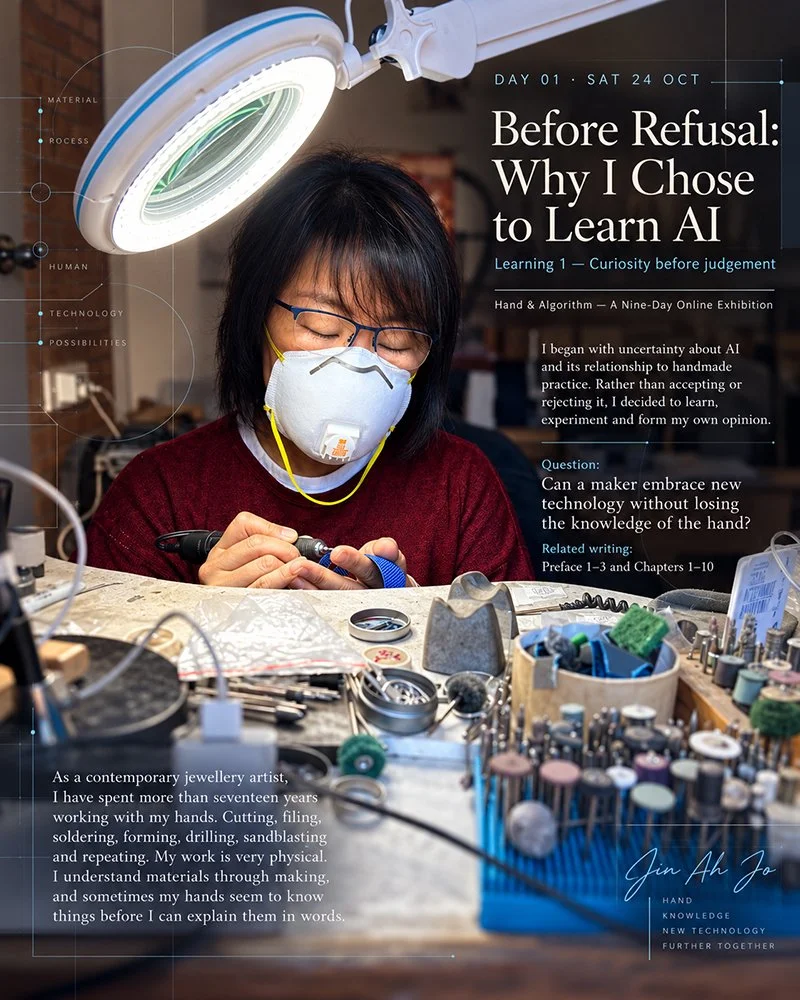
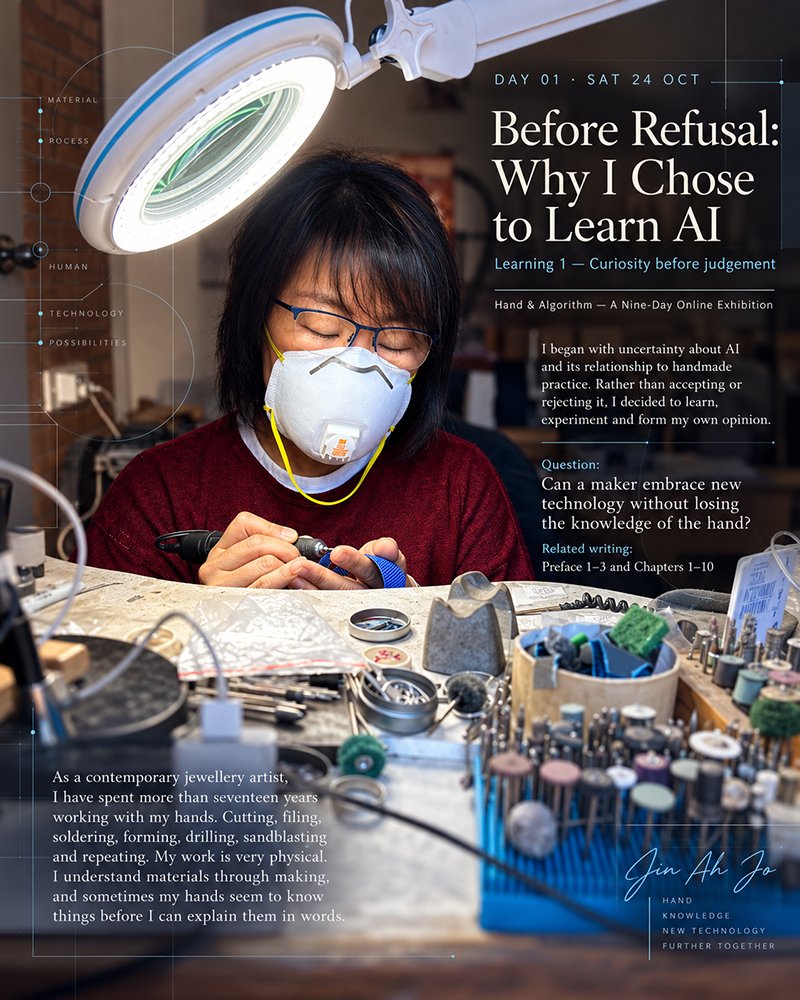
As a contemporary jewellery artist, I have spent more than seventeen years working with my hands. Cutting, filing, soldering, forming, drilling, sandblasting and repeating. My work is very physical. I understand materials through making, and sometimes my hands seem to know things before I can explain them in words." using the image, me at the bench
Learning 1: Curiosity Before Judgement
Artificial intelligence seemed to belong to a completely different world.
AI was appearing everywhere. People were talking about how it would transform our lives, change our jobs and perhaps even replace artists. I was curious, but also a little uncomfortable. If I brought AI into my world of jewellery making, how could a machine possibly understand the knowledge I had built through years of working with my hands?
My initial thought was that AI could never replace what I do with my hands. In that sense, I felt quite safe.
But then I asked myself another question. How could I judge something I didn't properly understand?
Why I Decided to Learn
Earlier this year, I enrolled in a Korean AI education program called *Plus Human*. I was interested in the idea that technology could extend human abilities rather than simply replace them.
At the same time, my professional situation was changing. After seventeen years with my main Melbourne stockist, e.g.etal, that relationship had come to an end. Suddenly, I had to rethink how I would present, promote and sell my jewellery independently.
I realised how much of my practice existed in scattered photographs, invoices, documents and memories. I had spent so many years making jewellery, but perhaps not enough time looking at the bigger picture of what I had created. It was both disappointing and frustrating.
Perhaps that frustration and disappointment, mixed with a sense of boredom, pushed me towards learning something new. Something that was becoming mainstream, yet still felt intimidating, exciting and irresistibly intriguing.
At first, I was honestly mesmerised by what AI could create visually with just a few words in a prompt. The results were fascinating, and perhaps a little frightening. What AI could do was undeniably impressive, but there was something strangely unsettling about it. It felt uncomfortably comfortable, if that makes sense.
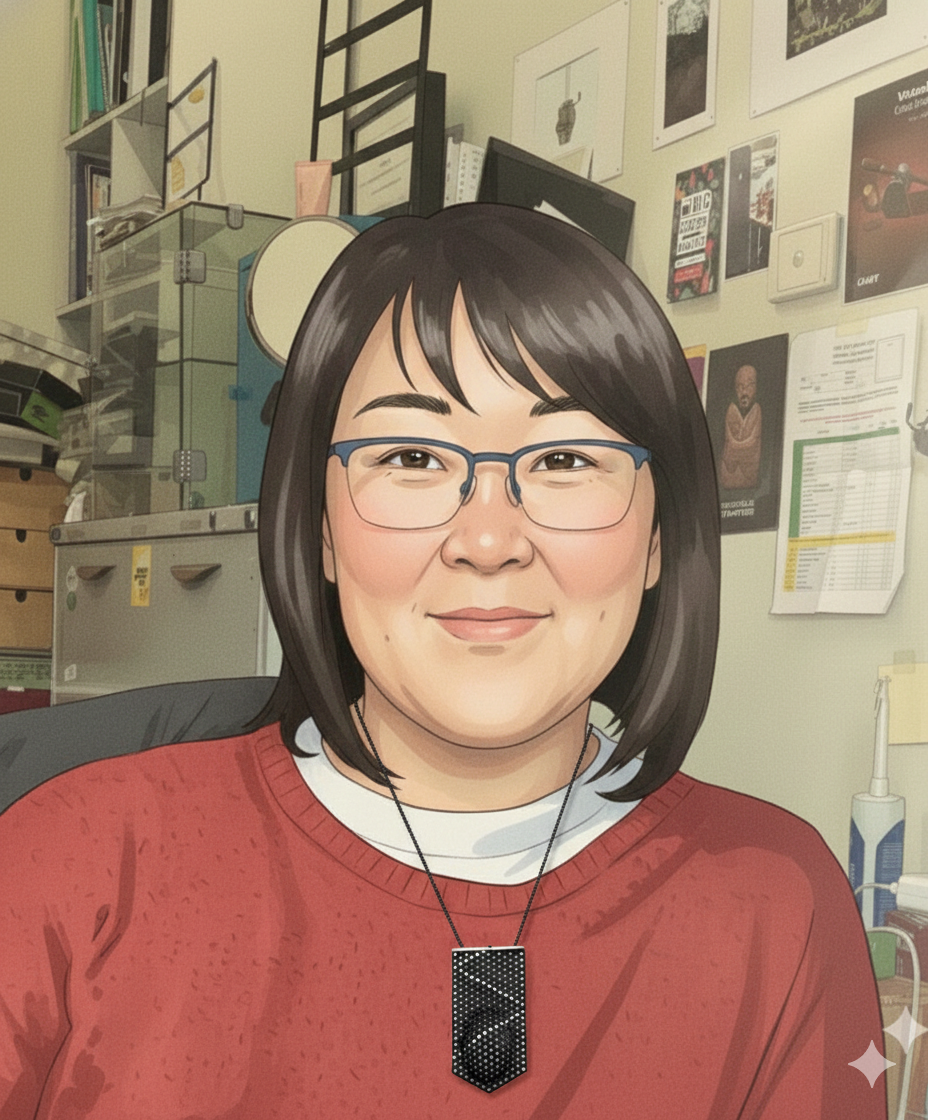
An AI-generated self-portrait created using just a few prompts and two images — one of myself and the other of my jewellery. I asked AI to transform them into a Studio Ghibli-inspired style.
Returning to my earlier frustration and the feeling that I had nothing left to explore, I began to wonder: Could AI help me organise all of this? Could it become another pair of hands, not necessarily at the jeweller’s bench, but in the many tasks surrounding my studio practice?
This became one of the starting points for Hand & Algorithm, my project for Radiant Pavilion 2026.
Learning Before Judging Definitely
At first, I began exploring AI through writing, research, image generation, organising information and visual experiments.
Some results were surprisingly useful. Others were strange, inaccurate and sometimes quite frustrating.
When I asked AI to interpret my jewellery, it often misunderstood the construction. Perforations disappeared, earring mechanisms changed, and carefully balanced forms became something entirely different.
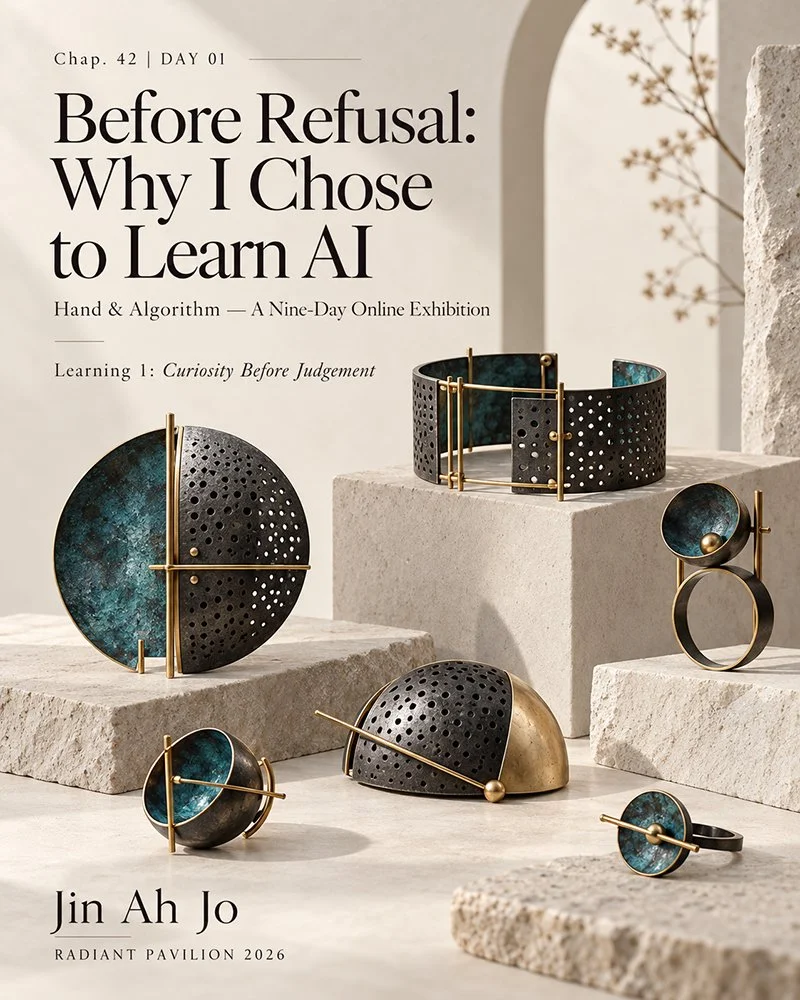
All the works totally over analysed and wrongly allegorised
The images could look beautiful to some, but they were no longer the jewellery I had made.
From my point of view, AI seems to understand my work in a very flat, two-dimensional way, treating it more as a composition of shapes and objects than as a three-dimensional piece of jewellery.
Even when I provided real photographs of my work and specifically asked AI to use them exactly as they were, the results were often frustrating. It frequently altered the forms, proportions and details of my jewellery rather than preserving the original pieces.
When I first started learning to use Nano Banana, many people described it as one of the best AI image-generation and editing tools. That may be true for certain purposes, but it has not been particularly successful at understanding or accurately representing my work.
The frustration continued as I experimented further. I began to realise that, although AI could produce visually impressive images, it still struggled to understand the physical qualities, construction methods and material relationships that are so important to my jewellery practice.
I realised something important through these failures.
Making jewellery is not simply creating a beautiful shape. It involves weight, balance, resistance, construction, wearability and countless small decisions.
Sometimes I start with a clear design in my mind. Other times, the design develops through touching materials, making mistakes and changing direction. I might spend hours solving a small technical problem, only to discover that the unexpected result is more interesting than my original plan.
AI can generate another image almost instantly. But I cannot make another piece of jewellery instantly, and perhaps I don't want to.
The time spent making is part of how I think.
Finding My Own Method
One of the most useful things I learned was to develop a simple method:
Rather than learning AI tools for their own sake, I decided to apply what I learned directly to Jin Ah Jo Jewellery. I would try something new, observe the result, question what worked and what didn't, and then decide whether it was genuinely useful. I also began thinking differently about the word *algorithm*.
In my jewellery practice, I repeat certain forms, materials and techniques. I make a decision, observe the result, adjust it and make another decision. Over many years, these repeated actions have developed into my own visual and material language.
Perhaps there is already an algorithm within my handmade practice.
The difference is that my process is not always predictable. The material can resist, an accident can become an idea, and I can change my mind halfway through making.
This is the part that fascinates me most.
The mistakes, errors and hesitations that AI can never understand (I hope)
Eight Months Later
Looking back now, I am glad I chose to learn before refusing.
AI has helped me in many ways, particularly in communication, research, planning and organising my practice. It has also opened possibilities I would not have imagined eight months ago.
But it has raised even more questions.
What happens to the knowledge we share with AI? Can years of craftsmanship be translated into language and data? Where should we draw the boundary between assistance and authorship?
The core distinction between AI assistance and AI authorship lies in human accountability, creative agency, and intellectual responsibility
And perhaps most importantly, how can we use new technology without losing our own curiosity, judgement and experience?
I don't think I have found all the answers. In fact, the more I learn, the more questions I seem to have.
Over the next eight days, I will share nine discoveries from this journey, drawing on 41 chapters of writing, experiments, successes, failures and new jewellery created along the way.
This exhibition is not about proving that AI is good or bad. It is about observing what happens when a maker invites an algorithm into the studio.
Eight months ago, I chose curiosity before judgement.
That decision has taken me somewhere unexpected.
And my hands are still making.
Jin Ah Jo
“Hand & Algorithm — Radiant Pavilion 2026”