Chap. 3-24: Trying Again- Can Flow Learn to Make My Jewellery More Accurately?
Trying Again
After making my first jewellery-making video with Google Flow, I wanted to try again.
My first experiment used 15 separate prompts to show the making of my perforated mild steel dome earrings. It was fun, but also quite awkward. The jewellery kept changing shape, some of the tools and processes were wrong, and maintaining consistency between scenes was one of the biggest problems.
But instead of stopping there, I thought: what happens if I simplify everything?
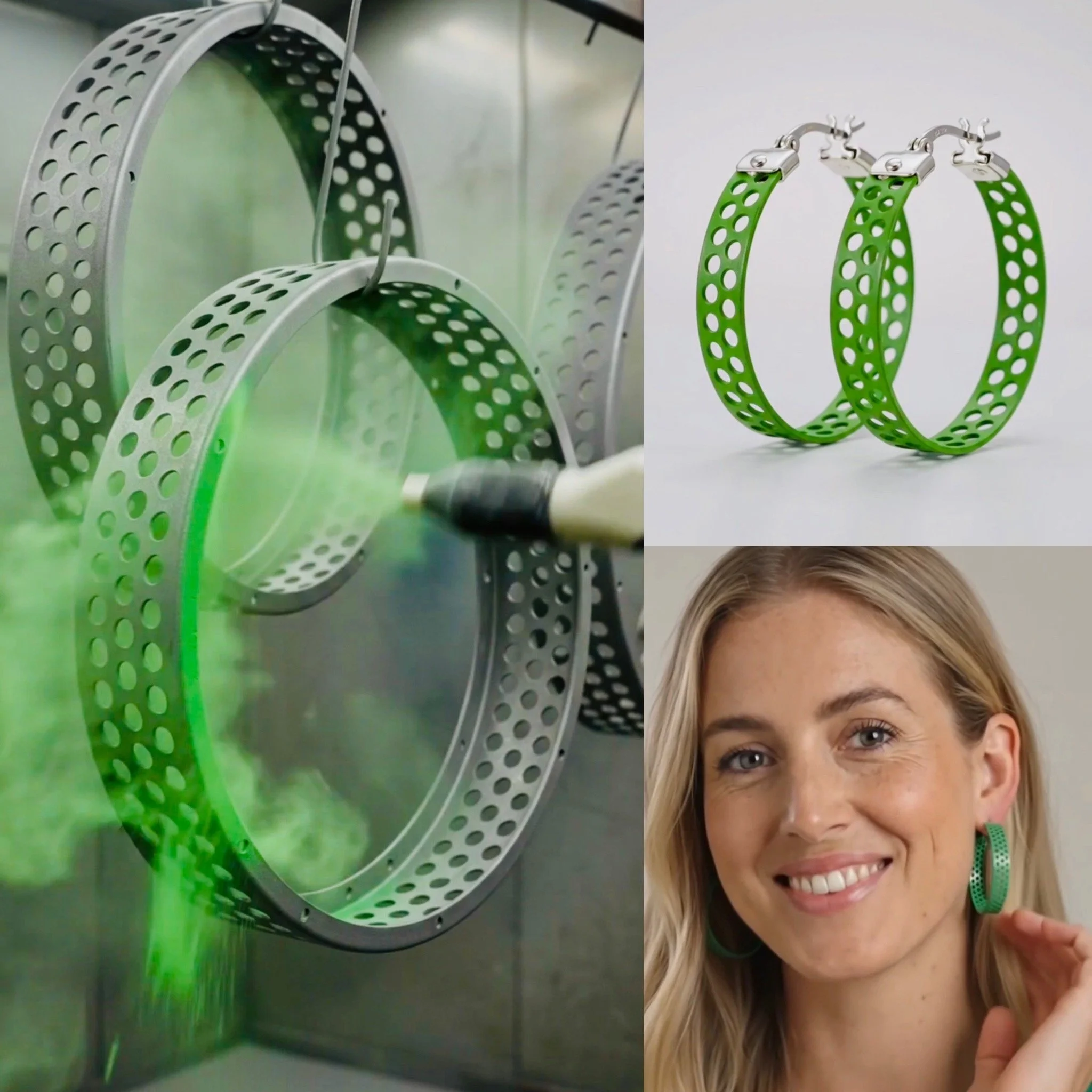
This time I chose one of my green perforated mild steel hoop earrings.
The form is much simpler. It begins as a straight strip and gradually becomes a circle. There are fewer components and fewer fabrication stages.
I also reduced the video from 15 scenes to only 7 scenes.
Starting Again With Something Simpler
I wrote down the real process I use to make these earrings:
Cut two 7 × 140 mm strips from 1.1 mm hole perforated mild steel with a jeweller's saw.
Solder silver strips and findings onto both ends.
Bend the strips around a steel hoop-earring mandrel.
Clean and sandblast them.
Powder coat them green.
File the coating back from the silver components and add silver wire to complete the findings.
Show the finished earrings.
Again, I asked ChatGPT to translate my making knowledge into individual prompts for Flow.
But this time we added something quite important to the prompts:
Maintain exactly the same earrings throughout the video.
I described the dimensions, perforations, materials and proportions repeatedly. I even told Flow not to redesign the jewellery.
Did that solve the problem?
Not completely.
It Is Better — But It Is Still Flow's Version
The result is definitely more coherent than my first experiment.
Because the hoop is a simpler form, Flow seems better able to maintain the general idea of the object from one scene to another. I can recognise the perforated strip and eventually recognise the green hoop earrings.
But once again, when I watch the video as a jeweller, I see so many strange things.
The scale changes. The perforated strips sometimes become much wider and heavier than my actual material. Tools and hand movements are not always correct. In the sandblasting and powder-coating scenes, the hoops suddenly look enormous — almost like industrial objects rather than earrings!
This is funny, but it is also interesting.
I gave Flow actual measurements.
I told it the strip was 7 mm wide and 140 mm long.
But knowing the numbers is not the same as understanding their physical scale.
As a maker, when I hear "7 mm wide", I immediately understand what that feels like in my hand.
AI doesn't seem to have that same physical understanding.
Again, I Love the Difficult-to-Film Parts
Something from my first experiment happened again.
I really like the sandblasting and powder-coating scenes.
They are not technically accurate. In fact, the scale becomes quite ridiculous. But visually, they communicate something about the transformation of the material.
These are also processes that are difficult for me to film while I am actually working.
So perhaps I am beginning to find a particular role for AI video in my practice.
I don't necessarily need AI to pretend to be my hands at the jewellery bench.
I already have my hands.
But perhaps it can help me visualise or communicate processes that are difficult to capture with a camera.
That distinction is becoming clearer with each experiment.
And Then My Earrings Have a Model!
At the end of the video, the finished green hoops appear on a model.
This was another interesting moment for me.
Normally, to create this kind of image or video, I would need to organise a model, photography, lighting and editing. Flow simply imagined the whole situation.
Again, it isn't really documenting my jewellery.
It is creating a possible visual world around my jewellery.
That could potentially be useful for social media, visual experiments or simply imagining how a piece might look when worn.
But I also need to be careful.
The more polished and convincing the AI-generated scene becomes, the easier it is to forget that this is not documentation.
My actual jewellery and my actual making process still need to remain the reference point.
Seven Scenes Worked Better for Me
Another thing I learned from this second experiment is that I don't necessarily need 15 scenes.
Seven scenes were enough to communicate the basic journey:
flat material → fabrication → forming → surface treatment → colour → finishing → jewellery being worn.
The video is much shorter and easier to manage.
This feels more useful for the kind of short-form content I might actually make for Instagram.
I am beginning to realise that learning AI video is not simply about learning how to write a better prompt.
It is also about learning what not to ask it to do.
My Making Knowledge Is Still Doing the Judging
This is probably the most important thing I am noticing through these experiments.
Flow can generate a jewellery-making video very quickly.
But it cannot tell me whether the process makes sense.
I can.
I know when the scale is wrong.
I know when a tool is being used incorrectly.
I know when soldering would physically fail.
I know what a 7 mm strip of perforated mild steel feels like.
I know how the metal behaves when I bend it around a mandrel.
That knowledge comes from making jewellery professionally for seventeen years.
So perhaps the interesting part of this experiment isn't:
Can AI make a jewellery-making video?
Clearly, it can.
The more useful question for me is:
What can I see in an AI-generated making video because I am already a maker?
The mistakes are becoming almost as useful as the successful parts.
They show me the gap between generating an image of making and actually knowing how to make.
And that gap is exactly where Hand & Algorithm is becoming interesting for me.
Next Experiment
I don't want to keep asking Flow to reproduce my existing jewellery forever.
I think these first two experiments have already taught me something.
The first was complicated.
The second was deliberately simpler.
Both still showed the same fundamental limitation: AI can visually imitate a making process, but it doesn't really understand the material in the way my hands understand it.
So perhaps the next step should be different.
Instead of asking:
"Can you show me how I make this?"
I want to ask:
"Can you show me something I haven't made yet?"
And then the experiment can move from AI trying to imitate my seventeen years of making knowledge to something much more interesting:
AI proposes.
I judge.
My hands work out whether it can actually exist.