Chap. 3-23: Making a Jewellery Video with Prompts: My First Flow Experiment
Making a Jewellery Video with Prompts: My First Flow Experiment
Until recently, video was not something I thought much about in my jewellery practice.
I photograph my work, document my making process and occasionally make short reels, but creating a video from nothing except words was completely new to me.
For this experiment, I wanted to see whether I could describe a jewellery-making process entirely through prompts and let AI create the moving images.
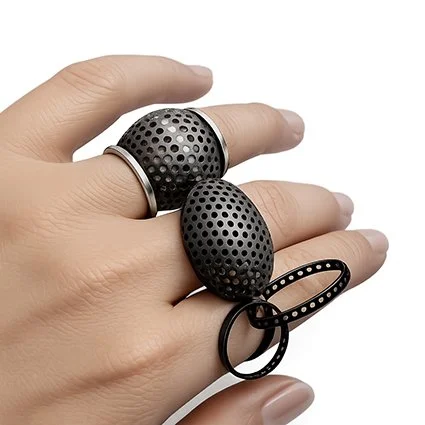
I chose something I know very well: a pair of my perforated mild steel dome earrings with silver rims.
I have made this kind of work many times, so I already knew exactly what should happen at every stage. That made it a good test.
From My Making Knowledge to AI Prompts
I first wrote down my actual making process:
cleaning the perforated mild steel, cutting two discs, forming them into cups using a dapping block and punch, filing the edges, making silver rims from square wire, soldering, cleaning, attaching silver wire for the hooks, sandblasting, powder coating the steel matte black, filing the coating back to reveal the silver rim, forming the hooks, polishing and finally finishing the earrings.
I then asked ChatGPT to translate my making process into 15 individual prompts for Google Flow.
Each prompt described one stage of making.
I generated each scene separately as a four-second video, then combined the 15 scenes to create approximately one minute of continuous video.
And the result?
It was good fun!
It is also quite awkward.
AI's Version of My Making Process
The finished video is definitely not an accurate demonstration of how I actually make these earrings.
Some tools are wrong. Some hand movements don't make sense. Processes happen in strange ways. Most noticeably, the object itself doesn't remain consistent.
The shape of the cup earrings keeps changing from scene to scene.
One moment Flow seems to understand the shallow perforated dome. In another scene, it becomes a slightly different object. When it reaches the silver hook-making process, the earring changes again into something quite different.
This became one of the biggest things I learned from the experiment.
Even though I described the same object repeatedly, AI did not seem to understand that the object in Scene 10 must physically be the same object that existed in Scenes 1–9.
For a maker, this continuity is obvious.
For AI video, apparently, it isn't.
But Some Parts Were Surprisingly Useful
Interestingly, some of my favourite scenes are not the traditional bench-making scenes.
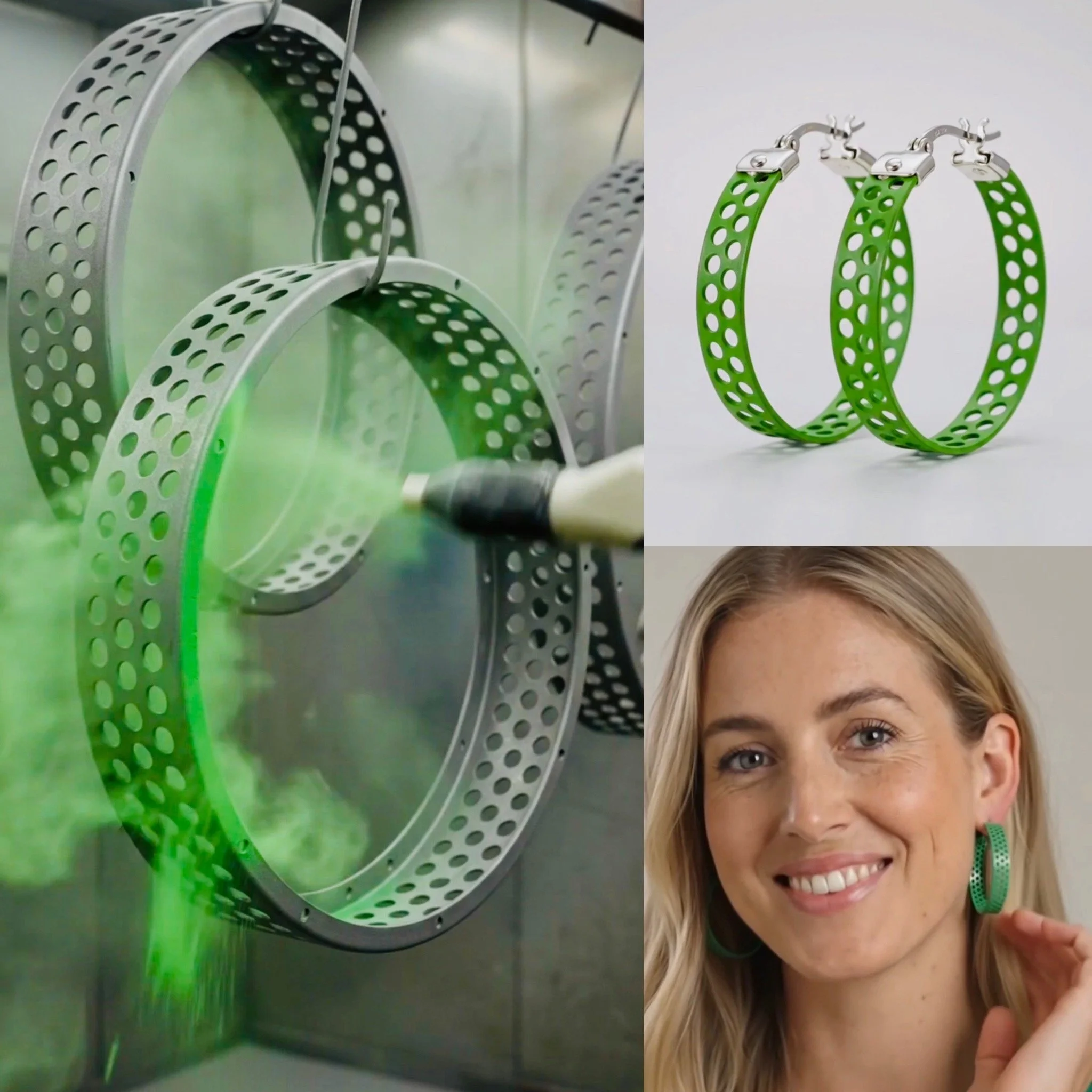
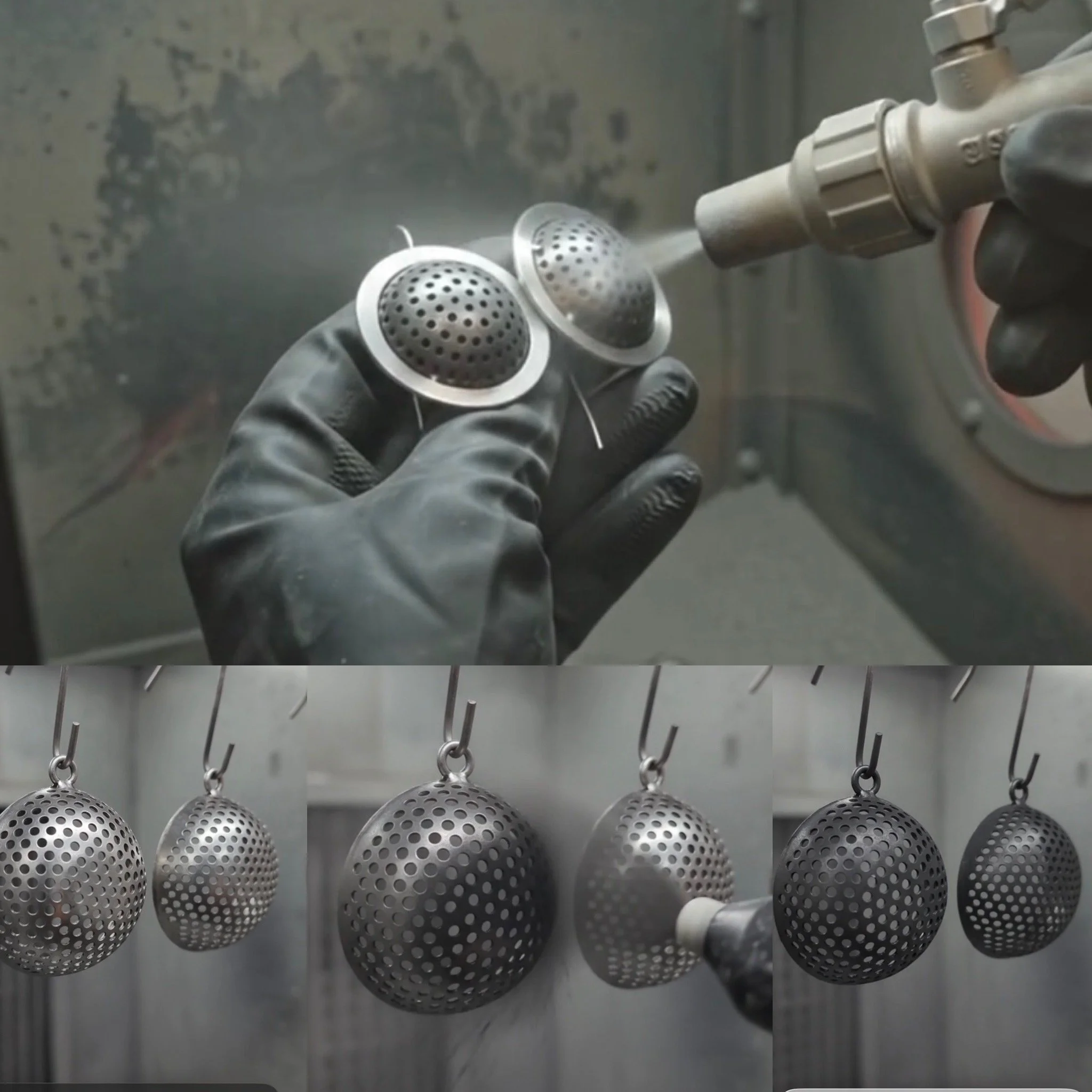
They are the sandblasting and powder-coating scenes.
These processes are actually quite difficult for me to film properly in reality. I can't easily hold a camera while sandblasting, and powder coating is not something that naturally lends itself to a simple studio reel.
Flow gave me a way to visually suggest these processes without having to film them myself.
They may not be technically perfect, but this made me realise that AI-generated video might be most useful to me not when it replaces what I can easily film, but when it visualises something that is difficult for me to capture.
That was an unexpected outcome.
Fifteen Scenes Took Two Days
I also discovered the practical limitations of working this way.
I made 15 scenes at four seconds each, but I couldn't complete them all in one day. After generating around eight scenes and trying different versions, I ran out of available credits.
So I had to stop and wait until the next day before continuing.
In total, this approximately one-minute experiment took me two days to generate and assemble.
That is interesting in itself.
Typing a prompt and generating four seconds of video feels incredibly fast. But making a longer sequence with multiple scenes, choosing between generations, maintaining some kind of visual continuity and assembling everything together is not necessarily instant at all.
AI may generate quickly, but making decisions still takes time.
What About Vrew?
I also experimented briefly with Vrew.
However, because I am not paying for a Vrew subscription at this stage, creating something this complicated and long wasn't really practical for this particular experiment.
So I decided not to force a comparison.
For now, this chapter is simply about Flow and prompt-generated video.
I may return to Vrew later when I understand more about what kind of video I actually want to create and whether a subscription would be worthwhile for my practice.
Showing the Prompts Matters
I also want to show the prompts behind this experiment.
For me, the prompts are part of the work because they show the translation between my material knowledge, language and AI-generated imagery.
For example:
My knowledge:
I know how perforated mild steel behaves when I form it with a nylon hammer, dapping block and punch.
My description:
I explain that physical process in words.
ChatGPT:
helps me structure that information into a video prompt.
Flow:
interprets those words and generates a moving image.
And then I, as the maker, look at the result and immediately recognise what is right, what is wrong and what is completely impossible.
That chain is becoming increasingly interesting to me.
The 15 prompts used in this experiment
Preparing and cleaning perforated mild steel
Cutting two circular discs
Forming the first perforated dome
Forming the second matching cup
Filing and flattening the edges
Making silver square-wire rims
Soldering the silver circles
Soldering the silver rims to the steel cups
Cleaning the soldered areas
Attaching silver wire for the hooks
Sandblasting
Matte-black powder coating
Filing back the coating to reveal the silver rim
Forming and polishing the silver hooks
Showing the finished earrings
I will include the actual prompts alongside the video so that viewers can see what instructions Flow received and compare those instructions with what it generated.
Perhaps Accuracy Isn't the Most Interesting Direction
This experiment has changed what I want to try next.
Now that I know AI-generated video can be completely wrong, I'm becoming less interested in asking it to perfectly reproduce something I already know how to make.
Instead, I want to turn that unpredictability into part of the experiment.
What if I ask Flow to imagine something that is beyond what I would normally design by hand?
Perhaps an extremely complicated structure of pipes—branching, crossing, twisting and connecting into an almost impossible piece of jewellery.
Rather than saying:
“AI, show me how I make this.”
I could ask:
“AI, show me something I haven't made before.”
Then I could look at the generated video and ask myself:
Can I actually make this at my bench?
That feels much more exciting.
AI could generate the impossible or improbable idea, but my seventeen years of making experience would have to work out the material, construction, soldering, connections, scale and compromises required to turn that moving image into a physical object.
The mistake might become the starting point.
Keep Experimenting
I think I need to make more videos.
Perhaps even one small video experiment each day for a while—not necessarily to produce finished content every time, but simply to understand what these tools can and cannot do.
The more I experiment, the more ideas I may discover.
At this stage, I am still excited.
The first video is awkward. The jewellery changes shape. Some of the making is completely wrong. It took longer than I expected and I ran out of credits halfway through.
But none of that makes me think the experiment failed.
Actually, it gives me more questions.
And that is what Hand & Algorithm is becoming for me: not trying to prove that AI can make everything better, but learning where these new tools might connect with my jewellery practice, my material knowledge and eventually my business—and where they cannot.