Chap. 3–22: When AI Makes My Jewellery Look Too Perfect-Have I gone too far?
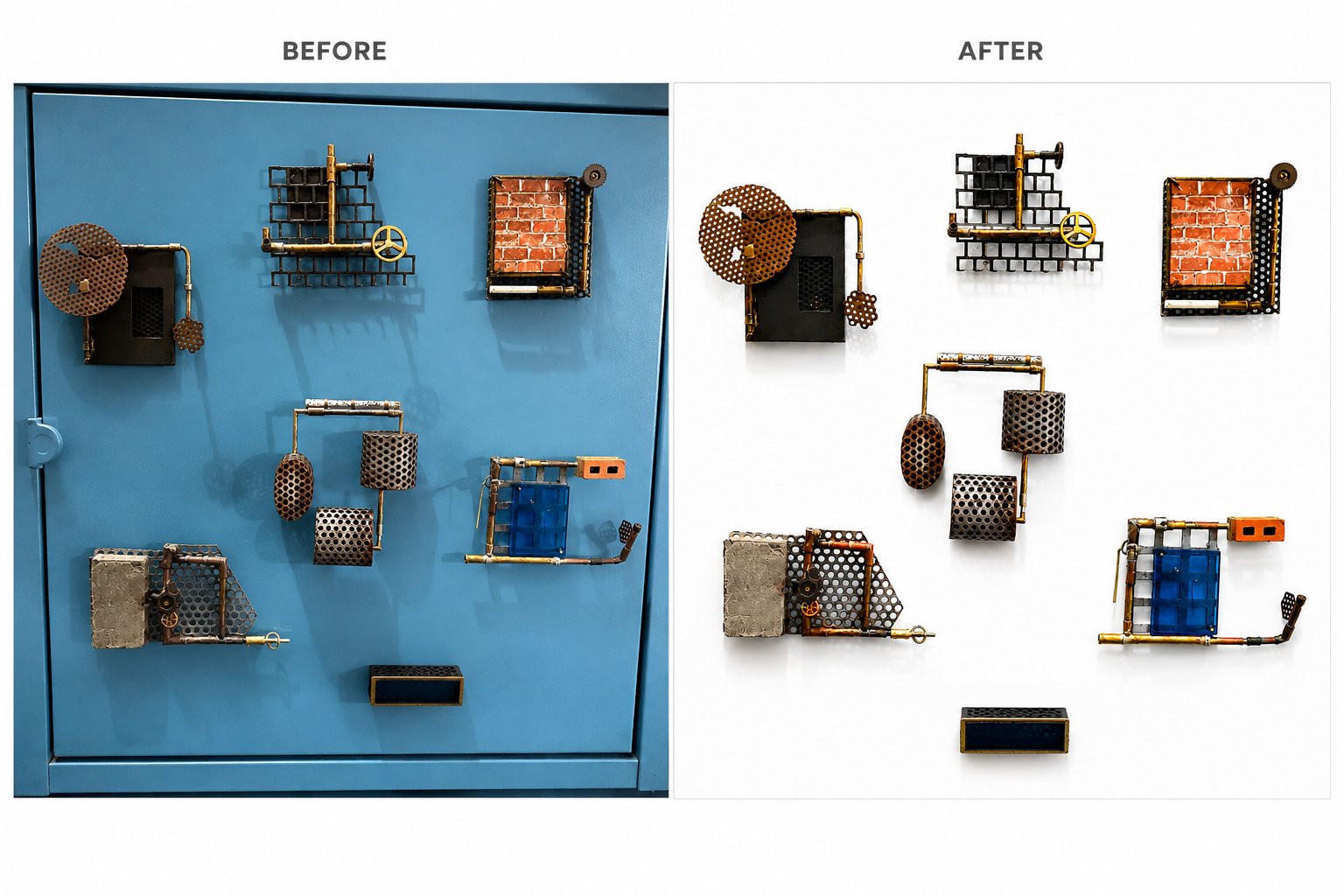
In the previous chapter, I wrote about how I use AI to edit my jewellery photographs—cleaning backgrounds, improving lighting, removing my fingers and sometimes placing jewellery onto AI-generated models.
But there is another side of this process that I want to look at more closely.
Sometimes AI doesn't just make my photograph better.
It makes my jewellery look better than my actual jewellery.
And strangely, sometimes I like the AI version more.
That is where things become much more complicated.
When the AI Version Looks Better
Imagine I have just finished making a ring.
I photograph it quickly in my studio and ask AI to put it onto a clean reflective background.
The background improves, but AI also makes the silver slightly smoother. The stone becomes brighter. The edge becomes cleaner. A tiny solder mark disappears. The proportions might become just slightly more elegant.
None of these changes are dramatic.
But suddenly I look at the image and think:
That looks really good.
Then I look at the actual ring in my hand.
It doesn't look quite like that.
This is an uncomfortable moment because I have to decide whether the AI has improved my photograph—or improved my jewellery.
There is a big difference between the two.
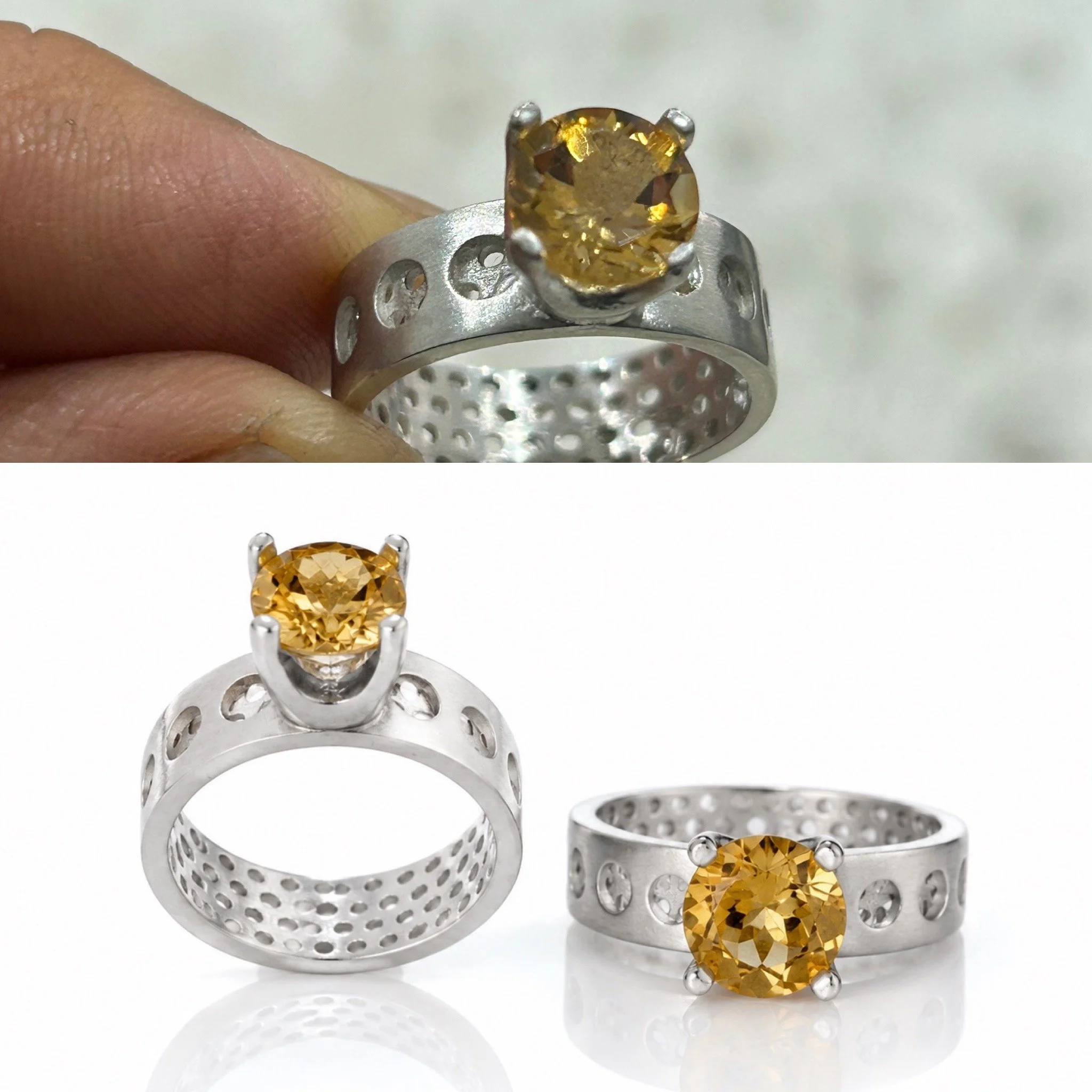
Original photograph → AI-edited photograph
What has AI actually changed? Background? Surface? Proportion? Stone?
AI Has Its Own Idea of What Jewellery Should Look Like
I have also noticed that AI seems to have a particular idea of what a beautiful jewellery photograph should be.
Ask for a professional jewellery image and it often moves towards something very familiar: perfect reflective surfaces, flawless lighting, dramatic gemstones, immaculate metal and a luxurious commercial feeling.
For some of my rings, this works beautifully.
But contemporary jewellery is not always about looking luxurious or flawless.
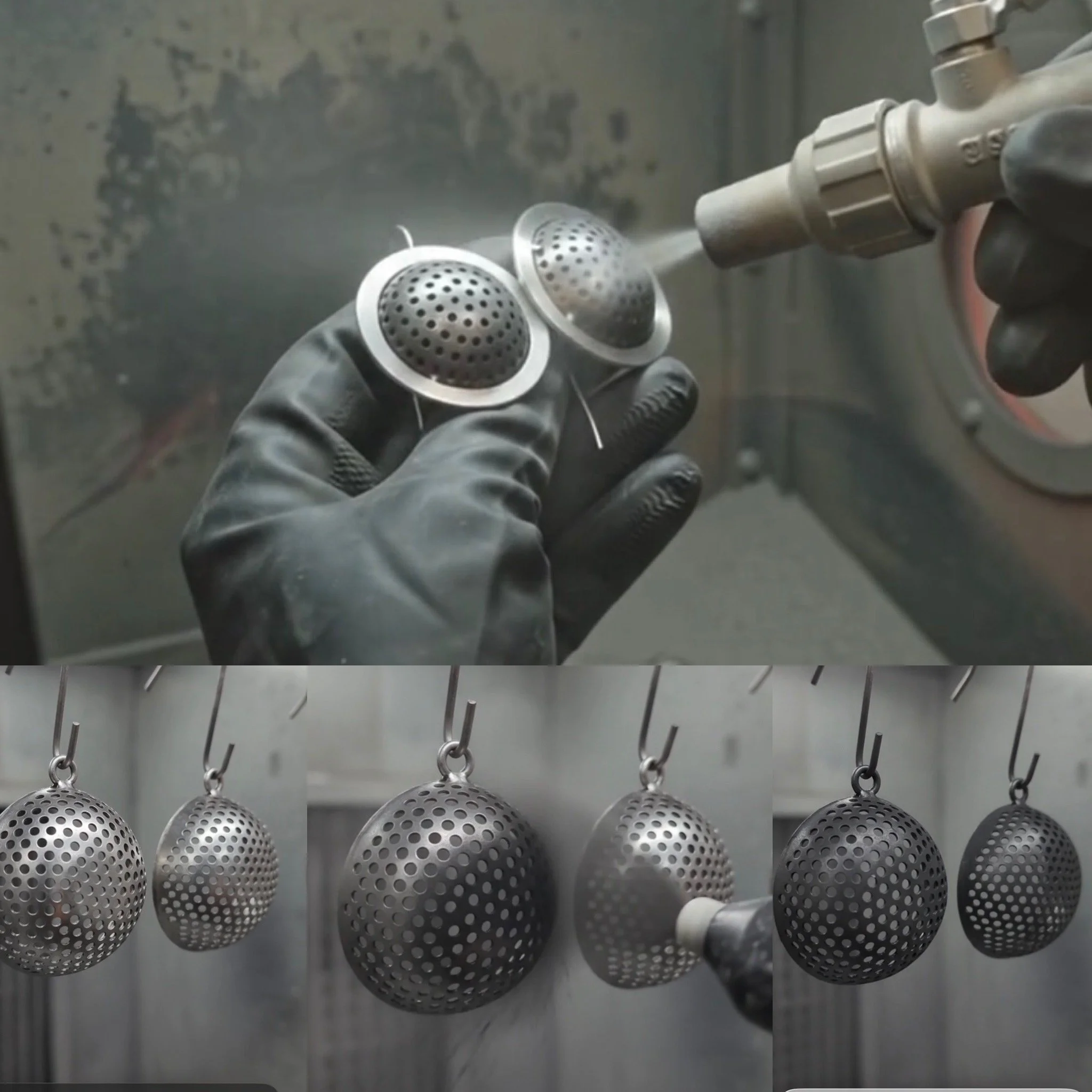
My work can include perforated mild steel, oxidised silver, powder-coated surfaces, visible construction and unusual combinations of materials. Sometimes the character of the work comes precisely from things that are not perfectly smooth or symmetrical.
AI doesn't necessarily understand why I want those things to remain.
It simply sees something that could be made more visually perfect.
But perfect according to whom?
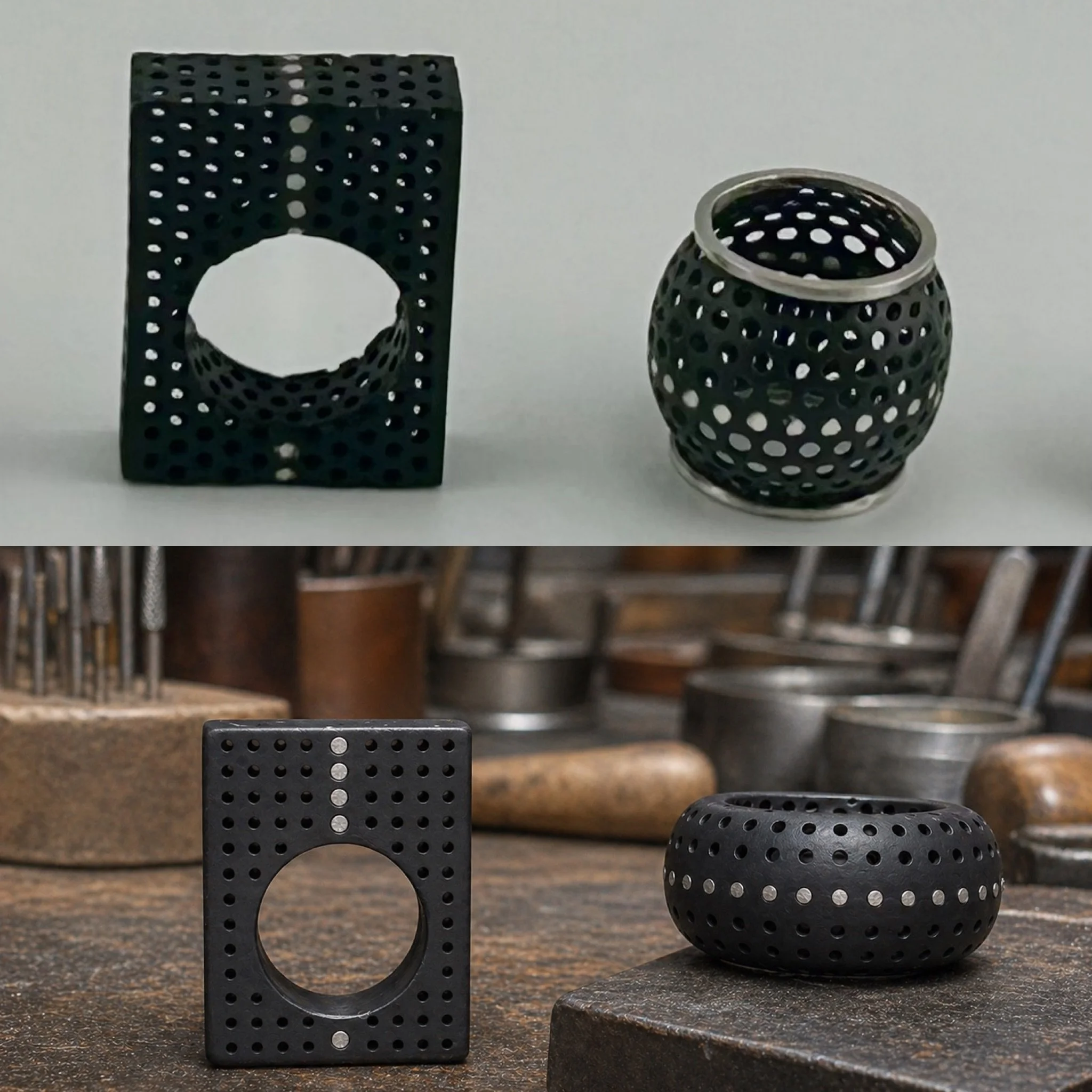
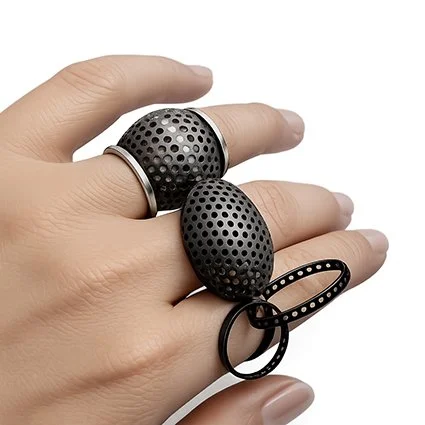
Actual surface → AI's interpretation of the surface
This could be particularly interesting with perforated steel, oxidised silver or one of my more industrial pieces.
As you can see, the roughness and originality of the fabricated perforated metal surface have been completely smoothed out. I feel that some of the excitement and unexpectedness of the material and fabrication process have been lost. It is a pity, and I don’t think I like it this way.
Also, when editing becomes designing, something else starts to happen. The AI-edited oval ring above, with silver inlays through the centre, actually suggests a completely different making process.
In my original work, I use ready-made perforated metal and fabricate the form through hammering and forming. But to make the AI-edited version physically, I would probably need to form the oval shape first and then drill each hole individually to achieve that consistent perforation.
So, is AI suggesting a different way of making?
What I can tell you now is: not really. AI is not that smart yet! It changed the image, but it didn't tell me how that change could actually be made at the bench. The understanding that this version would require a completely different fabrication process comes from my own knowledge and experience as a maker.
This is an important distinction for me.
AI can suggest a different-looking object, but understanding how that object could actually be made still comes from the maker.
Could AI Start Changing What I Make?
There is another possibility that I find even more interesting.
What if I actually prefer something AI changed?
Perhaps AI accidentally makes an edge thinner.
I look at it and think:
Actually... that might be better.
Then the next time I go to my bench, I make the edge thinner.
Something unexpected has happened.
Originally, the process was:
My hand → Jewellery → Photograph → AI-edited image
But now it could become:
My hand → Jewellery → Photograph → AI → New idea → Back to my hand
AI is no longer simply editing the photograph.
It has entered the design process.
This does not necessarily mean that AI has designed the jewellery for me. I still have to decide whether the suggestion makes sense. I need to understand the material, work out how it could be constructed and then physically make the object.
But the image has influenced my judgement.
And perhaps this is one of the more interesting questions emerging from Hand & Algorithm:
Can an AI-edited image slowly change what I consider beautiful?
Selling an Image and Documenting an Object Are Different Things
There is also a practical side to all of this.
I need good photographs because I need people to see my work.
On Instagram, a clean and beautiful photograph might stop someone scrolling.
On my website, it might help someone understand the jewellery clearly enough to want to buy it.
For those purposes, I am comfortable improving lighting, backgrounds and presentation.
But documentation has a different responsibility.
If I am photographing work for an exhibition application, competition, publication or my own archive, accuracy becomes much more important.
The image needs to represent the object that actually exists.
Perhaps this means I don't need one rule for every photograph.
Instead, I need to ask:
What is this image for?
Would I Show This Image Beside the Real Piece?
There is one very simple test I can use.
If someone buys my jewellery after seeing an AI-edited image, would I feel comfortable putting that photograph beside the actual piece and saying:
Yes. This is an accurate representation of what you bought.
If the answer is yes, perhaps the editing has done its job.
If the answer is no, perhaps I have gone too far.
Because ultimately, I am not selling the image.
I am selling the object.
What Happens to Imperfection?
This experiment has also made me think differently about imperfection.
AI often seems to read irregularity as something that needs correcting.
But as a maker, I don't necessarily see it that way.
A slight variation in a surface, evidence of forming metal, a soldered connection or the character of an oxidised finish can tell us something about how an object came into existence.
They are not always mistakes.
They can be evidence of the hand and the making process.
Perhaps this is why an AI image can sometimes become strangely lifeless when it is made too perfect.
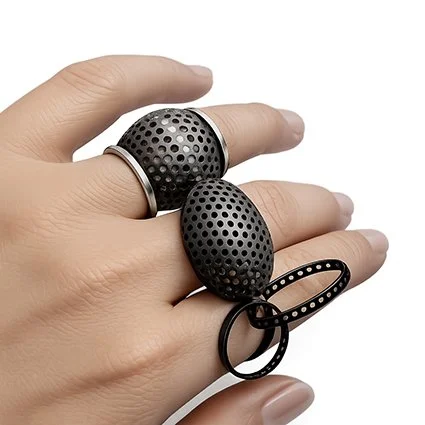
Three perforated metal rings in 3 different ways of wearing and designs-Design is a little modified but I like this image.
Everything is correct.
Everything is polished.
Everything is beautiful.
And somehow, something has disappeared.
Where Do I Stop?
Looking at these examples, I don't think the most important question is simply whether the AI-edited image looks better.
Instead, I want to ask:
At what point do I stop recognising the object I made?
In the previous chapter, I learned that one of the most useful instructions I can give AI is:
“Don't change the jewellery.”
But perhaps the harder question comes after that.
How much change am I willing to accept when the changed version looks better?
AI can edit my photograph. It can make my jewellery smoother, cleaner, brighter and perhaps even more desirable.
But the more I experiment with it, the more I realise that I also need to pay attention to what is happening in the opposite direction.
AI may change the image.
I look at the changed image.
The image may then give me another idea about how I could make the next piece.
And suddenly the relationship between the hand and the algorithm is no longer moving in only one direction.
Perhaps AI doesn't only edit the image.
Perhaps the image can also begin to edit my judgement.