Chap. 3-25: Ingredients → Process → Final Piece: Building a Jewellery Reel with Vrew AI
After experimenting with AI-generated jewellery videos in Flow, I wanted to try something slightly different.
Rather than asking AI to imagine how a piece of jewellery might be made, I decided to begin with something I already have: my actual making process.
This experiment also became the starting point for a new Instagram content idea:
Ingredients → Process of Making → Final Piece
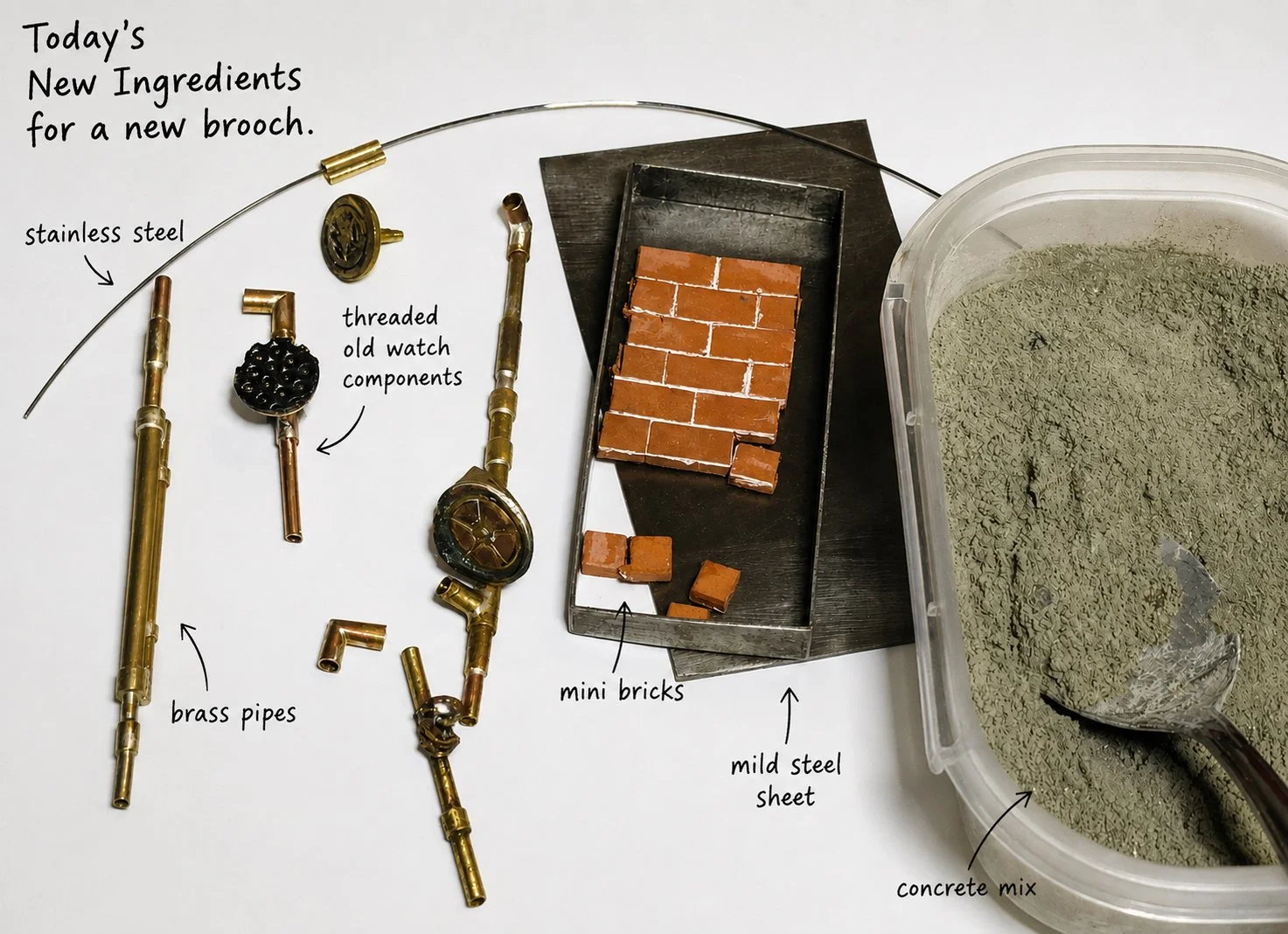
It is almost like a cooking video, except instead of flour, butter and eggs, my ingredients are mild steel, brass pipes, concrete, miniature bricks and old watch components.
And instead of a cake at the end, there is a brooch.
For this first experiment, I used my new brooch The Wall Has Moved.
Starting with the ingredients
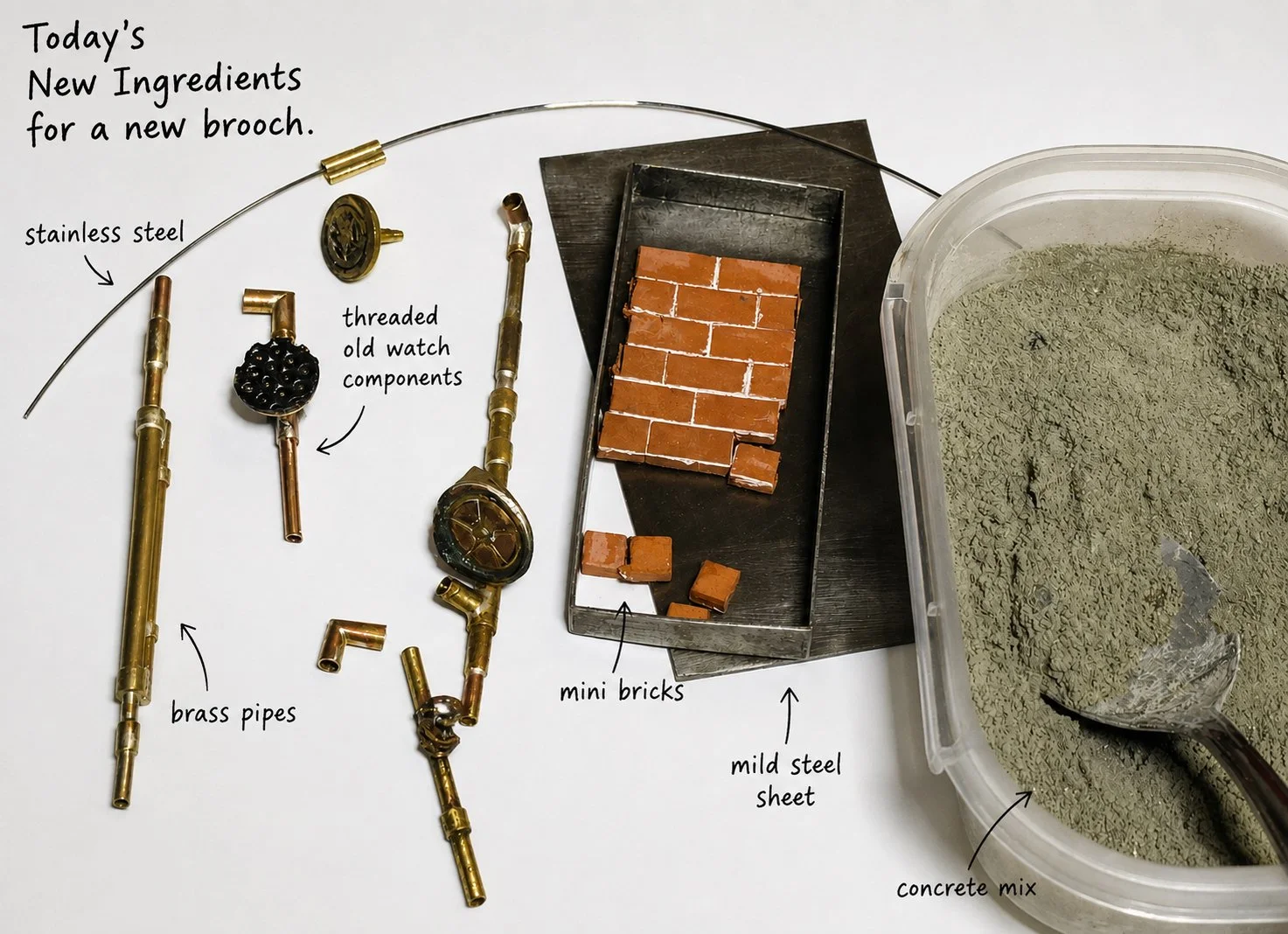
The ingredients for the brooch
Before I began editing the video, I photographed all the materials and components together.
For The Wall Has Moved, the ingredients included mild steel, brass pipes, concrete mix, miniature bricks, stainless steel, threaded old watch components and some of the small mechanical elements I had collected.
I liked starting the video this way because normally, when people see a finished piece of contemporary jewellery, they may have no idea what it began as.
The finished object can hide an enormous amount of making.
By showing the ingredients first, I can reveal some of that transformation.
It also creates a simple structure for the viewer:
These are the materials.
This is what I did with them.
And this is what they became.
For Instagram, I think this could become a recognisable format that I can repeat with many different pieces.
Recording the real process
This time, I didn't want AI to generate the fabrication process for me.
I used photographs and video from my actual bench work.
The video moves through different stages: preparing the mild-steel base, positioning the frame that will contain the concrete, constructing and soldering the pipe structure, using binding wire during soldering, sandblasting the assembled metalwork, attaching the brooch mechanism, setting concrete and miniature bricks, applying patina to the pipes, and finally showing the completed brooch.
The final video is only around 42 seconds, but behind those 42 seconds is a much longer physical process.
And I think that contrast is interesting.
A few seconds of video might represent an hour—or several hours—of filing, soldering, fitting, cleaning, waiting, adjusting and trying again.
AI can speed up the communication of the work.
It cannot speed up the knowledge inside my hands.
Using Vrew as the editor
I brought all these images and clips into Vrew AI and used it to construct the final sequence.
Vrew is an AI-assisted video editing platform developed in South Korea. It is designed to make video production easier by combining traditional video editing with AI-supported tools such as automatic captions, text-based editing, narration, music, images and scene organisation.
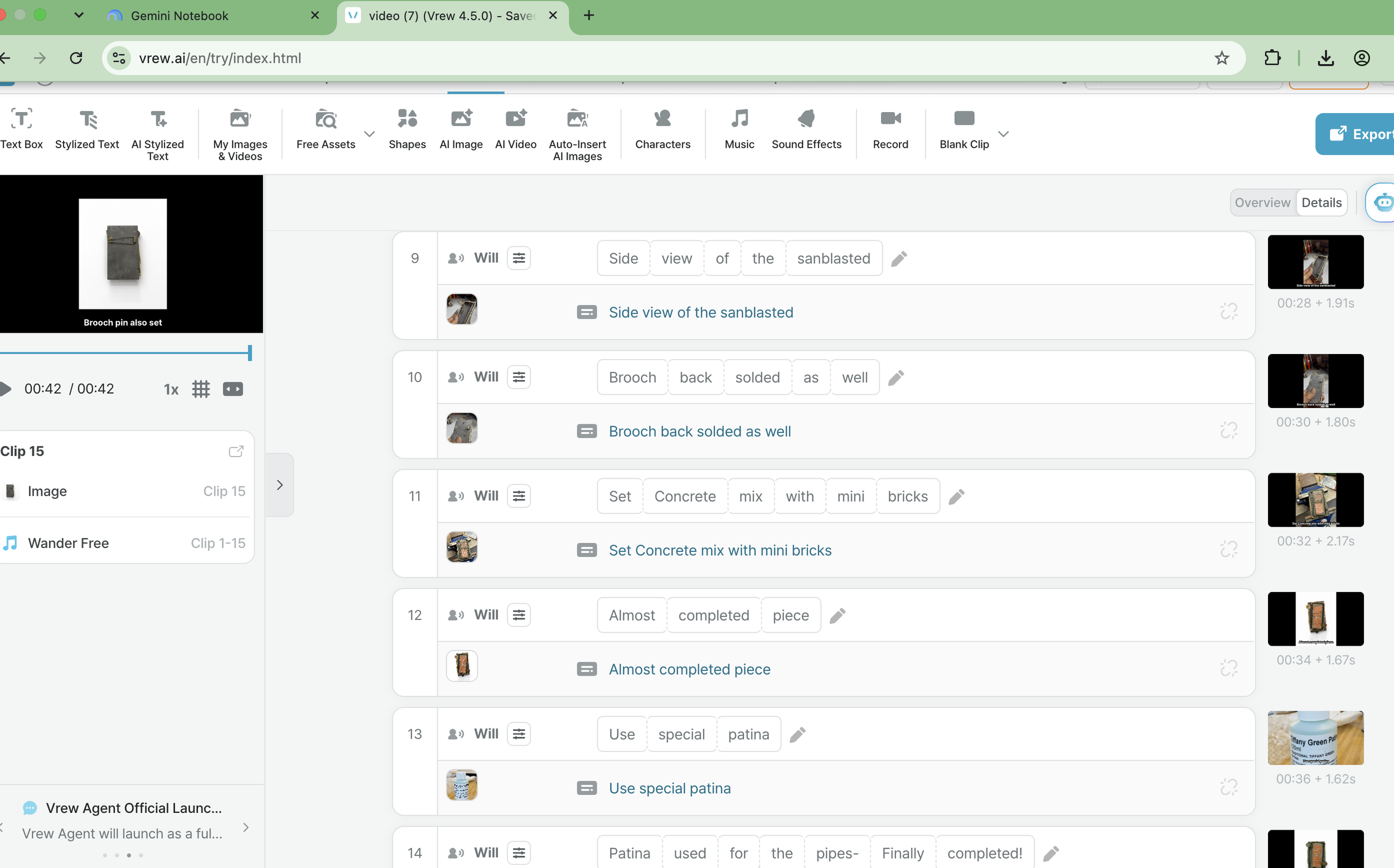
The screenshot of Vrew interface to show the sequence of the video
The screenshot of my Vrew workspace is interesting to me because you can actually see the process becoming a kind of visual script.
Each section has a short description:
Side view of the sandblasted…
Brooch back soldered as well.
Set concrete mix with mini bricks.
Almost completed piece.
Use special patina.
Patina used for the pipes — finally completed!
Vrew helped me turn many disconnected pieces of documentation into one short story.
I could arrange the sequence, add text and narration, adjust the timing and add music. What had been a folder of photographs and small video clips gradually became a 42-second explanation of how the brooch came into existence.
This feels quite different from my earlier experiments with Flow.
Flow imagined. Vrew organised.
In my previous Flow experiments, one of the biggest problems was accuracy.
I could describe a jewellery-making process very carefully, but AI would still change the object halfway through the video. A cup-shaped earring could suddenly become another shape. A silver hook could be fabricated in an impossible way. Tools and materials could behave differently from how they behave at a real jewellery bench.
It was fun—and sometimes visually beautiful—but it wasn't really my making process.
With this Vrew experiment, the relationship with AI changed.
AI was not generating the jewellery.
AI was helping me tell the story of jewellery I had actually made.
That distinction feels important.
The bricks are the bricks I placed.
The soldering is my soldering.
The rough concrete is the concrete I mixed.
The patina, scratches, marks and slightly unpredictable surfaces come from the physical process.
Vrew helps with the editing and presentation, but the material information remains mine.
For my Hand & Algorithm experiment, this might actually be a much more useful example of AI working as a studio assistant.
A new Instagram format
This experiment has also given me a clearer idea about what I want to do with my jewellery Instagram.
Rather than only posting a beautiful photograph of a finished piece, I want to create a repeating story:
INGREDIENTS → MAKING → FINISHED JEWELLERY
I want to photograph the materials before I begin.
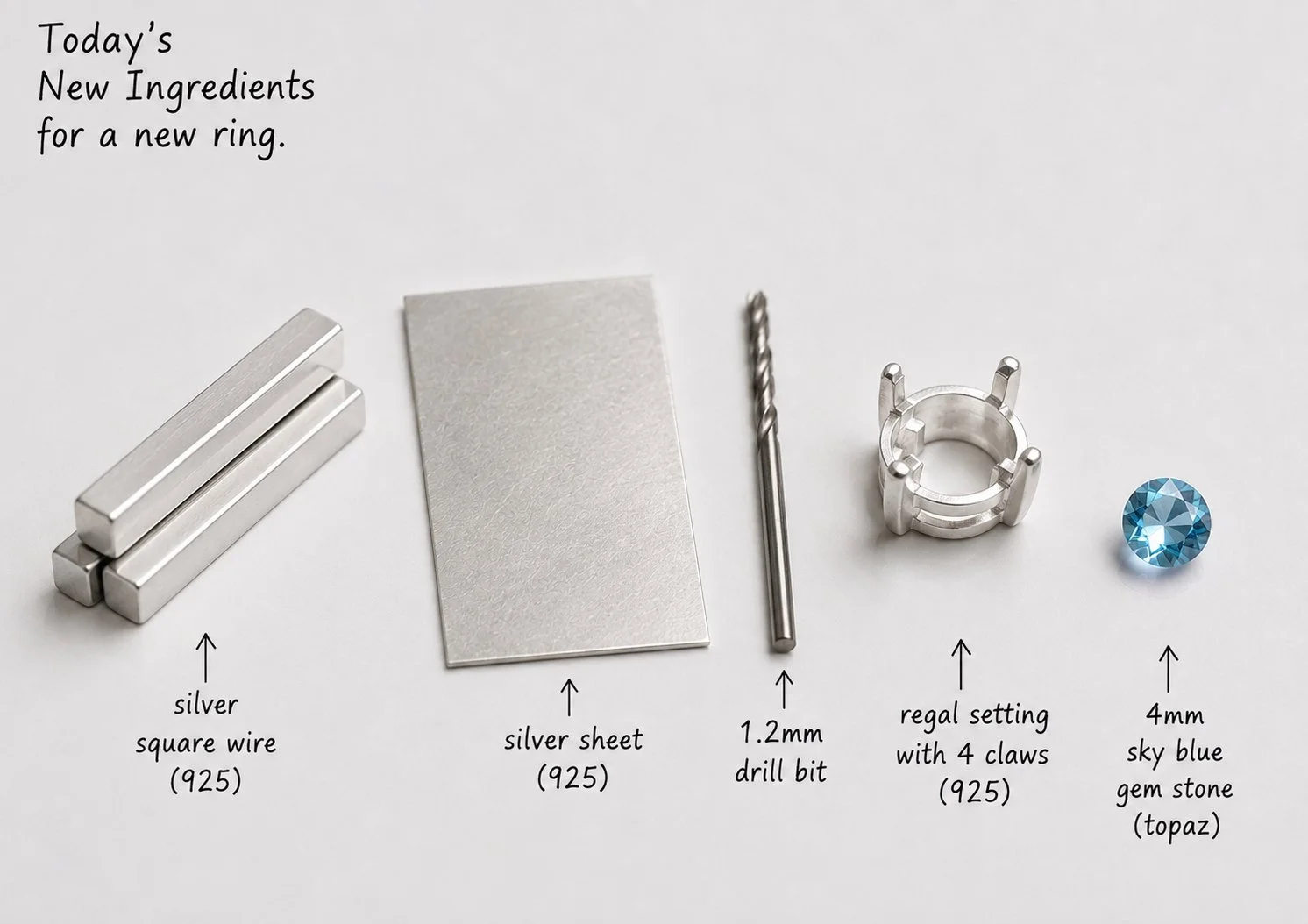
Another example of the ingredients image.- ring
Then, while working at the bench, I can collect a few short clips or photographs rather than trying to film every second of the fabrication.
Finally, I photograph the completed jewellery properly.
Vrew can help me bring those fragments together into a short Reel.
This feels manageable.
And importantly, it fits naturally with the way I already work.
I don't have to invent content separately from making jewellery. Making the jewellery becomes the content.
That is probably the biggest lesson from this experiment.
Showing what sits behind the finished object
There is another reason I like this format.
Contemporary jewellery often appears online only as a finished object against a clean background.
I do that myself. I photograph my work on white reflective backgrounds because I want people to see the form clearly.
But there is a danger that the cleaner the final photograph becomes, the more invisible the labour becomes.
With The Wall Has Moved, the finished brooch contains concrete, miniature brick walls, oxidised and patinated pipes, old mechanical components and a mild-steel structure. The surfaces are deliberately not perfect.
Showing the ingredients and construction lets the viewer understand why those surfaces exist.
The imperfections aren't simply decoration added afterwards.
They are evidence of the process.
Where AI fits
Perhaps this experiment is helping me answer one of the questions that has been underneath this whole project:
Where is AI actually useful in my practice?
Not necessarily in pretending to know how to solder.
Not necessarily in inventing a fabrication process it doesn't fully understand.
But in organising, editing, captioning, sequencing and helping me communicate what I already know how to do.
That is a quieter role for AI.
But perhaps it is a more useful one.
My hands still make the brooch.
My experience decides how the materials should be connected.
My judgement decides when the concrete is rough enough, when the patina is right, and when the piece is finished.
Vrew helps turn that long physical process into something another person can watch in less than a minute.
And that is exactly what I originally meant when I started calling AI my studio assistant.
What comes next
The Wall Has Moved is only the first trial of this new format.
I want to continue making these Ingredients → Process → Final Piece videos with different pieces of jewellery and see what happens after five, ten or twenty of them.
I don't want every Reel to look identical. The materials and processes will naturally change.
But the structure can remain familiar.
Perhaps over time, people will begin to recognise a Jin Ah Jo jewellery video before they even see the finished piece.
And for me, there is something satisfying about beginning with a table full of strange ingredients and ending with an object that didn't exist before.
That transformation is what jewellery making has always been about.
AI is simply helping me show it.