Chap. 3-20: Using AI to Proofread My English Without Losing My Voice
English is my second language.
I have lived in Australia for many years. I work here, run my jewellery practice here, raise my family here and communicate in English every day. But that doesn't mean communicating in English has always felt easy.
For a long time, I often felt disconnected because I couldn't express exactly what I wanted to say. I knew what I meant in my head, but getting that thought into good-flowing English was another matter.
My husband used to proofread things for me very often. He was always sweet and willing to help, and I appreciated it. But there was another feeling underneath that gratitude.
I sometimes felt powerless.
I didn't want to depend on another person every time I needed to write an important email, an artist statement or something for my website. Even when the idea was completely mine, I needed someone else to help me communicate it properly.
This is one of the reasons AI proofreading has become unexpectedly important to me.
It Is About Communication, Not Perfect English
When I first started using AI for proofreading, I immediately found it useful.
I could write something in my own English and ask AI to check the grammar or improve the flow. I could ask:
“Does this make sense?”
“Can you make this clearer?”
“Can you correct my English but keep the way I speak?”
Suddenly I didn't have to wait for somebody else.
That might sound like a small convenience, but to me it has a personal and emotional value.
Living in a country where your first language is not the main language can sometimes make communication feel unstable. You can have the knowledge, experience and ideas, but still worry about whether other people will understand you in the way you intended.
Now, knowing that I can get help with my English whenever I need it makes me feel more stable and independent.
AI doesn't give me the ideas.
It helps me get the ideas across.
And there is an important difference between those two things.
Moving Between Two Languages
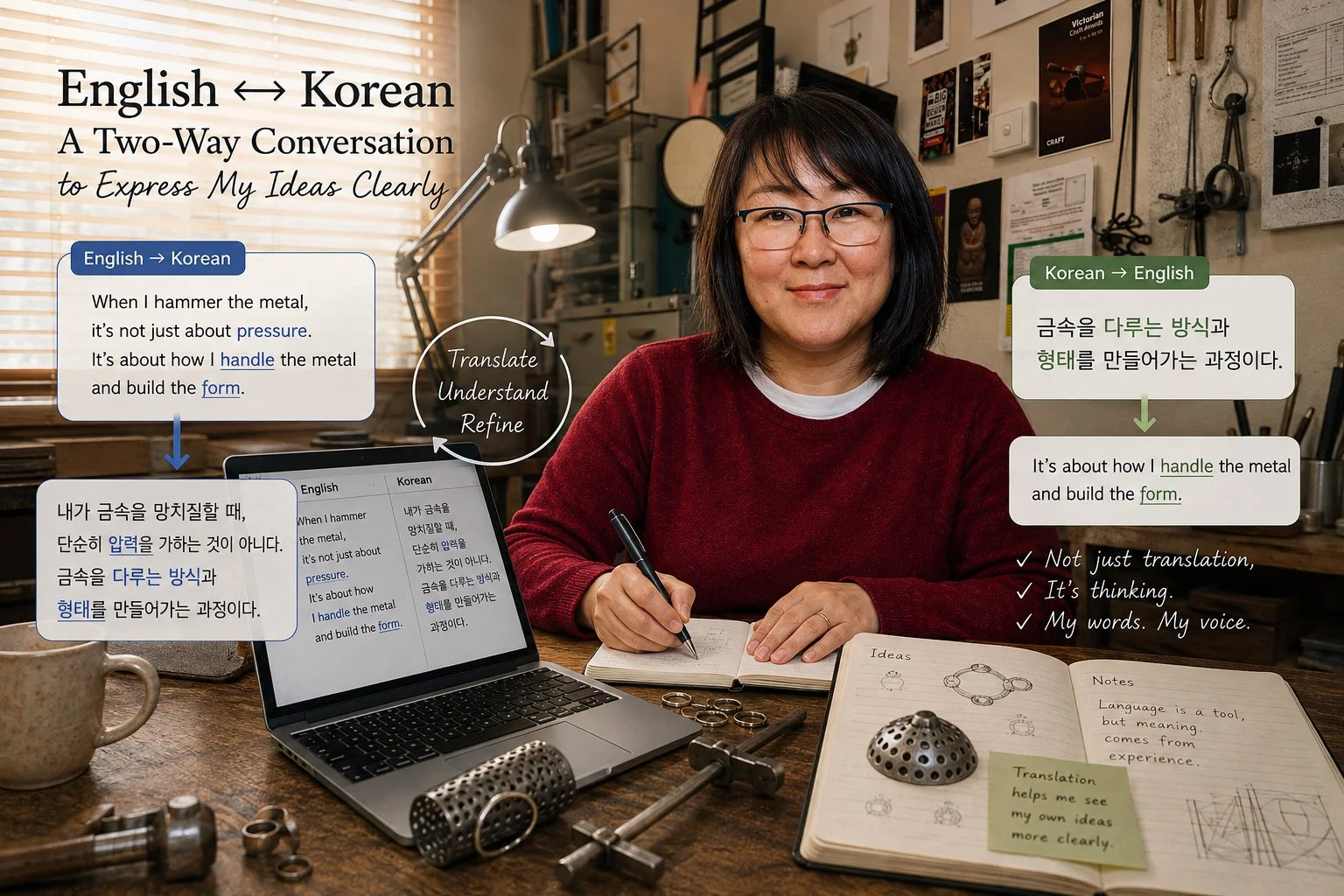
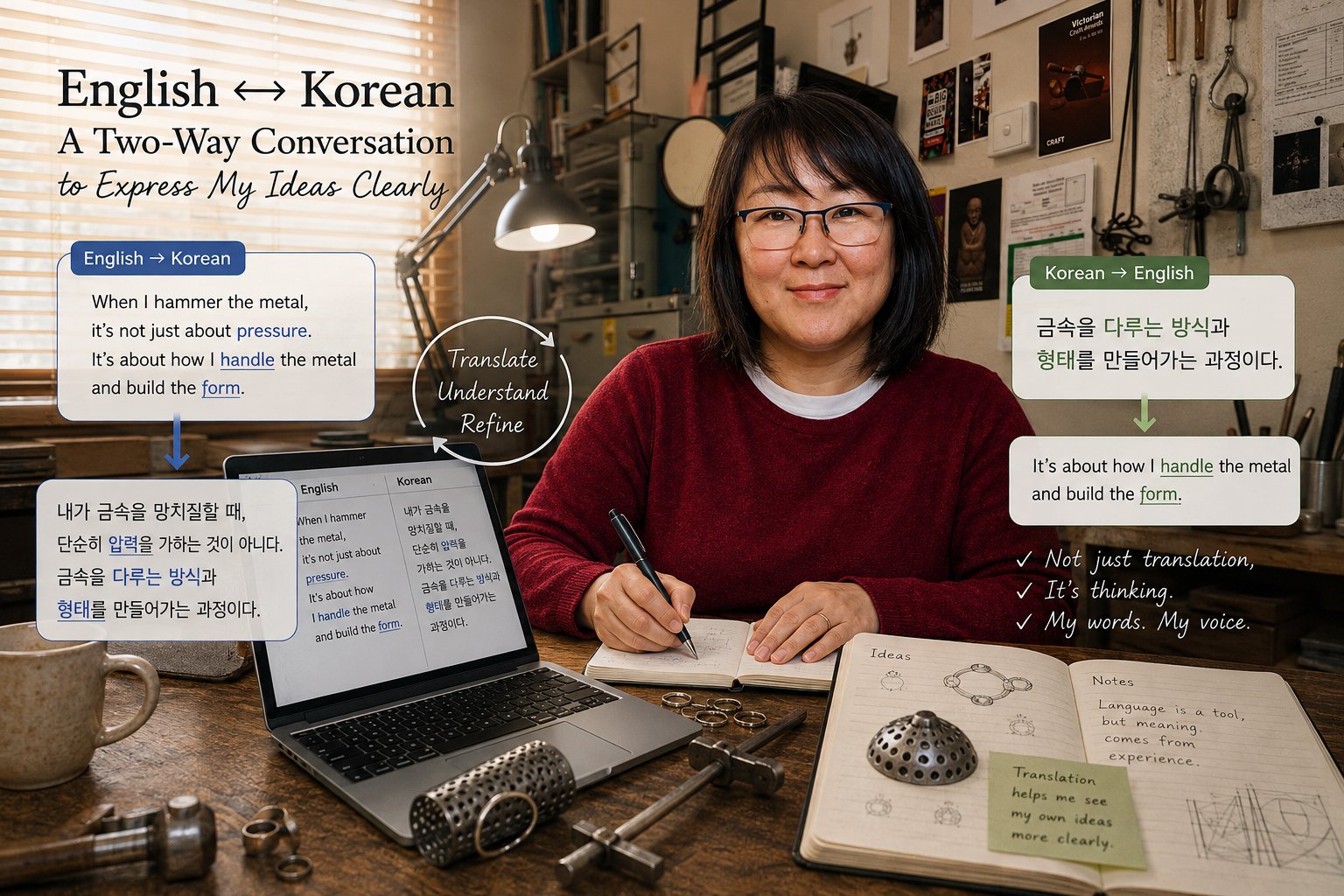
AI has also changed the way I move between Korean and English.
While studying the Plus Human course, for example, I sometimes take Korean prompts from the course and translate them into English. I don't necessarily have to do this, but seeing the same idea in another language sometimes helps me understand what the prompt is actually asking me to do.
I also use translation in the opposite direction.
When I encounter difficult English—particularly professional or highly technical language—I sometimes ask AI to explain or translate it into Korean.
Medical terminology is a good example.
I can read a medical report in English and understand parts of it, but when the terminology becomes very specialised, reading an explanation in my mother tongue gives me a much deeper and more immediate understanding.
This made me realise that translation isn't simply:
Korean → English
or
English → Korean.
Sometimes I move backwards and forwards between the two languages until I understand the idea properly.
Korean → English → clarification → Korean → understanding.
AI becomes a kind of bridge between the languages rather than simply a translation machine.
But Whose Voice Is It?
There is another side to this convenience.
AI is very good at making English sound polished.
Sometimes, perhaps, too good.
When I ask it to improve something I have written, the result can suddenly sound much more academic, sophisticated or confident than I would naturally speak.
The grammar might be perfect, but I read it and think:
I would never say that.
So I have started giving AI different instructions:
“Make it simpler.”
“Don't make it too wordy.”
“Keep my voice.”
“This doesn't sound like me.”
These instructions are becoming just as important as asking it to correct my grammar.
I don't want perfect English if the price is losing myself from the writing.
AI Can Correct My English, but I Can Correct AI
There is another limitation I have discovered.
AI can make a sentence grammatically perfect while making the meaning slightly wrong.
This becomes especially obvious when I write about jewellery making.
I understand soldering, hammering, filing, constructing and handling metal through years of physical practice. AI understands those processes primarily through language and information.
Recently AI described part of my making process as being about “how much pressure I use.”
I immediately disagreed.
Hammering, soldering and filing are not simply about pressure. What I was trying to describe was much closer to handling metal and building form.
The English might have sounded convincing, but the material understanding wasn't quite right.
That small moment was important.
AI might be helping me with the language, but I still hold the knowledge.
A Different Kind of Independence
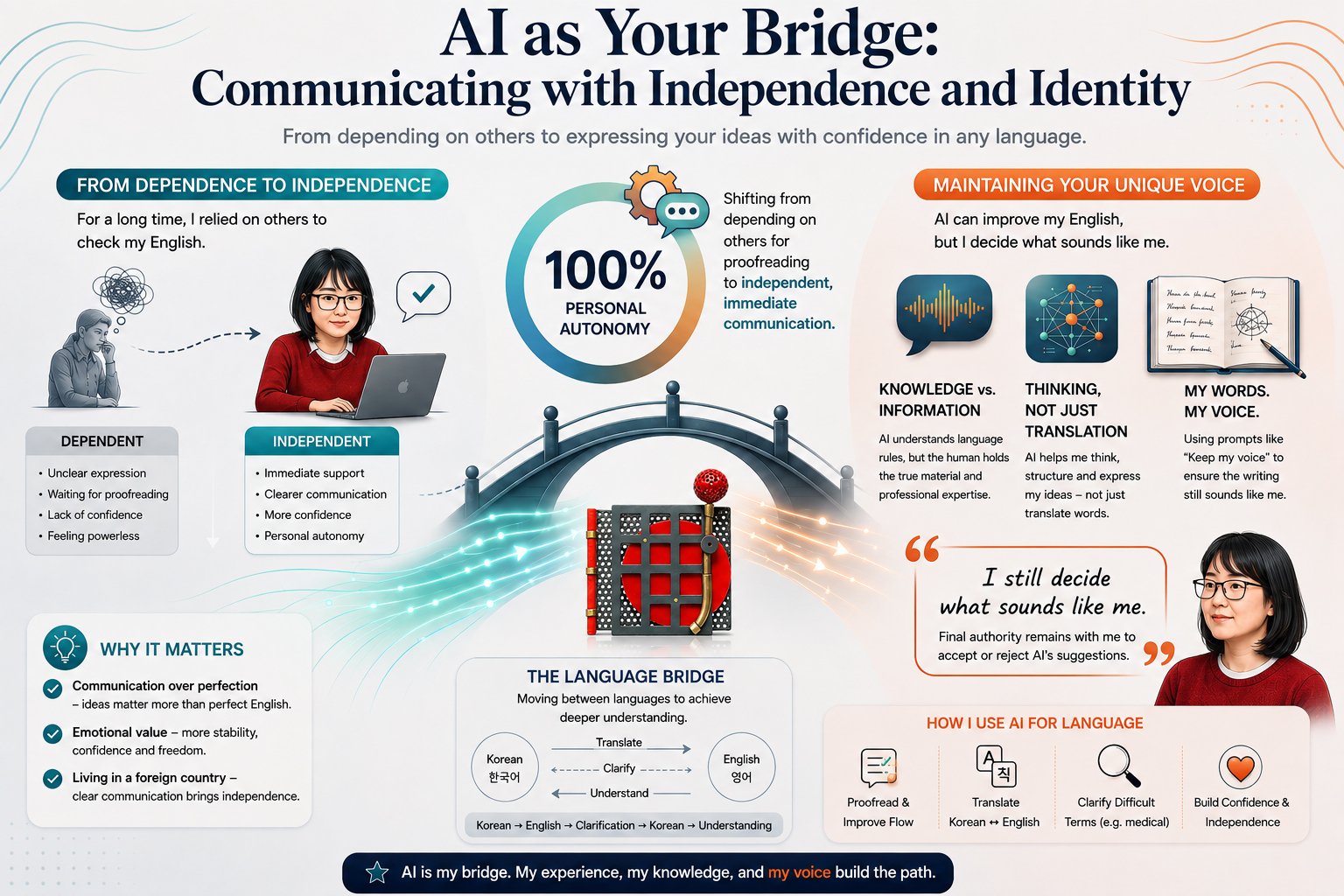
At the beginning of Hand & Algorithm, I thought about AI mainly as a possible studio assistant: something that could help with research, images, planning, writing and perhaps even design.
I didn't expect proofreading to become one of its most personally meaningful roles.
For someone working in their second language, the ability to communicate independently is not simply about efficiency.
For me, there is confidence attached to it.
There is independence attached to it.
And perhaps even a small sense of freedom.
I can write something imperfectly. I can ask questions. I can translate it backwards and forwards. I can reject AI's version. I can rewrite it again.
The final words don't have to be perfect.
They just need to communicate what I am trying to say.
So perhaps using AI for English is not about making my voice sound more English.
It is about giving my own voice a clearer way to come through.
AI can proofread my English.
But I still decide what sounds like me.