Chap. 3–19: NotebookLM — Turning Specific Research into New Forms
As an independent jewellery artist, I do much more than physically make jewellery. I research, write blog posts, prepare exhibition applications, photograph and describe my work, update my website, analyse sales, and promote my practice through Instagram, newsletters, and videos. Each activity creates more documents, links, images, videos, and notes.
The challenge is not always finding information. Often, it is bringing the right information together and understanding how it relates specifically to my practice.
This is where I began using Google's Gemini Notebook (formerly NotebookLM).
What Is Gemini Notebook?
Gemini Notebook is an AI research tool developed by Google. It allows me to create an individual notebook for a particular subject and fill it with selected sources.
These sources can include PDFs, websites, YouTube videos, Google Docs, presentations, audio files, and my own writing. Once they are collected, I can ask questions about them, compare different arguments, identify repeated themes, and generate summaries. Because its answers include direct citations, I can always return to my original material to verify the context.
This is entirely different from asking a general AI tool a broad question. Gemini Notebook works strictly from the sources I have selected for that specific notebook. In a way, I am building a small, highly focused research environment for each distinct part of my practice.
Building Notebooks Around My Practice
I have created separate notebooks for different aspects of my studio:
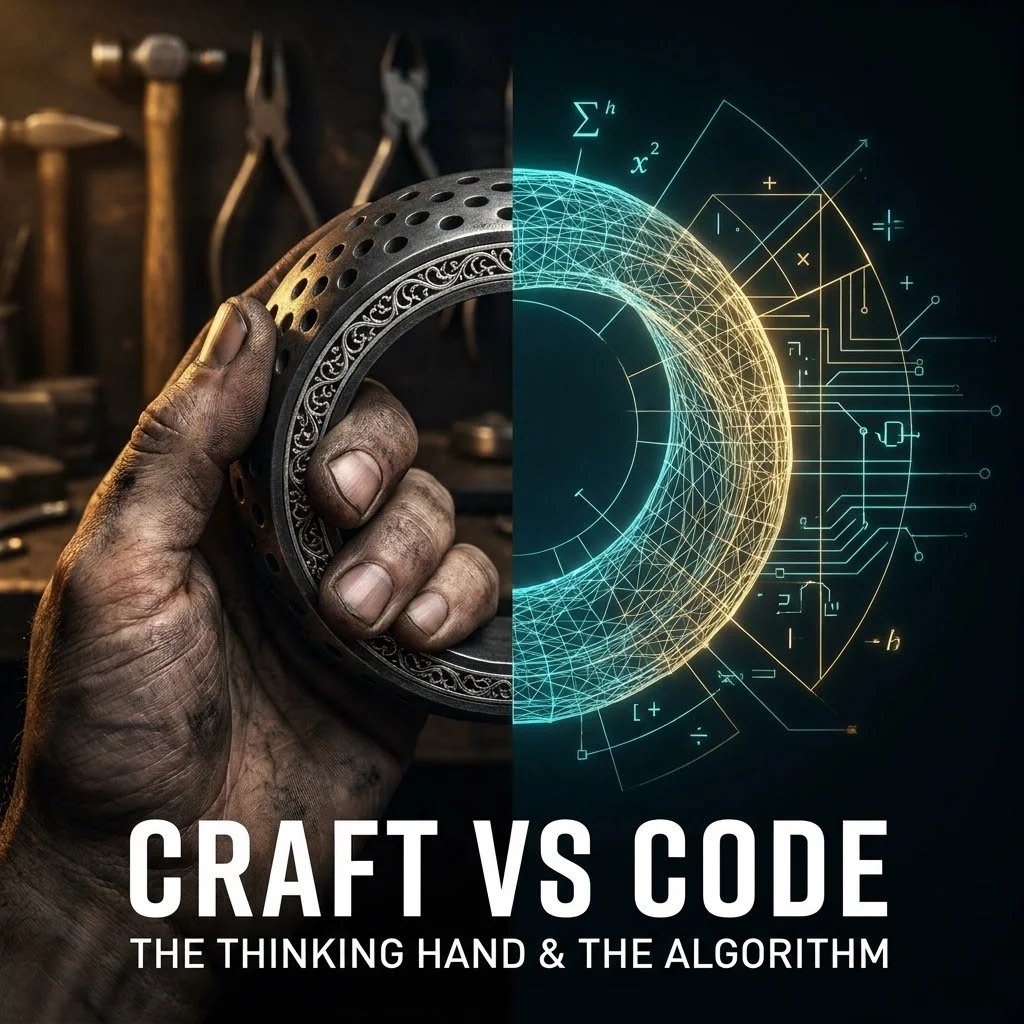
Hand & Algorithm
Jin Ah Jo Contemporary Jewellery
The City and Its Uncertain Walls
My jewellery sales history
The Big Design Market
Product pages for my website
Social media promotion
New directions in my practice
These notebooks are connected, but each serves a unique purpose. For example, my Hand & Algorithm notebook contains research and writing connected to AI, contemporary art, design, craft, authorship, and material knowledge. Conversely, my Big Design Market notebook is purely practical, focusing on customers, promotion, stock, display, and preparation.
Separating these subjects helps me ask useful, targeted questions instead of expecting one broad AI system to understand my entire practice at once.
Researching AI and Creative Practice
For Hand & Algorithm, I have been researching three closely connected areas:
AI and art
AI and design
AI and craft
Although they overlap, the discussions are not identical. AI and art often raise questions about originality, authorship, and image generation. AI and design focus more on speed, iteration, and collaboration. AI and craft, however, introduces entirely different concerns: touch, material resistance, embodied knowledge, repetition, and the intuitive skills developed through years of physical experience.
By bringing these specific sources together, I can compare how different creative fields are responding to digital change. I can ask my notebook questions such as:
What concerns about authorship appear across art, design, and craft?
How is embodied knowledge discussed differently within craft?
Which arguments are most relevant to a contemporary jeweller using AI as a studio assistant?
Where do the sources agree, and where do they contradict each other?
This gives me highly specific information tailored to my project, rather than generic online advice. It doesn’t make the research automatically correct—I still must check the sources and decide which arguments are relevant—but it helps me recognize connections that are hard to spot when scattered across separate files.
Analysing Jewellery Shorts and Reels
I also use Gemini Notebook for very practical, business-focused research—like studying successful jewellery-making videos.
I collected popular YouTube Shorts and Reels about jewellery making, including examples with high view counts. I then asked my notebook to analyse what these videos had in common:
What happens during the first crucial seconds?
Which making processes immediately attract eye contact?
How quickly do the scenes cut and change?
Is the finished jewellery shown at the beginning or saved for a final reveal?
How are the maker’s hands, tools, and materials framed?
Do the videos create interest through skill, transformation, surprise, or satisfying movement?
From this research, I can ask the notebook to draft highly specific, structured outlines for my own video content:
"Compare these highly viewed jewellery-making Shorts. Identify repeated patterns in their opening, pacing, camera angles, and final reveal. Based on these findings, create a 20-second Reel structure showing the making of my perforated metal earrings—while preserving my real hands, real tools, and real workbench."
This is infinitely more useful than simply asking a generic AI tool to "make a viral jewellery Reel." I am not trying to copy another maker’s content. I see it as benchmarking: studying how short-form video communicates, and deciding which elements I can honestly adapt to my own practice.
Prompt Writing as a Tool for Self-Reflection
Using these tools has reminded me that the quality of an AI's response depends entirely on the clarity of the question.
A broad prompt produces broad, useless advice. A great prompt must explain what sources to examine, what I want to learn, who the audience is, and what must remain authentic to my practice. I also ask critical follow-up questions:
Which of these recommendations are too corporate or general for a one-person jewellery practice?
What assumptions are you making about my time, budget, and equipment?
Which of these conclusions are directly supported by my uploaded sources?
Writing prompts in this way is not just about instructing a machine. It forces me to define my own creative and business problems much more clearly.
Reviewing Hand & Algorithm
Recently, I used Gemini Notebook to review the entire Hand & Algorithm project so far.
Using my collected research, writings, and studio notes, it helped me generate three distinct outcomes: a video presentation, an audio review presented as a debate, and a structured slide deck.
Each format interprets the same project through a different lens. The video presentation creates a visual overview, the slide deck organises it into key stages, and the audio debate highlights the tensions of my practice—specifically, the boundary between digital assistance and physical making.
I plan to share these experiments through this blog, Instagram, and perhaps my YouTube channel. Currently, almost nobody is interested in my YouTube account, but that makes it a perfect, low-pressure sandbox to begin experimenting.
But this review process raises an incredibly interesting question:
If AI reads my sources and then produces a confident, polished discussion about my practice, is it actually revealing a pattern I had not noticed—or is it simply arranging my own words into a convincing performance?
Looking at My Practice Through an Algorithm
While the results are incredibly useful, I refuse to treat them as an authoritative interpretation of my work.
I must actively notice what the algorithm emphasises, what it leaves out, and what it simplifies. AI naturally tries to organize my practice into a much clearer, smoother story than the actual, messy reality of making.
The actual Hand & Algorithm project has been full of uncertainty, physical mistakes, failed prompts, unrealistic images, unsuccessful videos, and sudden changes of direction. These disruptions are not errors to be polished away; they are the heart of what this project is documenting. The notebook allows me to hold up a mirror, comparing my lived experience of the studio with the clean archive the AI constructs.
A Tool to Support the Bench
I highly recommend Gemini Notebook to jewellers, craftspeople, and independent makers who must manage their own research, writing, and admin.
It is an invaluable assistant for analyzing media, drafting proposals, and organizing a chaotic studio archive. But its limits are absolute. It can organize my files, but it cannot understand how I handle steel to build a form, judge when a physical piece finally feels resolved, or decide the future direction of my practice.
Those decisions still happen at the bench, guided by what the hand knows.